SON 90 A1 OVERLOCK SEWING MACHINE - Sewing machine SILVERCREST - Free user manual and instructions
Find the device manual for free SON 90 A1 OVERLOCK SEWING MACHINE SILVERCREST in PDF.

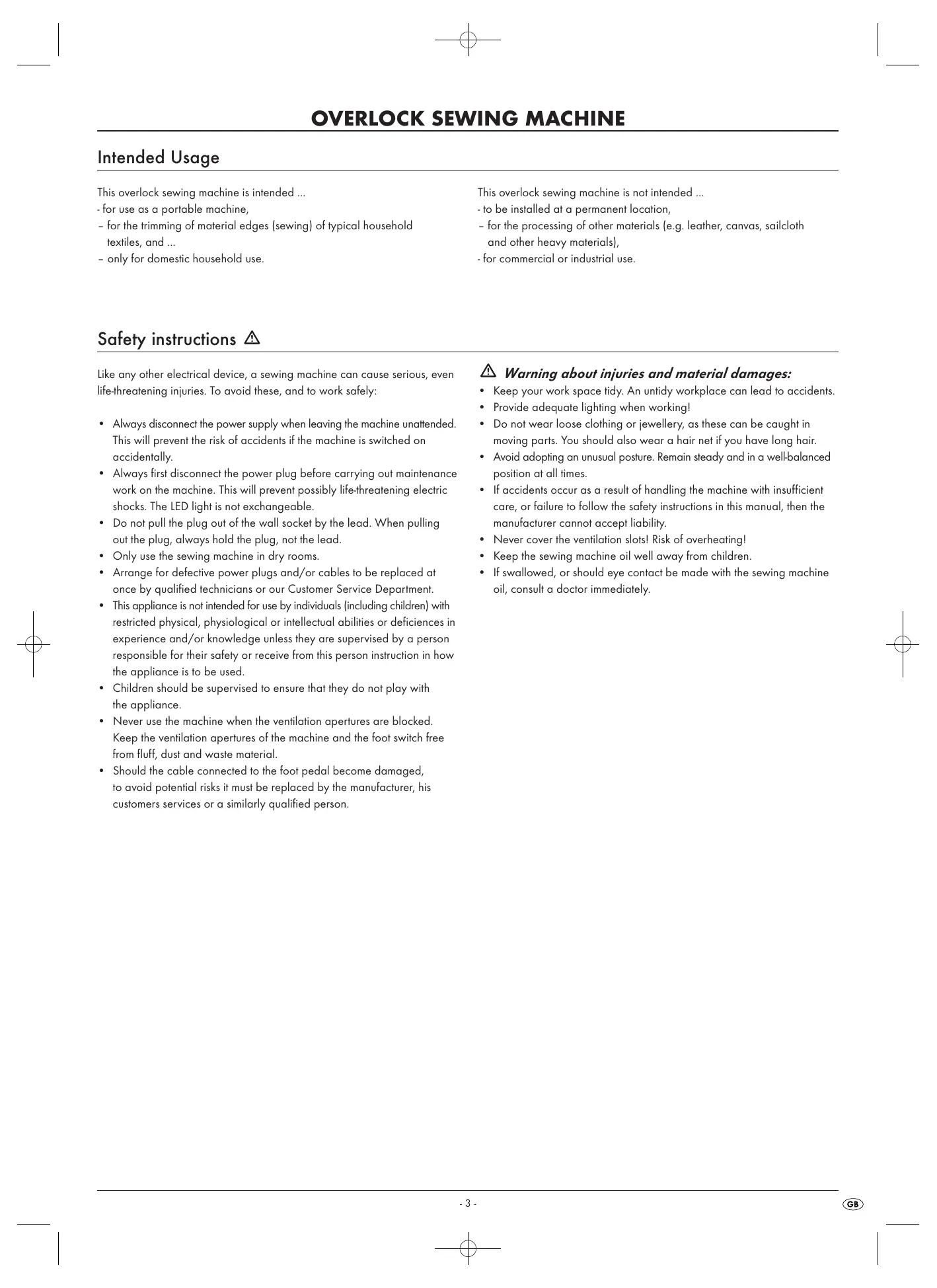


| Brand | SILVERCREST |
| Model | SON 90 A1 OVERLOCK SEWING MACHINE |
| Type | Overlock sewing machine |
| Number of threads | 2, 3 or 4 |
| Number of needles | 1 or 2 |
| Sewing speed | Approximately 1200 stitches/min |
| Stitch width | Right needle: 3.0–4.5 mm; left needle: 5.2–6.7 mm |
| Stitch length | 1–4 mm |
| Compatible needles | HA x1 No. 11–14 or 130/705 No. 75–90 |
| Power supply | 220–240 V ~, 50 Hz |
| Power consumption | 90 W (motor) |
| Protection class | II |
| Noise level | 78 dB(A) |
| Pedal | Electronic FDM, type KD-2902 |
| Stitches possible | Overlock with 2, 3 or 4 threads, rolled hem, flatlock, blind stitch, decorative stitches, etc. |
| Differential feed | Yes, adjustable from 0.7 to 2.0 |
| Free arm | Yes |
| Lighting | Integrated LED (non-replaceable) |
| Safety | Microswitch preventing startup if the front cover is open |
| Maintenance | Regular cleaning with the provided brush; lubrication at indicated points with sewing machine oil; replacement of the lower blade if necessary |
| Package contents | Machine, pedal, oil, waste bin, accessory box (extra needles, screwdriver, tweezers, brush/seam ripper, protective cover), instruction manual |
| Warranty | 3 years |
Frequently Asked Questions - SON 90 A1 OVERLOCK SEWING MACHINE SILVERCREST
User questions about SON 90 A1 OVERLOCK SEWING MACHINE SILVERCREST
0 question about this device. Answer the ones you know or ask your own.
Ask a new question about this device
Download the instructions for your Sewing machine in PDF format for free! Find your manual SON 90 A1 OVERLOCK SEWING MACHINE - SILVERCREST and take your electronic device back in hand. On this page are published all the documents necessary for the use of your device. SON 90 A1 OVERLOCK SEWING MACHINE by SILVERCREST.
USER MANUAL SON 90 A1 OVERLOCK SEWING MACHINE SILVERCREST
Overlock Sewing Machine SON 90 A1
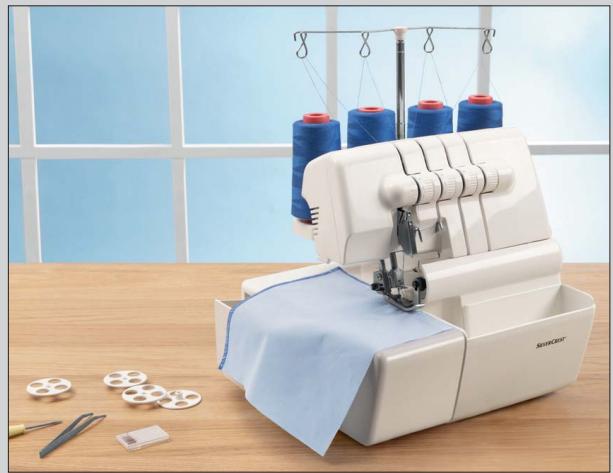
natural_image
Sunder machine with blue yarn spools on a wooden table, no visible text or symbolsGB Overlock Sewing Machine
IE Operating instructions
SE Overlock-symaskin Bruksanvisning
SI Opletilni (overlock) šivalni stroj Navodila za uporabo
INDEX
PAGE
Intended Usage 3
Safety instructions 3
Items supplied 4
Technical Data 4
Description of the appliance 5
Bringing the upper blade into a rest position 5
Needle Information 5
Upper looper element 5
Opening the front flap 6
Preparation 6
Connecting the foot pedal 6
Controlling the sewing speed 6
Safety switch 6
Fitting the waste container ....6
Removing needle(s) 7
Inserting needle(s) 7
Operating the handwheel 7
Adjusting the thread tree ....7
Threading 8
General instructions for threading ....8
Threading the upper looper thread (red) 8
Threading the lower looper thread (yellow) 10
Threading yarn for the right needle (green) 11
Threading yarn for the left needle (blue) 13
Trial run 14
Changing threads (binding together) 15
Set the stitch length 15
Setting the seam width 15
... by using the right or left needle ....15
... by turning the seam width adjustment knob ....16
Setting the seam width adjustment knob 16
Adjust sewing foot pressure 16
Differential transport 17
Manner of operation 17
Gathered overlock seam - Settings 17
Stretched overlock seam - Settings 17
Free arm sewing 18
Overlock seams 19
Roll hemmings 19
Binding-off and sample sewing 20
Recommended tension settings 20
2-thread overcast chain stitch (overlock) 21
2-thread-overcast-stitch .....22
3-thread chain stitch (overlock) 23
3-thread-flatlockseam 24
3-thread overcast chain stitch (overlock) 25
3-thread safety stitch, highly elastic, imitated 26
4-thread safety stitch, highly elastic, imitated 27
Roll hemmings 28
3-thread rolled hem 28
3-thread upper looper overcast rolled hem 28
2-thread rolled hem 29
2-thread lower looper overcast rolled hem 29
Flatlock decorative seams 30
Flatlock seam as assembly seam 30
Flatlock seam as decorative seam 31
Overlock blind hems 31
Pin tucks 31
Sewing corners 32
Outer corners 32
Inner corners 32
Tips and Tricks 33
Using pins ....33
Secure empty threads 33
Seam reinforcement 33
Edging 33
Maintenance and Cleaning 34
Cleaning and lubrication 34
Exchanging the lower blade ....34
Storage 35
Disposal 35
Warranty and Service 35
Importer 35
Troubleshooting 36
Intended Usage
This overlock sewing machine is intended ...
- for use as a portable machine,
- for the trimming of material edges (sewing) of typical household textiles, and ...
- only for domestic household use.
This overlock sewing machine is not intended ...
- to be installed at a permanent location,
- for the processing of other materials (e.g. leather, canvas, sailcloth and other heavy materials),
- for commercial or industrial use.
Safety instructions ⚠️
Like any other electrical device, a sewing machine can cause serious, even life-threatening injuries. To avoid these, and to work safely:
- Always disconnect the power supply when leaving the machine unattended. This will prevent the risk of accidents if the machine is switched on accidentally.
- Always first disconnect the power plug before carrying out maintenance work on the machine. This will prevent possibly life-threatening electric shocks. The LED light is not exchangeable.
- Do not pull the plug out of the wall socket by the lead. When pulling out the plug, always hold the plug, not the lead.
- Only use the sewing machine in dry rooms.
- Arrange for defective power plugs and/or cables to be replaced at once by qualified technicians or our Customer Service Department.
- This appliance is not intended for use by individuals (including children) with restricted physical, physiological or intellectual abilities or deficiencies in experience and/or knowledge unless they are supervised by a person responsible for their safety or receive from this person instruction in how the appliance is to be used.
- Children should be supervised to ensure that they do not play with the appliance.
- Never use the machine when the ventilation apertures are blocked. Keep the ventilation apertures of the machine and the foot switch free from fluff, dust and waste material.
- Should the cable connected to the foot pedal become damaged, to avoid potential risks it must be replaced by the manufacturer, his customers services or a similarly qualified person.
⚠ Warning about injuries and material damages:
- Keep your work space tidy. An untidy workplace can lead to accidents.
- Provide adequate lighting when working!
- Do not wear loose clothing or jewellery, as these can be caught in moving parts. You should also wear a hair net if you have long hair.
- Avoid adopting an unusual posture. Remain steady and in a well-balanced position at all times.
- If accidents occur as a result of handling the machine with insufficient care, or failure to follow the safety instructions in this manual, then the manufacturer cannot accept liability.
- Never cover the ventilation slots! Risk of overheating!
- Keep the sewing machine oil well away from children.
- If swallowed, or should eye contact be made with the sewing machine oil, consult a doctor immediately.
Overlock Sewing Machine
Oil
Waste container
Accessory box
Operating instructions
| Replacement blade(bottom) |  |
| 2 Needles Nr. 114 Needles Nr. 14(2 in the machine,pre-installed) |  |
| 4 Bobbin caps | 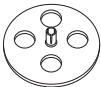 |
| Upper looper element | 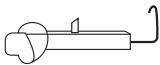 |
| Screwdriver small |  |
| Screwdriver large |  |
| Covering hood | 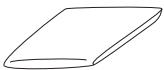 |
| Tweezers |  |
| Brush with integrated unstitcher |  |
The accessories are to be found in the accessory box on the side of the machine (Fig.1.).
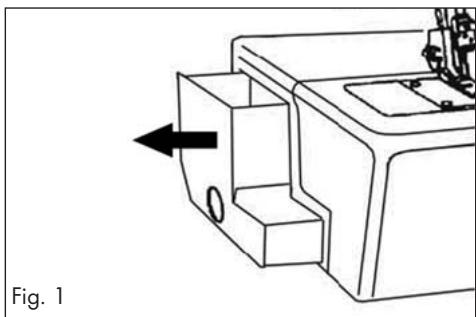
natural_image
Technical line drawing of a mechanical component with an arrow indicating direction (no text or symbols)Technical Data
Number of threads 2, 3 or 4
Number of needles 2 or 1
Sewing speed approx. 1200 rpm
Stitch width
right: 3.0 mm - 4.5 mm
left: 5.2 mm - 6.7 mm
Stitch length 1 - 4 mm
Needles HA x 1 Nr. 11-14 or 130/705 Nr. 75-90
Power consumption : Motor: 90 W
Rated voltage: 220 - 240 V \~ , 50Hz
Protection class: II ☐
The sound intensity level under normal operating conditions amounts to 78dB(A).
Foot pedal
Use only the foot pedal originally supplied with this sewing machine:
- ELECTRONIC FDM Speed Controller
- Type KD - 2902
① Thread tree
② Spool support
③ Thread roll centerer
4 Sewing foot lever
⑤ Adjustment wheel for stitch length
6 Handwheel
⑦ Connection Footpedal/Power supply
⑧ Power switch (On/Off switch)
⑨ Differential transport lever
10 Front flap
⑪ Support plate of the seam width finger
12 Free arm
13 Stitch plate
14 Thread tension selector (left needle)
15 Thread tension selector (right needle)
16 Thread tension selector (upper looper)
⑰ Thread tension selector (lower looper)
18 movable upper blade (Upper blade)
19 Upper looper
20 Lower looper
21 Sewing foot
22 Fixed lower blade
23 Seam width switch
24 Seam width adjustment knob
Bringing the upper blade into a rest position
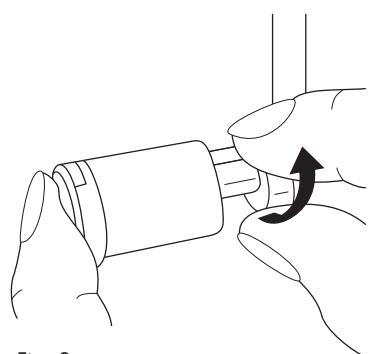
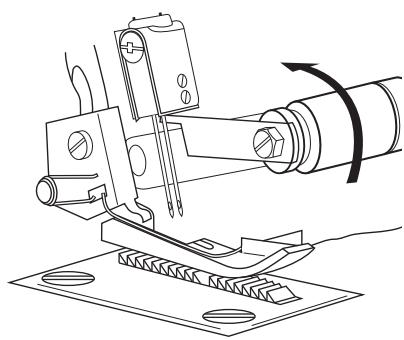
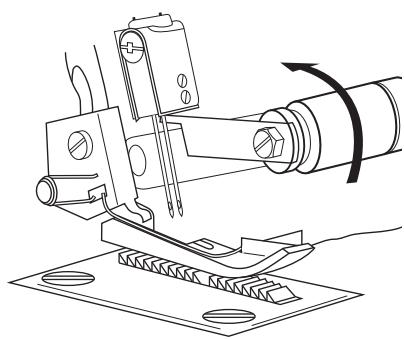
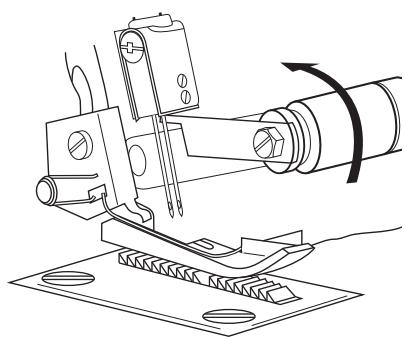
To make certain types of seam, or to more easily operate the adjustment wheel for cutting width 24, you must bring the upper blade 18 into a rest position.
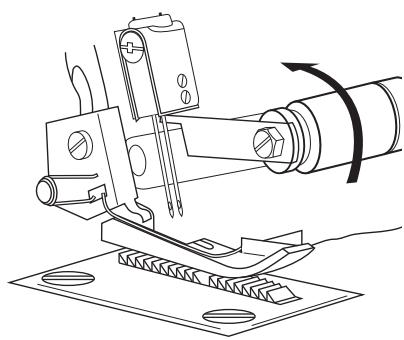
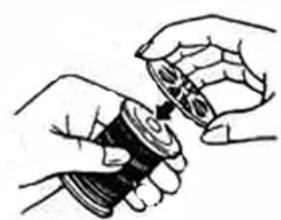
For this, press the upper blade 18 to the right and rotate it a little, so that it is firmly seated (Fig. 2 and 3).
natural_image
Illustration of hands holding a cylindrical object with an arrow indicating rotation (no text or symbols)Fig. 2
natural_image
Technical line drawing of a sewing machine with a rotating shaft and base plate (no text or symbols)Fig. 3
Needle Information
This machine uses standard commercial flat-shaft needles for sewing machines. These prevent the incorrect insertion of the needle. You can purchase these needles in any specialist shop.
You can use needles of the sizes 11 and 14 in this machine.
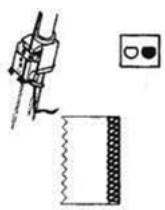
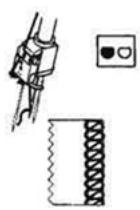
The adjoining table gives you a brief overview of the differences when using a needle (for detailed information, see "Setting the seam width).
| Seam width | 3.5 mm | 5.7 mm |
| Employed needle | right needle | left needle |
| Thread tension selector | green | blue |
 |  |
Upper looper element
For some kinds of stitches you will need to use the upper looper element.
When you need to insert it is described in the individual stitches.
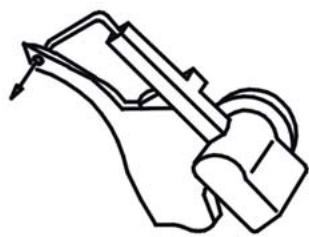
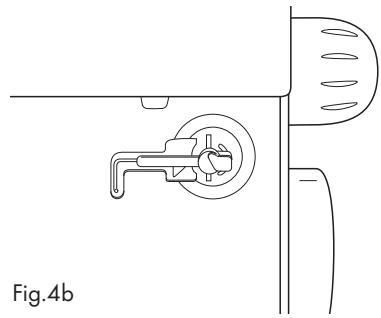
Insert the small wire from behind in the eyelet of the upper looper 19 and the plastic bolt, on the other end and from the front, in the hole in the upper looper 19 (Fig. 4a).
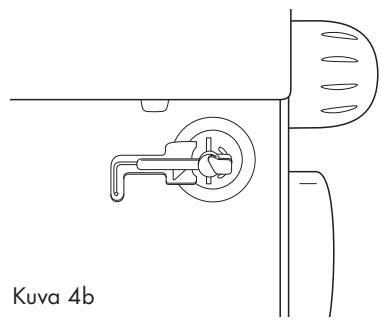
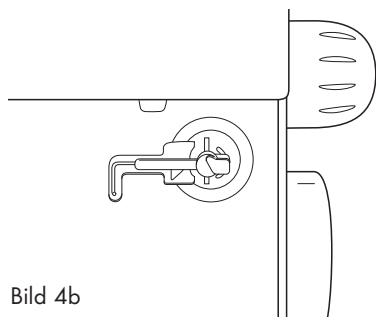
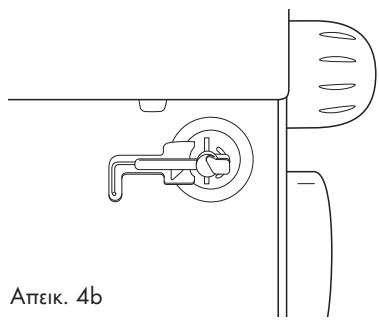
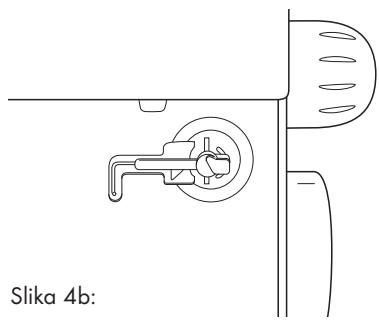
You can store the upper looper ready for use in the slot behind the front flap 10 (Fig. 4b).
natural_image
Line drawing of a hand holding a key and a lock (no text or symbols)Fig.4a
natural_image
Technical line drawing of a mechanical component with a valve and housing (no text or symbols)
Attention!
Always switch the machine off with the power switch ⑧ when you open the front flap ⑩. Risk of Injury!
- Slide the front flap 10 to the right (A) and then pull it towards you (B) (Fig. 5). You will see the upper looper behind the front flap 10.

Note:
While sewing, the front flap 10 must be kept closed!
Preparation
Place the overlock sewing machine on a stable and level surface. Ensure there is sufficient illumination at your workplace.
Connecting the foot pedal
- Insert the plug of the foot pedal into the socket for the foot pedal ⑦.
- Insert the plug into a power socket.
To switch the machine on, press the power switch ⑧.

Attention!
During absences from the machine or when doing maintenance work, always remove the plug from the mains power socket. Risk of Injury!
Controlling the sewing speed
The sewing speed is controlled by means of the footpedal. The sewing speed is changed by applying more or less pressure to the footpedal.
Safety switch
This machine is fitted with a micro safety switch. You cannot start the machine if the front flap 10 is open. Close the front flap 10 before you start to sew.
Fitting the waste container
The waste container collects remnants during sewing, so that your workplace stays tidy.
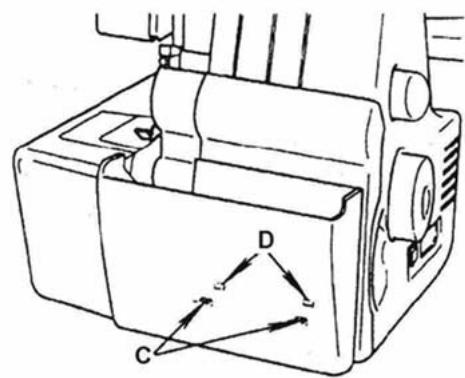
- First push the two restraints (A) into the receiving holes (B) (Fig. 6).
- Then guide the two restraints (C) into the receiving holes (D) (Fig. 7).
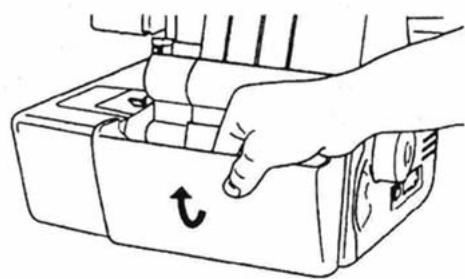
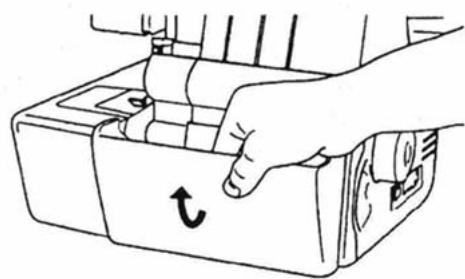
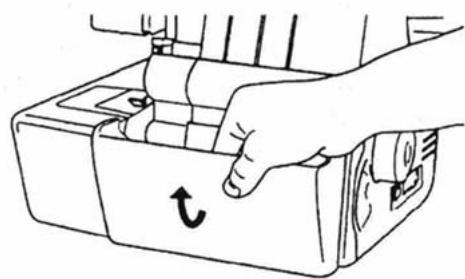
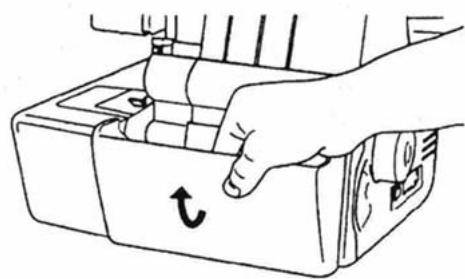
- To remove the waste container, pull it forward and then tilt it slightly (Fig. 8).
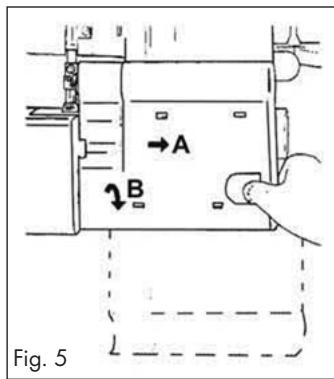
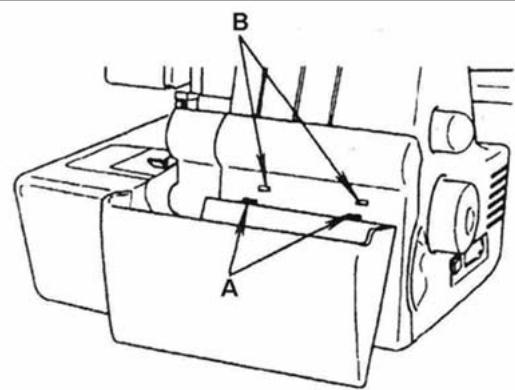
Fig. 6
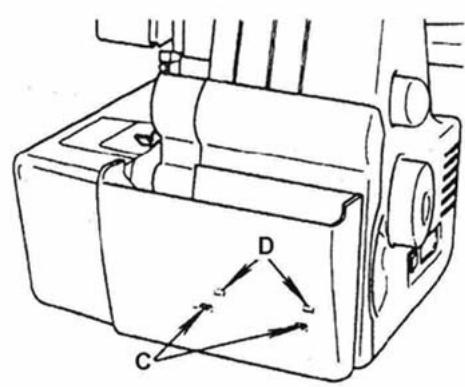
Fig. 7
natural_image
Hand inserting a device into a box with an arrow indicating rotation (no text or symbols)Fig. 8
Removing needle(s)

Attention!
Before exchanging the needles, remove the power plug. This prevents an unintended starting of the machine. If you do not, you run a risk of serious injury!
Tip!
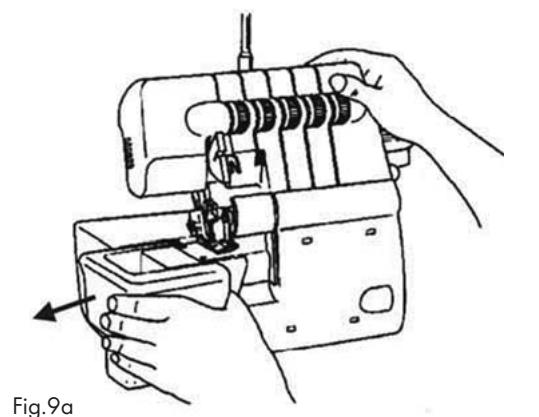
An exchange of the needles is easier if you first remove the free arm cover (Fig. 9a)!
- Turn the handwheel ⑥ towards yourself until the needles are in the highest position (Fig. 9b)
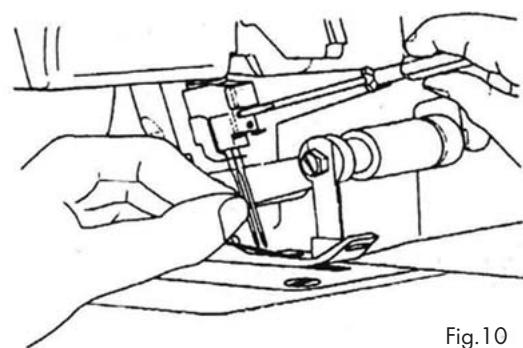
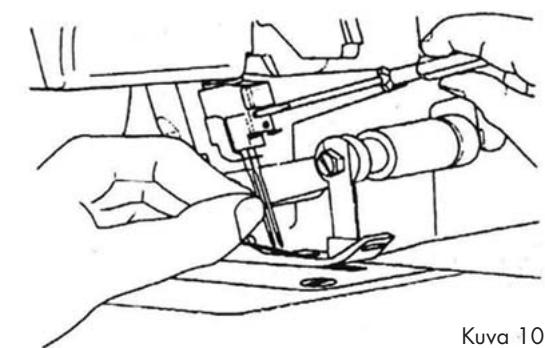
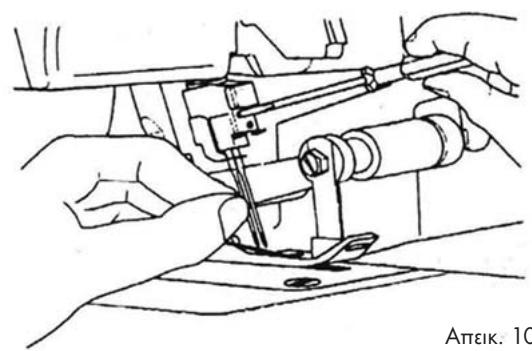
- Loosen the needle retaining screws with the small screwdriver until the needles are free (Fig. 10).
- Remove the needles.
Inserting needle(s)

Attention!
Before exchanging the needles, remove the power plug. This prevents an unintended starting of the machine. If you do not, you run a risk of serious injury!
- Hold the needle with the flattened side to the rear.
- Push the needle as far as it will go into the needle holder.
- Firmly tighten the needle screws with the small screwdriver (Fig. 10).
Operating the handwheel

Note:
Always turn the handwheel ⑥ only towards yourself (Fig. 9b).
Adjusting the thread tree
- Completely remove the thread tree ① before threading (Fig. 11).
- Turn the thread tree ① so that the thread guides stand exactly above the spool supports ②.
- In the correct position, the two jointed parts of the thread tree ① snap audibly into position.
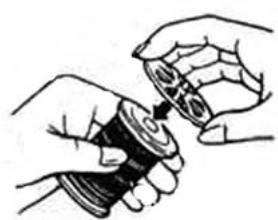
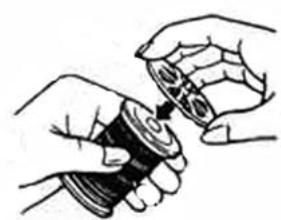
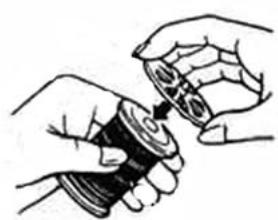
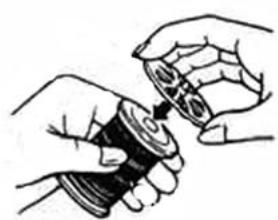
- Place the thread rolls on the thread roll centrings. If you do not use industrial coils, remove the thread roll centrings. Slide a spool cap onto each of the thread rolls (Fig. 12). This will hold them in place when sewing.
natural_image
Line drawing of hands operating a sewing machine with a tool, no text or symbols present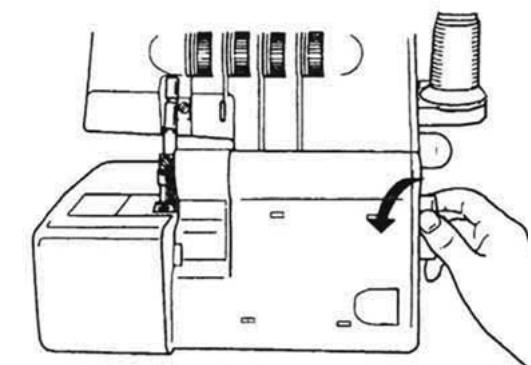
natural_image
Line drawing of a sewing machine needle stitching fabric, with a hand adjusting the seam (no text or symbols)Fig.9b
natural_image
Line drawing of hands operating a sewing machine with a tool, labeled Fig.10 (no text or symbols on the diagram itself)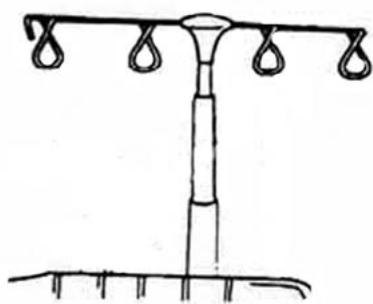
natural_image
Simple line drawing of a balance scale with six hanging weights (no text or symbols)Fig. 11
natural_image
Illustration of hands using a mechanical tool to spread a cylindrical component (no text or symbols visible)Fig. 12
(i) Note:
On delivery, all 4 threads are already threaded. You can begin sewing immediately. Should you wish to change the thread, and all 4 threads are still threaded, then proceed as described in the chapter "Changing threads (binding together)".
Should you need to rethread all threads from scratch, then proceed as described in this chapter, "Threading".
General instructions for threading
Attention!
Before threading, ALWAYS place the power switch ⑧ at "O" (Off) and remove the plug from the mains power socket. This prevents an unintended starting of the machine. If you do not, you run a risk of serious injury!
Correct threading is important, so that the stitches are not irregular and that the yarn does not break.
Behind the front flap 10 there is a diagram with instructions for threading. Additionally, the thread guides are marked in various colours.
In the accessory box you will find tweezers, the use of which helps make threading easier.
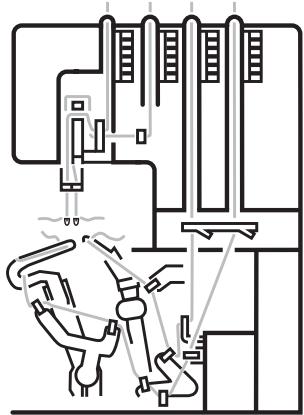
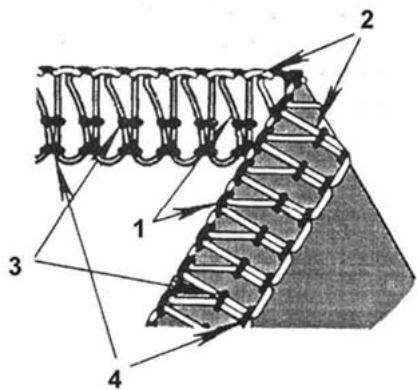
Threading is done in this order (Fig. 13/14):
- First step: Upper looper (red)
- Second step: Lower looper (yellow)
- Third step: Thread for the right needle (green)
- Fourth step: Thread for the left needle (blue)
(i) Note:
When all threads are threaded, and the lower looper thread loosens itself, proceed as follows:
- Unthread the two threads of the needles.
- Then thread the lower looper thread.
- First then rethread the threads of the two needles again.
The needles must always be the last to be threaded!
For simplification, the individual steps are numbered on the drawings.
Threading the upper looper thread (red)
Attention!
Before threading, ALWAYS place the power switch ⑧ at "O" (Off) and remove the plug from the mains power socket. This prevents an unintended starting of the machine. If you do not, you run a risk of serious injury!
Always use the accompanying drawings for assistance.
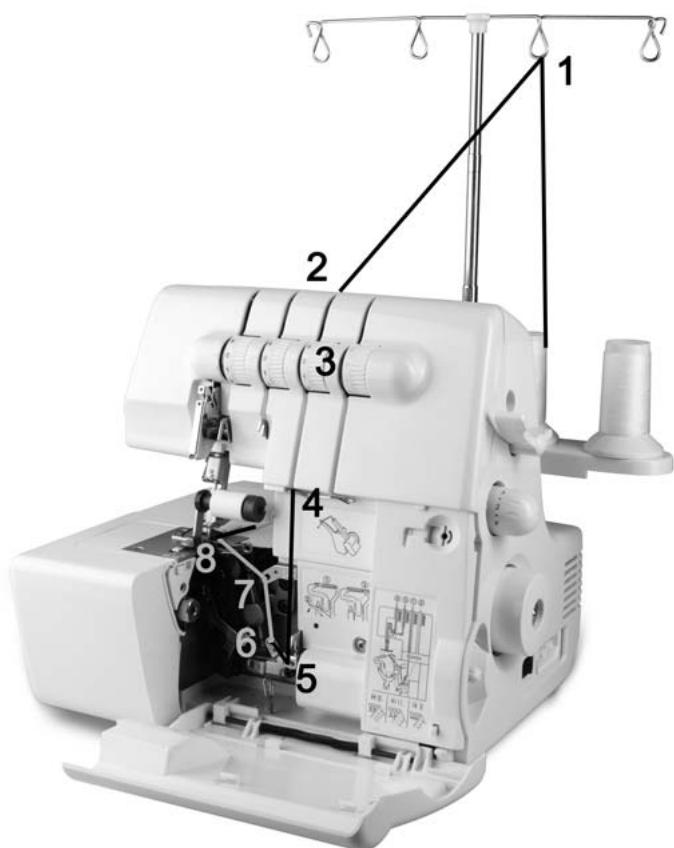
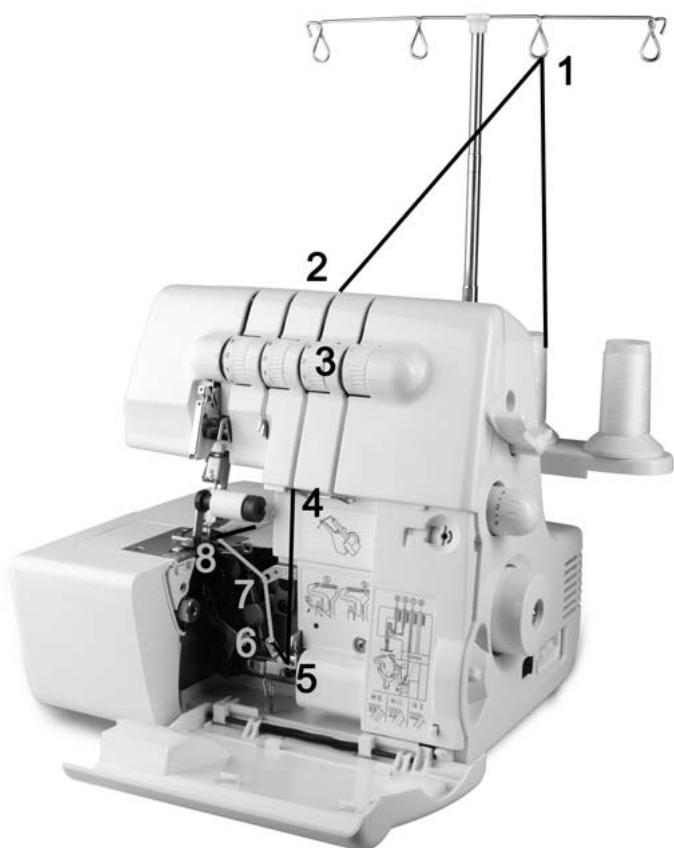
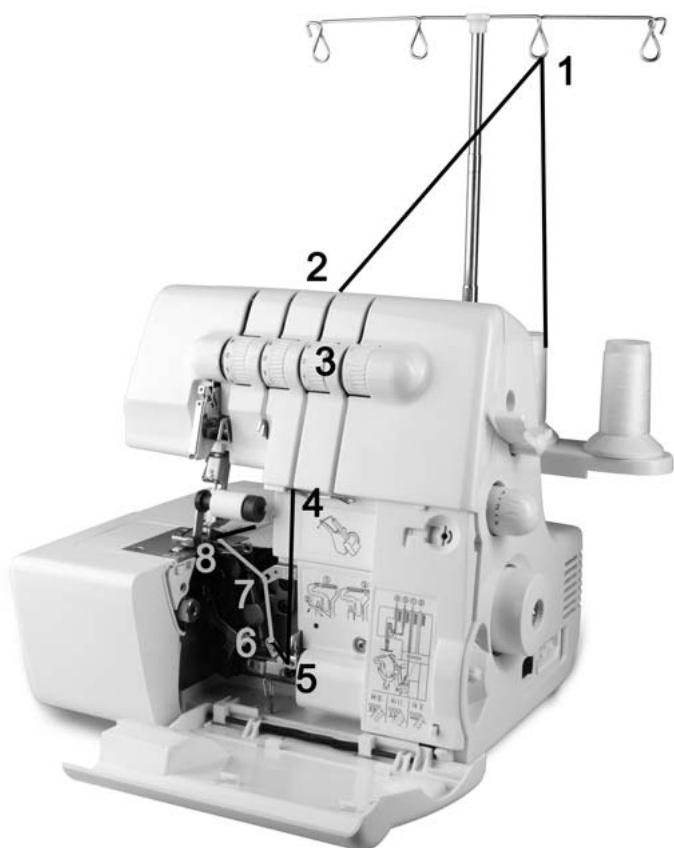
Figure 15 shows the thread path of the upper looper thread. The individual threading positions are numbered and described in detail in the following.
- Open the front flap ⑩.
- Guide the yarn from back to front through the thread tree ① (1).
4 3 1 2
natural_image
Pure technical diagram of a mechanical or electrical component with no text, numbers, or symbolsFig. 13
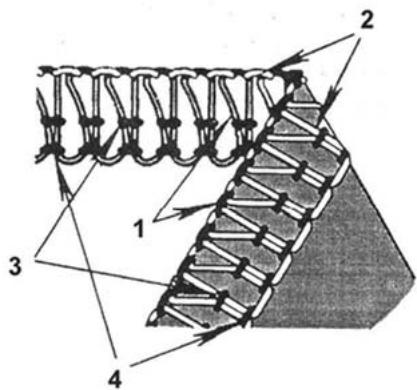
Fig. 14
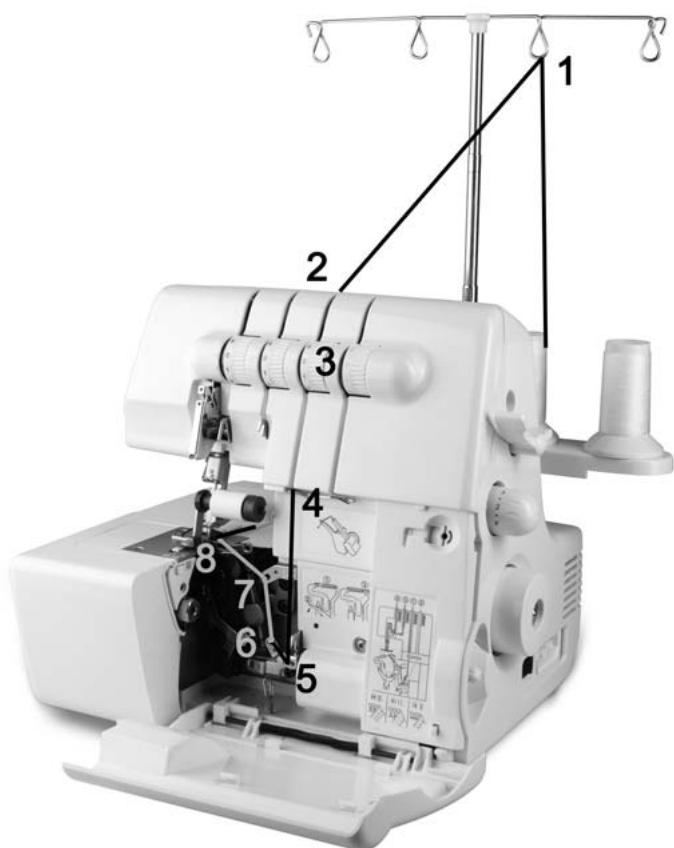
Fig. 15
-
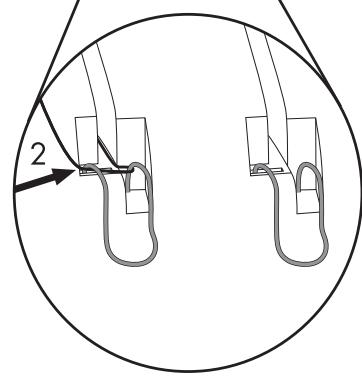
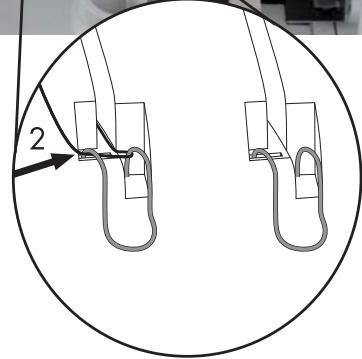
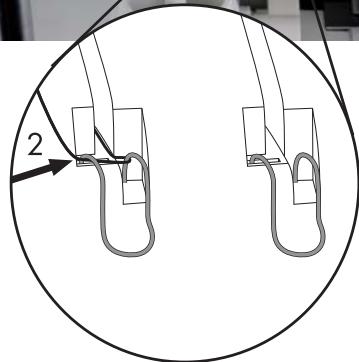
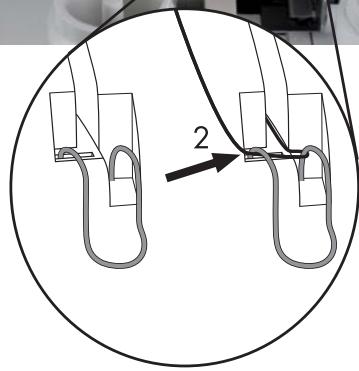
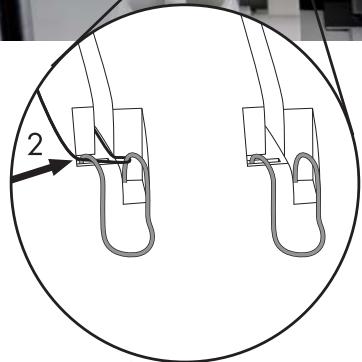
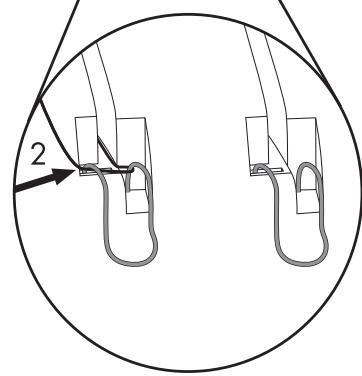
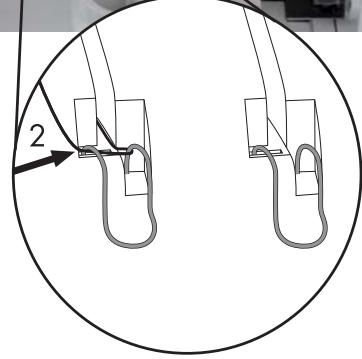
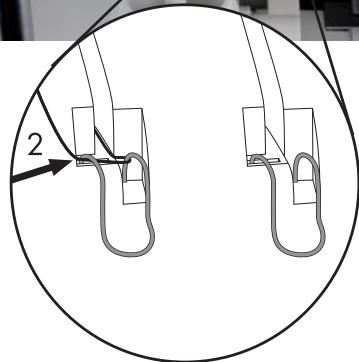
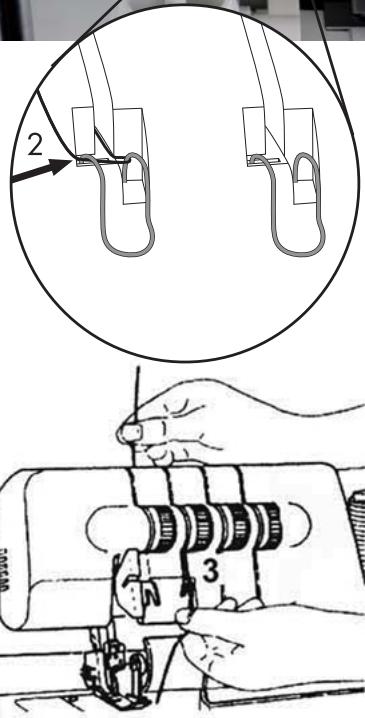
Thread the yarn into the thread guide in that you pull the thread down until it slips under the thread guide (2) (Fig. 16).
-
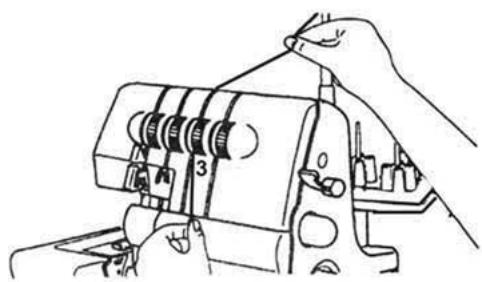
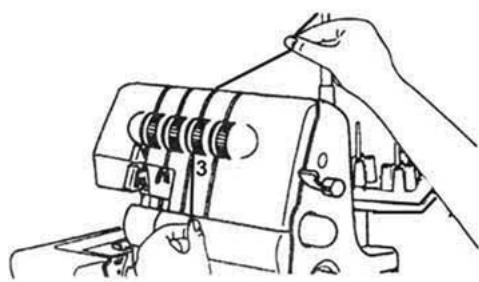
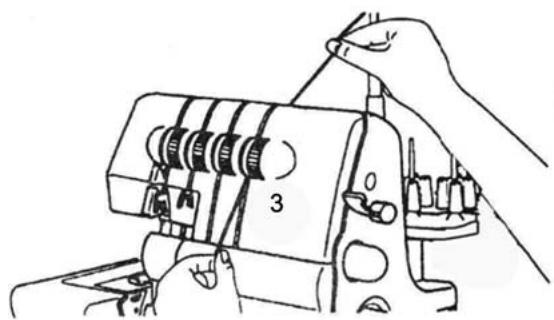
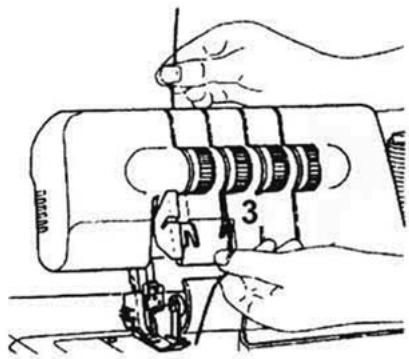
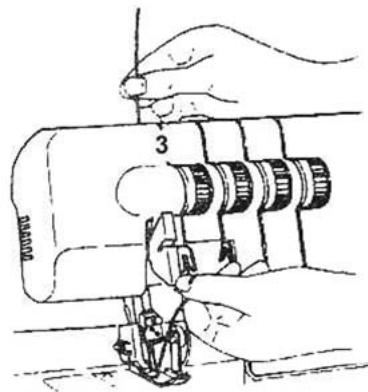
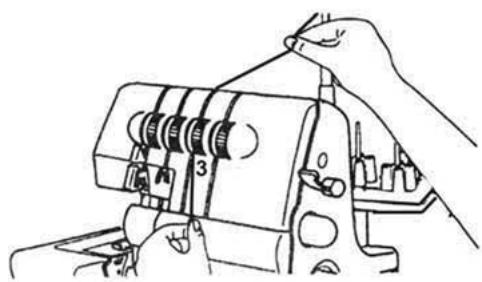
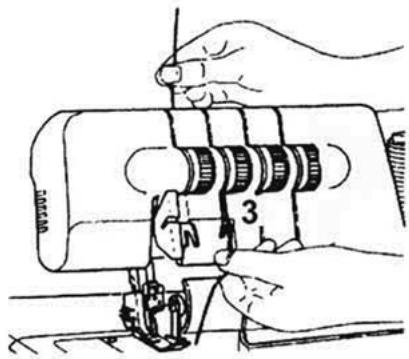
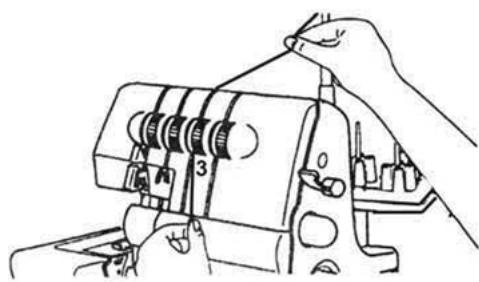
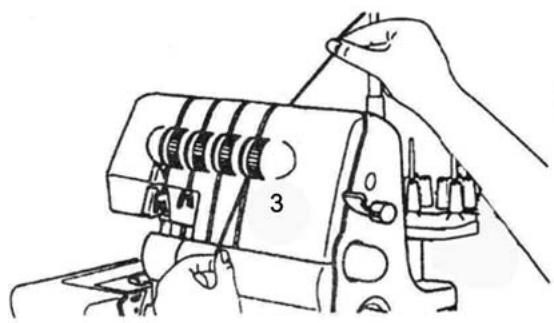
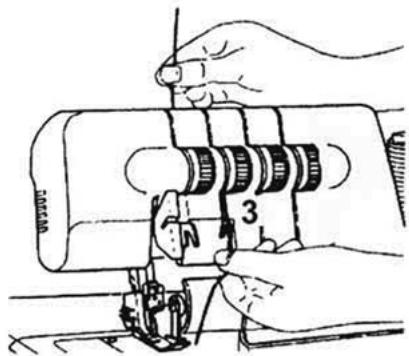
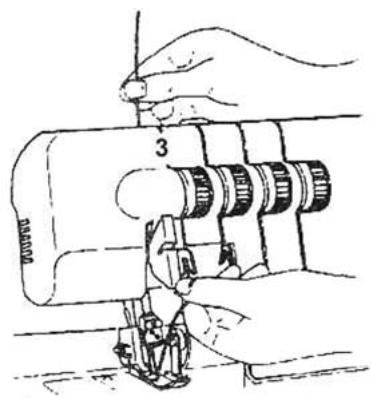
Firmly hold the yarn with your fingers, guide it between and through the discs of the thread tension selector 16 and then pull it down (3) (Fig. 17).
(i) Note:
The yarn must lie correctly between the two discs of the thread tension selector 16.
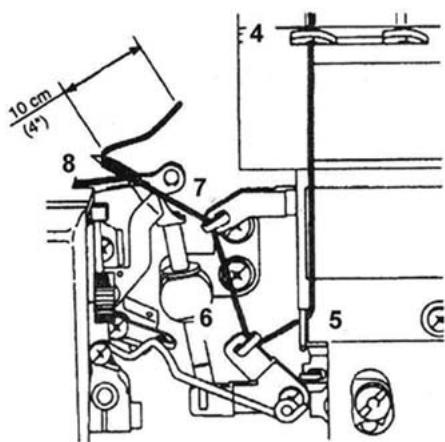
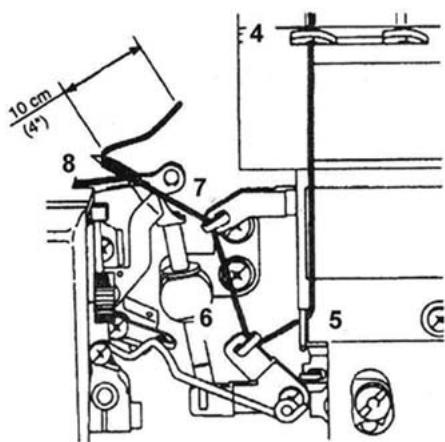
- Thread the yarn in the looper area as per the red markings (Fig. 18).
- Pull the thread from back to front through the upper looper 19.
- Pull around 10 cm of thread through the looper and place it behind the stitch plate ⑬.
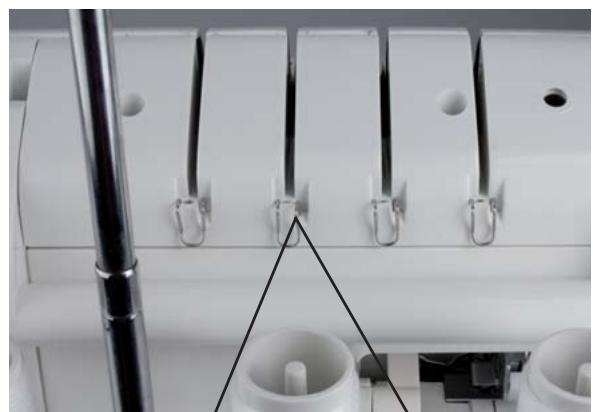
natural_image
Close-up of a mechanical assembly with metal rods and a triangular component (no visible text or symbols)Fig. 16
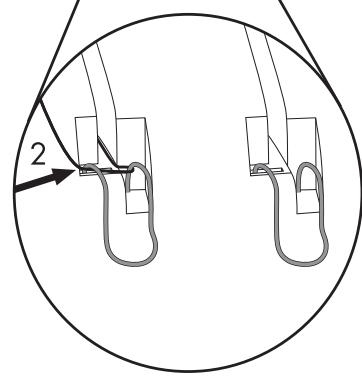
natural_image
Line drawing of a sewing machine with hands operating it (no text or symbols present)Fig. 17
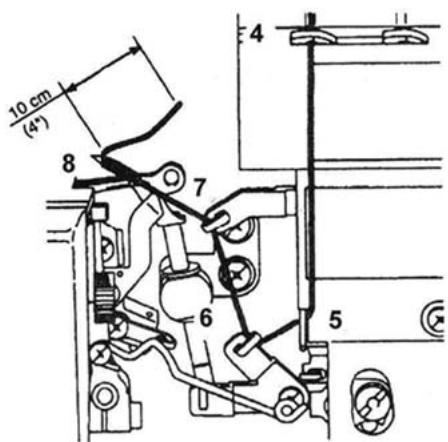
Fig. 18
Threading the lower looper thread (yellow)

Attention!
Before threading, ALWAYS place the power switch ⑧ at "O" (Off) and remove the plug from the mains power socket. This prevents an unintended starting of the machine. If you do not, you run a risk of serious injury!
Figure 19 shows the thread path of the lower looper thread. The individual threading positions are numbered and described in detail in the following.
- Guide the yarn from back to front through the thread tree ① (1).
-
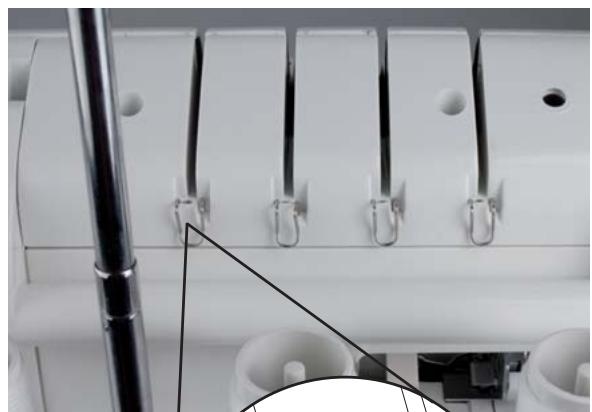
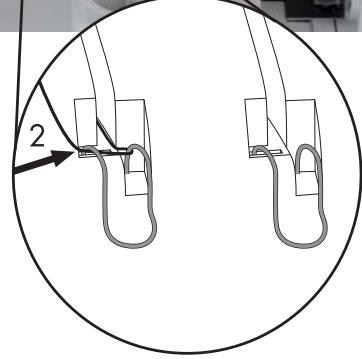
Thread the yarn into the thread guide in that you pull the thread down until it slips under the thread guide (2) (Fig. 20).
-
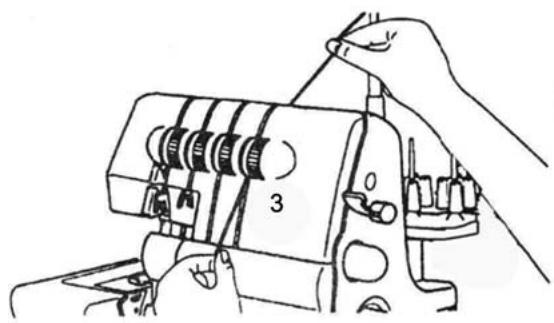
Firmly hold the yarn with your fingers, guide it between and through the discs of the thread tension selector ⑰ and then pull it down (3) (Fig. 21).

Note:
The yarn must lie correctly between the two discs of the thread tension selector 17.
4. Turn the handwheel ⑥ to yourself until the lower looper ⑳ is at the far right.
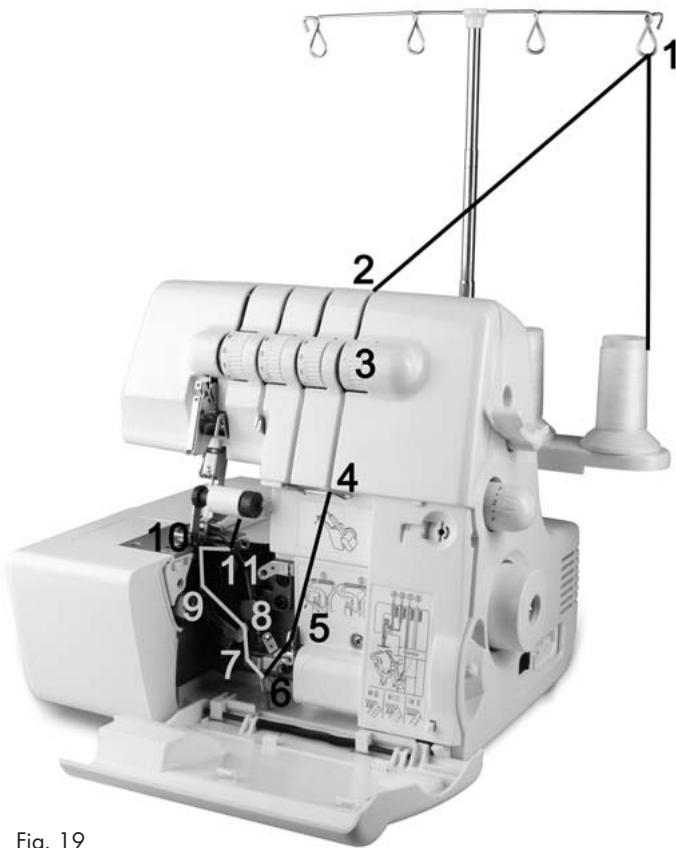
Fig. 19
natural_image
Close-up of a white mechanical component with metal rods and circular holes, no visible text or symbolsFig. 20
natural_image
Line drawing of hands operating a sewing machine with numbered parts (no text or symbols)Fig. 21
-
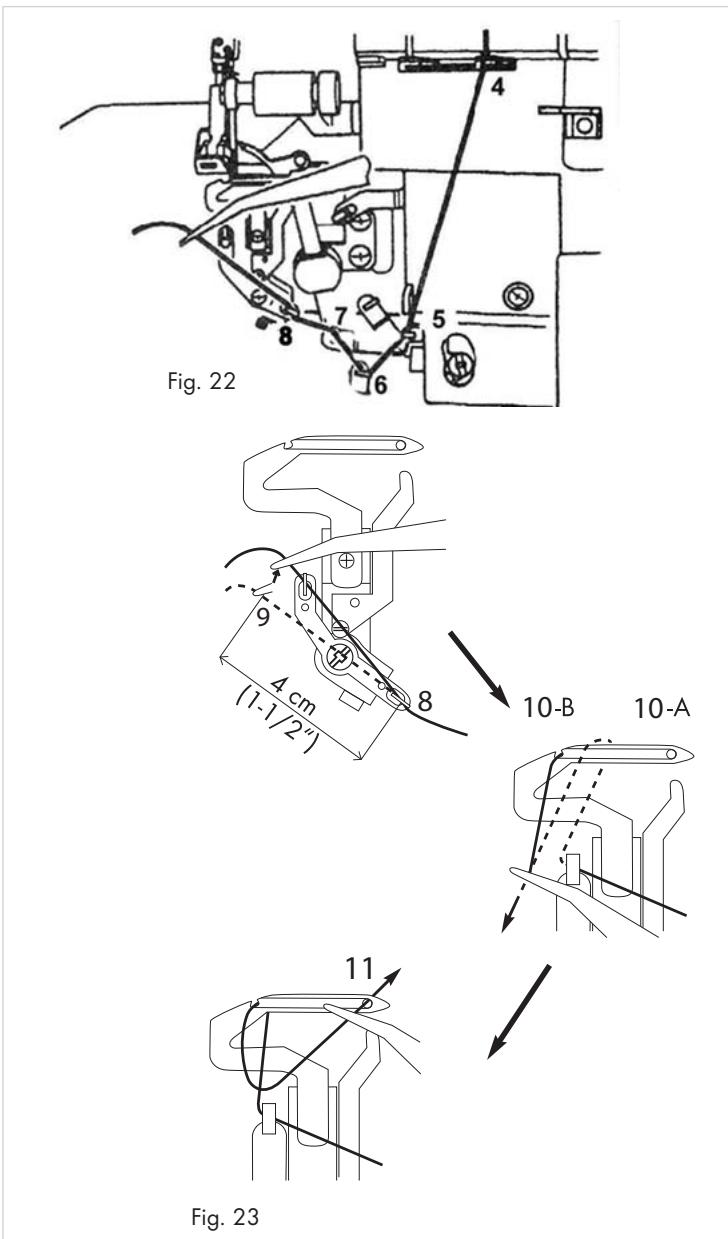
Thread the yarn in the looper area as per the yellow markings (4 - 8) (Fig. 22).
-
Firmly hold the yarn with the tweezers about 4 cm from the thread guide (Fig. 23).
- Now guide it lightly, from the left and with the tweezers, under the thread guide.
- Pull the yarn upwards into the thread guide (9).
- Lead the yarn to the rear and over the upper end of the lower looper 20 (10A) (Fig. 23).
- Then, carefully pull the yarn down so that it slides into the recess of the looper (10B) (Fig. 23). For this step also use the drawing which is attached to the machine!
- Guide the thread through the looper eyelet (11). The yarn should run in the groove of the lower looper 20 (Fig. 23).
- Draw around 10 cm of yarn through the looper and place it to the rear over the upper looper 19 and the stitch plate 13 .
Threading yarn for the right needle (green)
⚠ Attention!
Before threading, ALWAYS place the power switch ⑧ at "O" (Off) and remove the plug from the mains power socket. This prevents an unintended starting of the machine. If you do not, you run a risk of serious injury!
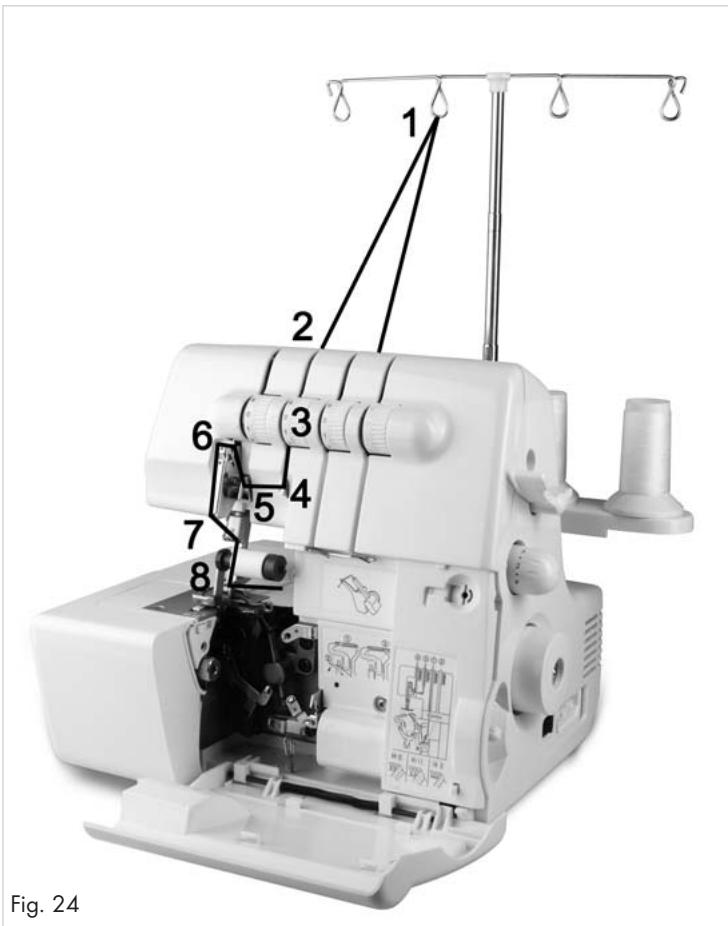
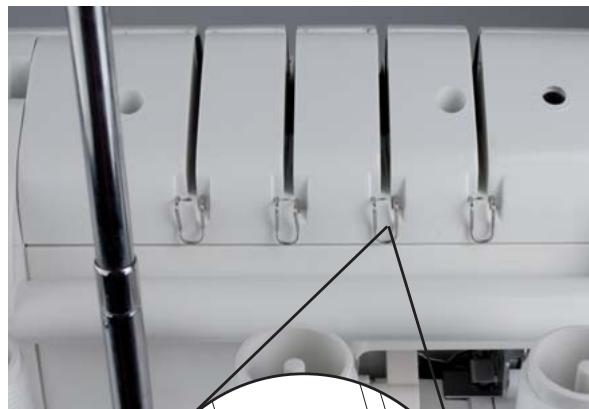
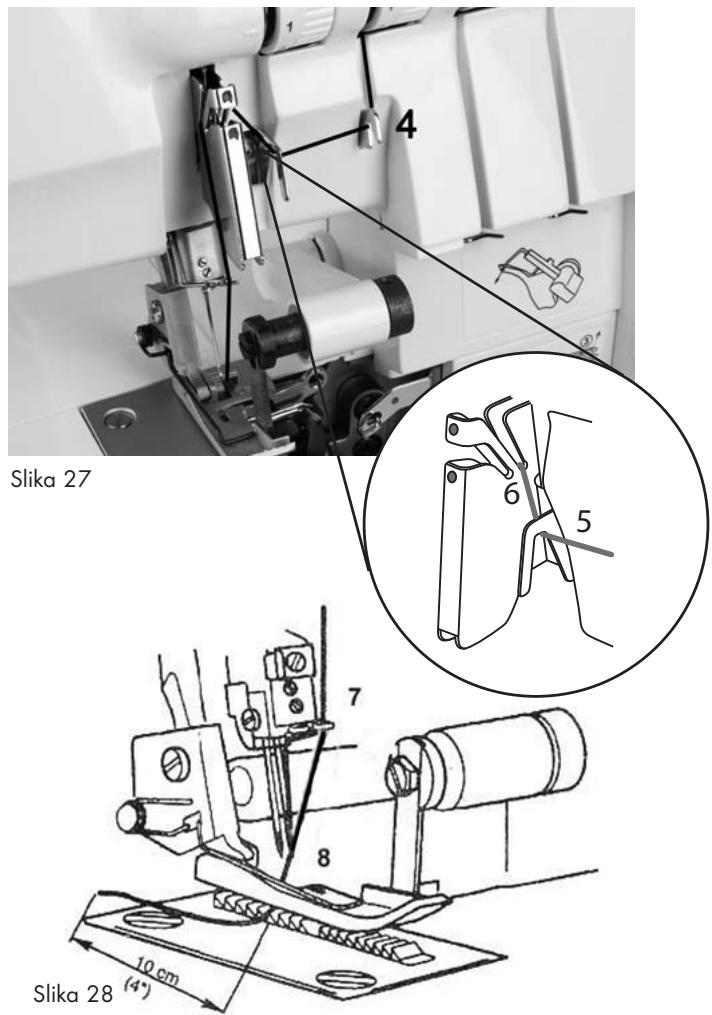
Figure 24 shows the thread path of the right needle thread. The individual threading positions are numbered and described in detail in the following.
- Guide the yarn from back to front through the thread tree ① (1).
-
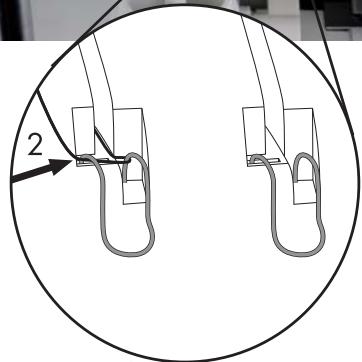
Thread the yarn into the thread guide in that you pull the thread down until it slips under the thread guide (2) (Fig. 25).
-
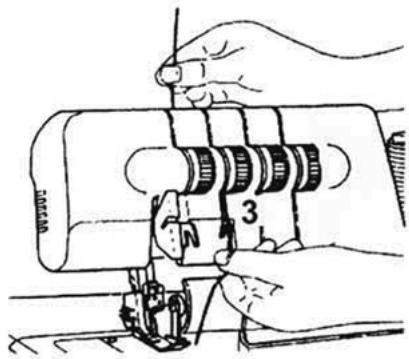
Firmly hold the yarn with your fingers, guide it between and through the discs of the thread tension selector 15 and then pull it down (3) (Fig. 26).
(i) Note:
The yarn must lie correctly between the two discs of the thread tension selector 15.
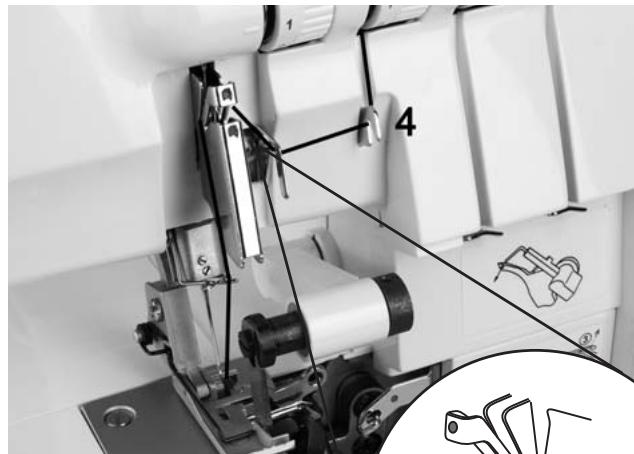
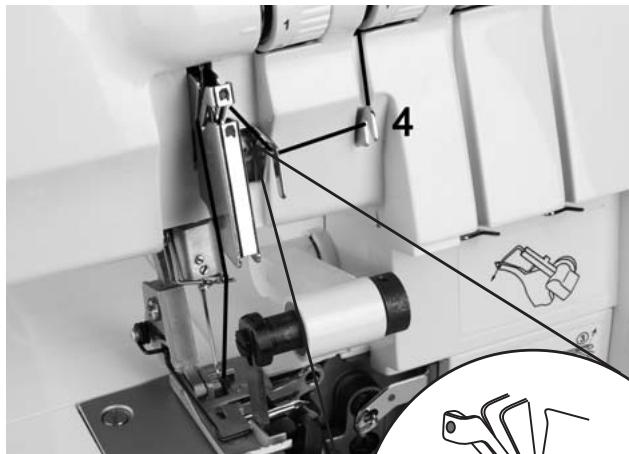
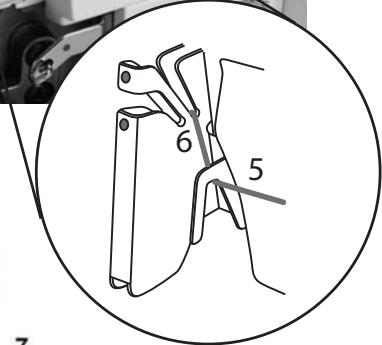
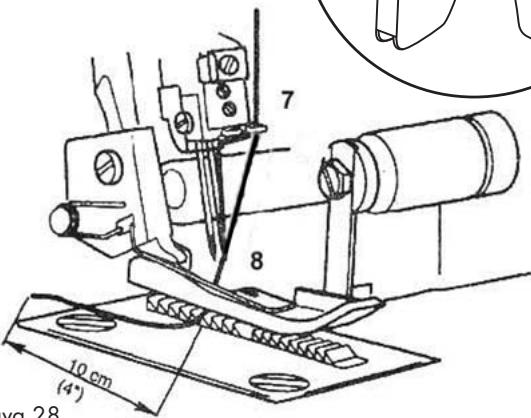
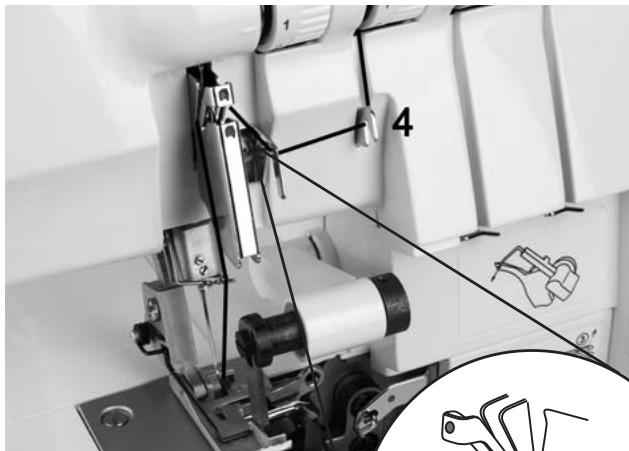
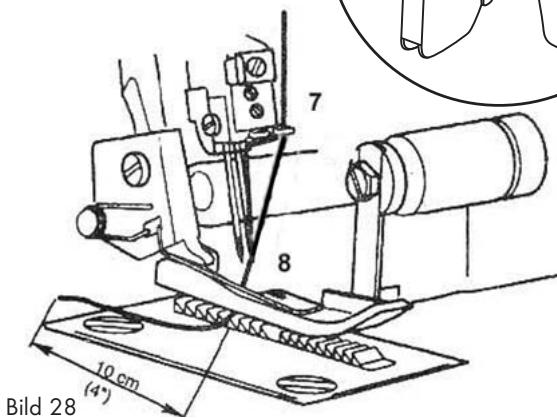
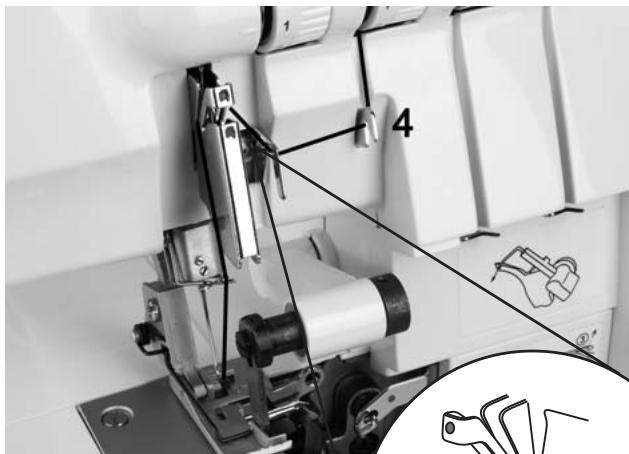
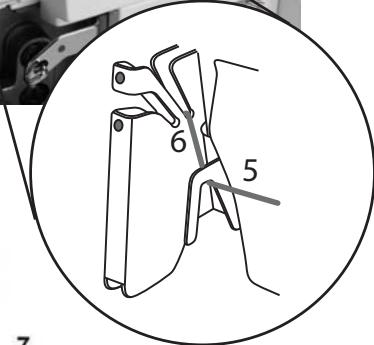
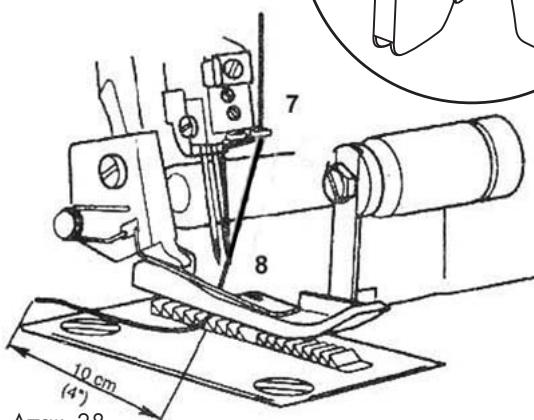
4. Thread the yarn as per the green markings (4-7) (Fig. 27/28).
5. Thread the yarn through the right needle (8) (Fig. 28).
6. Lay the yarn to the rear under the sewing foot 21.
natural_image
Close-up of a mechanical assembly with metal rods and a circular component, no visible text or symbolsFig. 25
natural_image
Illustration of a sewing machine needle stitching a seam, with hands adjusting the mechanism (no text or symbols present)Fig. 26
natural_image
Close-up of a sewing machine needle and fabric assembly (no visible text or symbols)Fig. 27
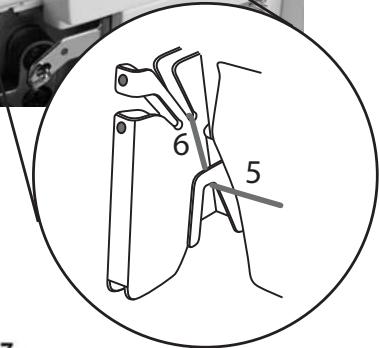
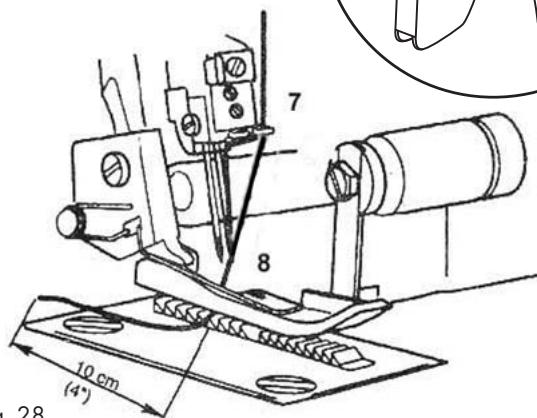
Fig. 28
Threading yarn for the left needle (blue)

Attention!
Before threading, ALWAYS place the power switch ⑧ at "O" (Off) and remove the plug from the mains power socket. This prevents an unintended starting of the machine. If you do not, you run a risk of serious injury!
Figure 29 shows the thread path of the left needle thread. The individual threading positions are numbered and described in detail in the following.
-
Guide the yarn from back to front through the thread tree ① (1).
-
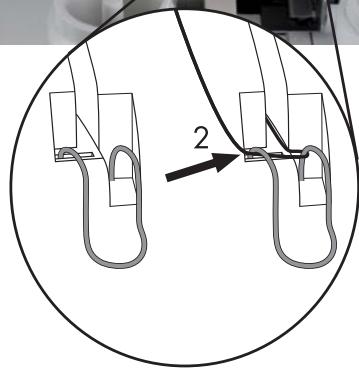
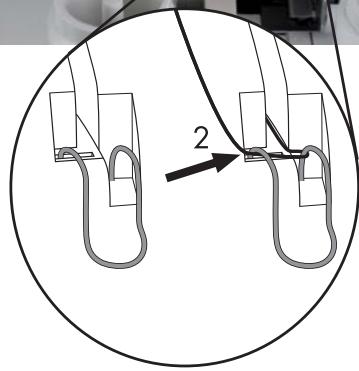
Thread the yarn into the thread guide in that you pull the thread down until it slips under the thread guide (2) (Fig. 30).
-
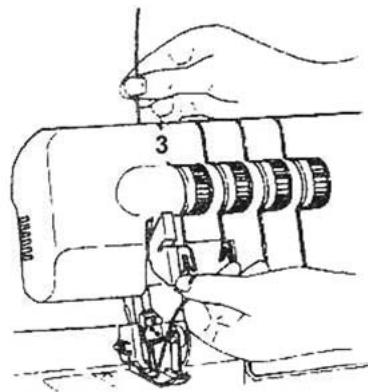
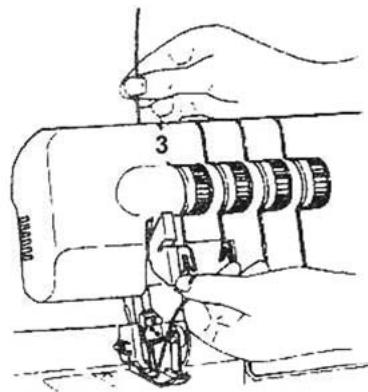
Firmly hold the yarn with your fingers, guide it between and through the discs of the thread tension selector 14 and then pull it down (3) (Fig. 31).

Note:
The yarn must lie correctly between the two discs of the thread tension selector 14.
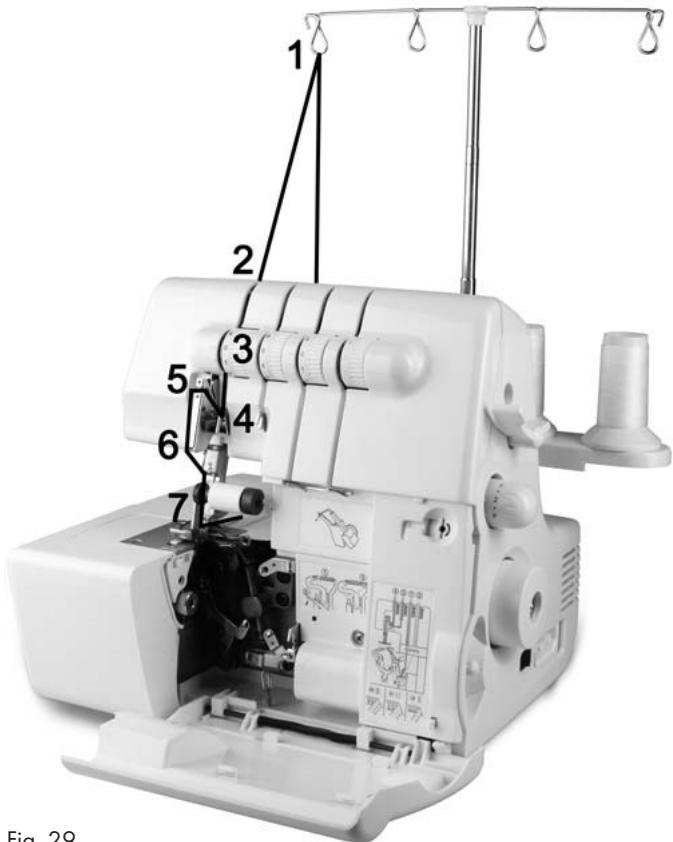
Fig. 29
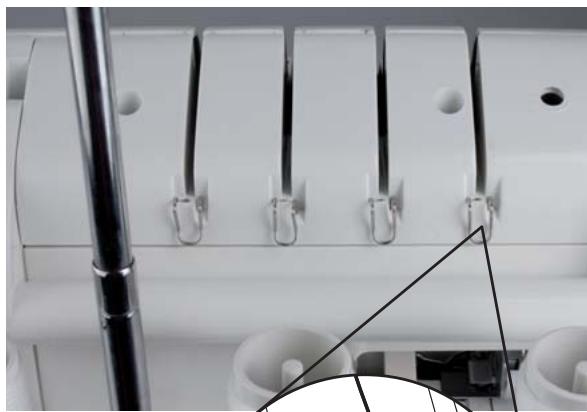
natural_image
Close-up of a white mechanical component with four vertical pins and a metal rod, no visible text or symbols.Fig. 30
natural_image
Illustration of a sewing machine needle stitching a fabric, with hands operating the work (no text or symbols present)Fig. 31
-
Thread the yarn as per the blue markings (4 - 6) (Fig. 32/33).
-
Thread the yarn through the left needle (7) (Fig. 33).
- Lay the yarn to the rear under the sewing foot 21.
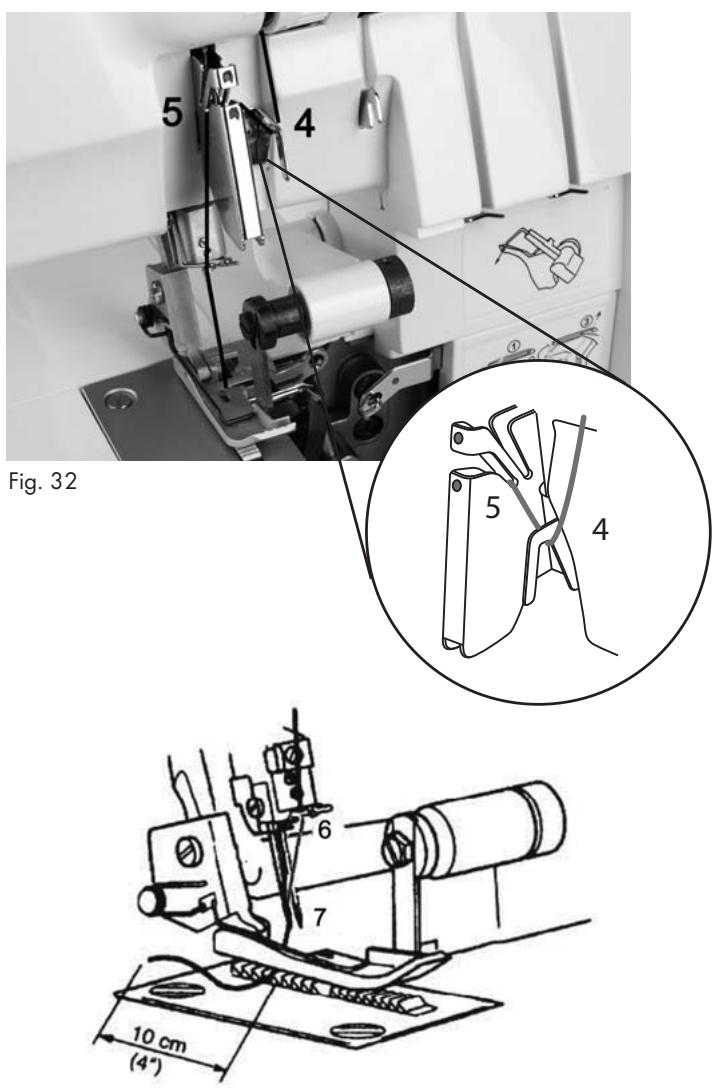
Fig. 33
Trial run
When yarn has been threaded for the first time, or after a yarn breakage it must be rethreaded, proceed as follows:
Lift the sewing foot 21.
Hold the ends of the threads between the fingertips of your left hand, slowly turn the handwheel ⑥ two or three times towards yourself and then check the threads once again.
Lay the material for a trial run under the sewing foot ② and slowly start to sew.
The material will be automatically fed through.
When the task is complete, continue sewing until an approximately 5cm (2") long length of threads has formed at the end of the material.
Cut through the threads with scissors.
Changing threads is quite simple with the following procedure:
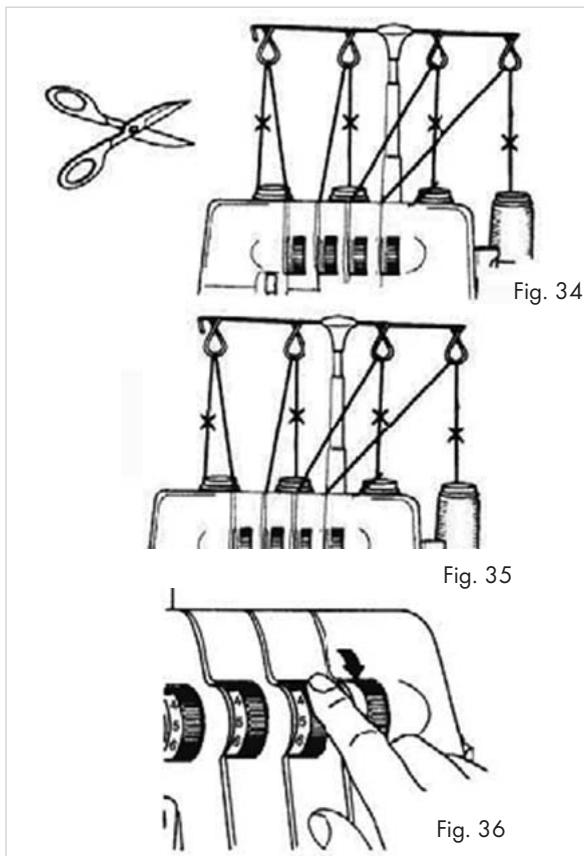
- Cut the yarn above the spool support ② (Fig. 34) and place the new roll of thread on the spool support ②.
- Tie the ends of the new and the old thread together (Fig. 35).
- Place the thread tension selector 14/15/16/17 at "0" (Fig. 36) and lift the sewing foot 21.
- Pull on the other end of the yarn until the knot passes under the sewing foot 21.
- For threading it in the needle, pull on the other end until the knot is in the eye of the needle and then cut the yarn to the left and right of the knot. Then carry out the rethreading.
Set the stitch length
The stitch length can be adjusted from 1.0 to 4.0 mm. Almost all overlock work is carried out with a stitch length of 2.5 - 3.5 mm.
Turn on the adjustment wheel for stitch length ⑤ (Fig. 37) to adjust the stitch length:
- A stitch length of 3 mm is recommended for most sewing.
- For the working of heavy fabrics, a stitch length of 4 mm is to be recommended.
- For the working of light fabrics, a stitch length of 2 mm is to be recommended..
With these settings you will produce respectable seams and the fabric will not be crimped.
Setting the seam width
The width of seams can be determined both by changing the needle position and via the seam width adjustment knob 24.
... by using the right or left needle
The width of the seam can be determined by using the left or the right needle.
• Only the left needle is used: 5.7 mm
• Only the right needle is used: 3.5 mm
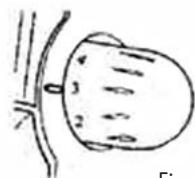
Fig. 37
... by turning the seam width adjustment knob
By using the seam width adjustment knob 24, seam width can be adjusted within the ranges indicated below.
• Only the left needle is used: 5.2 - 6.7 mm
• Only the right needle is used: 3.0 - 4.5 mm
Setting the seam width adjustment knob
Attention!
Before making adjustments with the seam width adjustment knob 24 always place the mains switch 8 at the position "O" (Off). This prevents an accidental start of the appliance and thus the risk of injury!
- Open the front flap 10, this can make the adjustment easier to carry out.
- Turn the seam width adjustment knob 24 to the desired seam width (Fig. 38). Orientate yourself on the scale on the stitch plate 13 (Fig. 39).
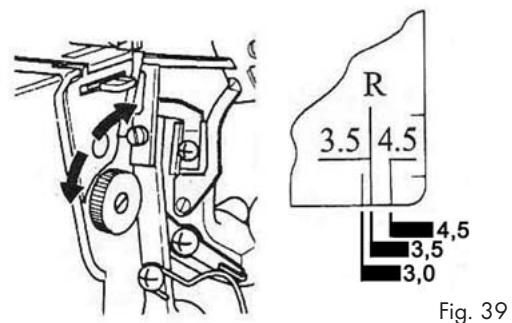
Fig. 38
Adjust sewing foot pressure
Upon delivery, the sewing foot pressure is set for medium-weight materials. If you wish to use heavier or lighter materials, adjust the sewing foot pressure as follows:
- For lighter fabrics, you need to reduce the pressure.
- For heavier fabrics, you need to increase the pressure.
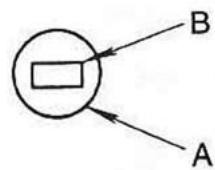
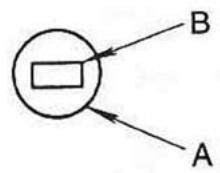
Insert the small screwdriver into the hole on the upper side of the machine (Fig. 40). The pressure adjustment screw is located here (A). Ensure that the screwdriver slips into the slot of the pressure adjustment screw (B) (Fig. 41).
- Turn the screwdriver in the direction "+" if you want to increase the pressure.
- Turn the screwdriver in the direction "-" if you want to reduce the pressure.
(i) Note:
To return to the factory-set default sewing foot pressure, turn the pressure adjustment screw as far as it will go anti-clockwise (-). Then turn it 6 rotations in a clockwise (+) direction.
The standard sewing foot pressure is reset.
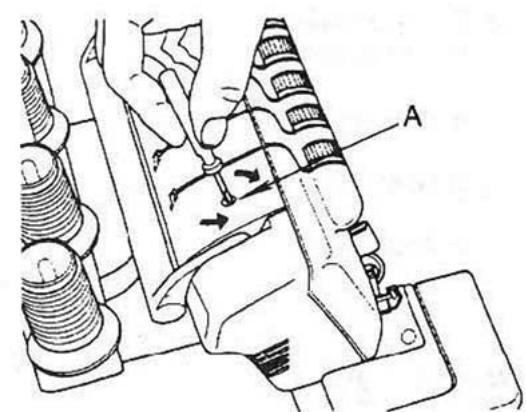
Fig. 40
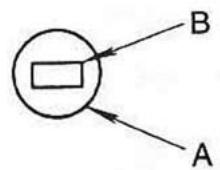
Fig. 41
Manner of operation
The machine has two sets of toothed rack feeders, one to the front and one to the rear. Both sets move independent of each other. Through the differential feed motion both toothed rack sets can move themselves at various speeds.
With this, the fabric is stretched or gathered, depending on which transport differential has been set between the front and rear rack feeders.
With the aid of the differential transport, interesting effects can be achieved when sewing overlock seams on stretch materials and diagonally cut fabrics (Fig. 43).
(i) Note:
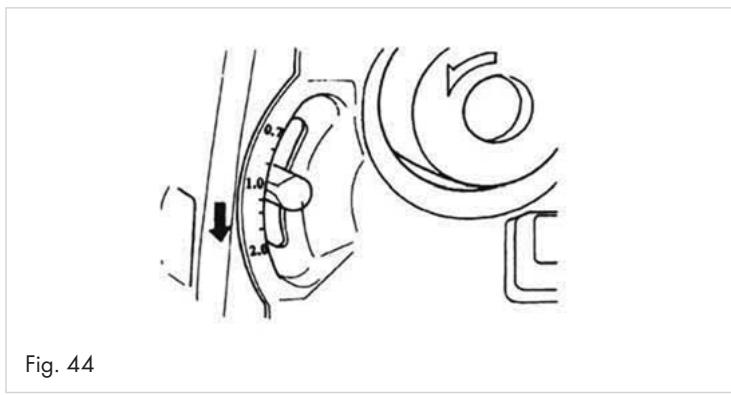
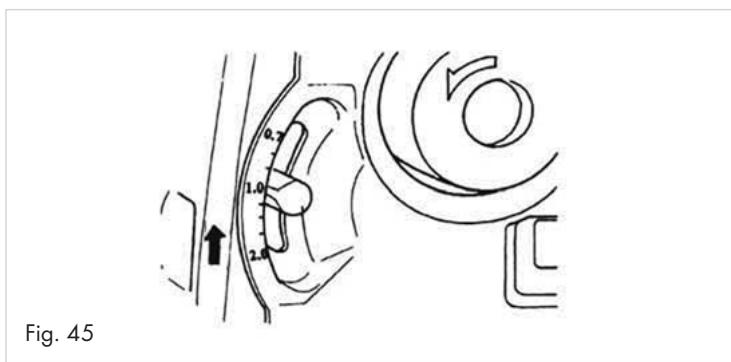
When the differential transport lever ⑨ stands at "1.0", that corresponds to a differential transport ratio of 1:1. Both toothed feed racks move at the same rate (Fig. 42).
The differential transport lever ⑨ can be adjusted in a range from 1:0.7 to 1:2.0.

Gathered overlock seam - Settings
The gathered overlock seam is suitable for the ruffling of sleeves, back upper parts, skirt seams etc. made of elastic materials such as knitwear and jersey. The individual parts should be brought together before sewing.
- Adjust the differential transport lever ⑨ to a value higher than 1.0 (Fig. 44). The exact setting depends on the material to be processed and the desired level of ruffling or gathering.
Therefore always do a sample stitching to test the settings.
Stretched overlock seam - Settings
The stretched overlock seam is suitable for the manufacture of ruffles at the collar, cuffs and skirt edges etc. in soft, stretchy fabric and knitwear.
- Adjust the differential transport lever ⑨ to a value lower than 1.0 (Fig. 45). The exact setting depends on the material to be processed, and on the strength of the desired "ruffle effect".
Therefore always do a sample stitching to test the settings. - Hold the seam down with slight firmness before and behind the sewing foot 21 so as to keep the textile under tension.
(i) Note:
If you have set a value of "3" or higher on the adjustment wheel for the stitch length ⑤, this setting will automatically return to "3" when you set the differential transport lever ⑨ to 2.0.
To work tubular-shaped fabrics, such as sleeves or trouser legs, you can remove the free arm cover.
- If appropriate, remove the waste container from the machine.
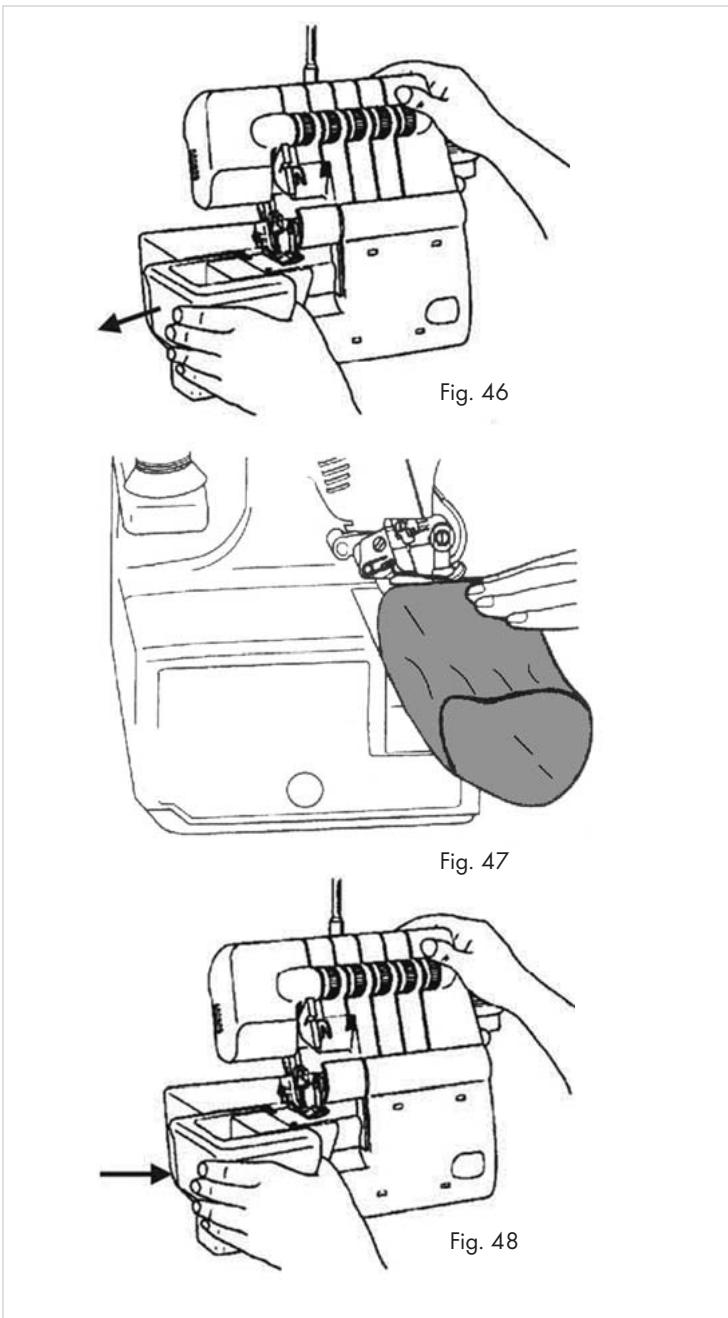
- Slide the free arm cover to the left and pull it off (Fig. 46)..
- You can now pull the textiles over the free arm 12 and work them (Fig. 47).
- To replace the free arm cover, push it onto the free arm 12 until it clicks into place and is firmly seated (Fig. 48).
- Open the front flap 10.
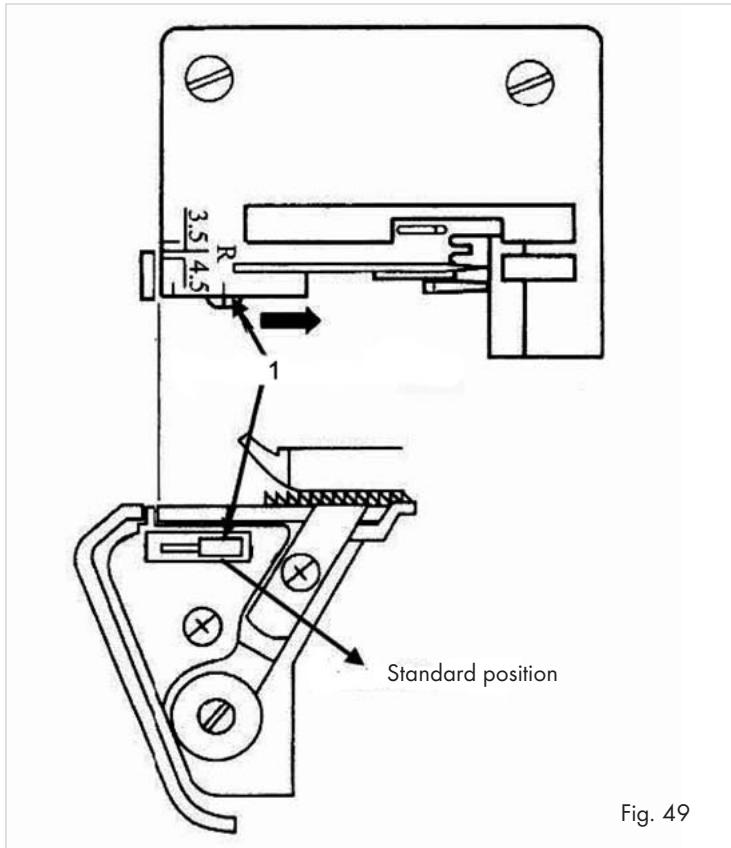
- Slide the seam width switch 23 to "S", so that the seam width finger is pushed forward (1) (Fig. 49).
(i) Note:
The seam width switch 23 must be pushed until it can go no further. Otherwise, the seams will be untidy.
Roll hemmings
- Open the front flap 10.
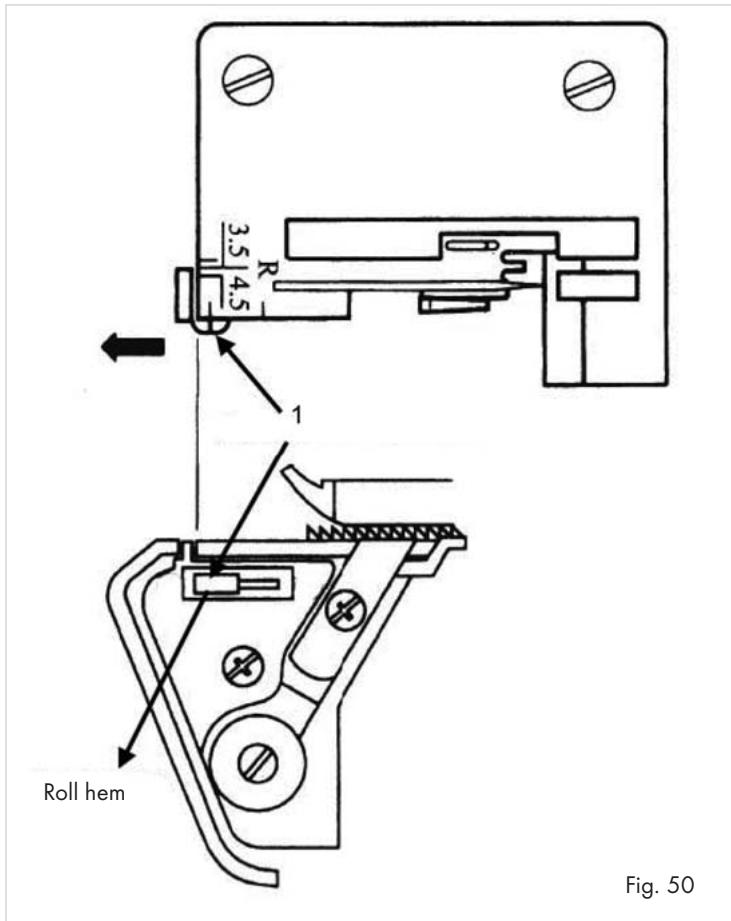
- Slide the seam width switch 23 to "R", so that the seam width finger is pushed backward (1) (Fig. 50).
(i) Note:
The seam width switch ②3 must be pushed until it can go no further, otherwise the seams will be untidy.
Binding-off and sample sewing
- Lay all yarns under the sewing foot 21, to the rear, slightly to the left and over the stitch plate 13.
- Firmly hold the yarns under a slight tension.
- Turn the handwheel ⑥ 2 to 3 revolutions onto itself to begin empty chainstitch formation.
- Lower the sewing foot 21 with the sewing foot lever 4.
- Hold the empty chainstitch again firmly and carefully activate the foot pedal until the empty chainstatch is approximately 5 - 7.5 cm long.
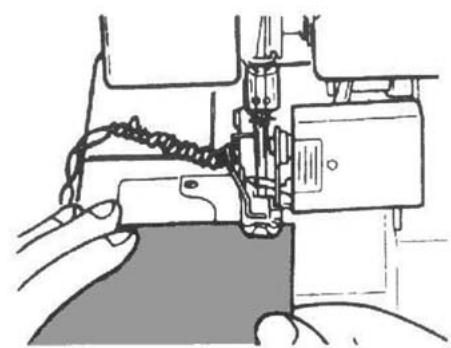
- Place the fabric from the front under the sewing foot 21 and sew a test seam (Fig. 51). Under no circumstances should you pull on the textile, otherwise the needle will be bent or could even break off.
- Continue sewing even after the textile is finished for about 15 to 20 cm.
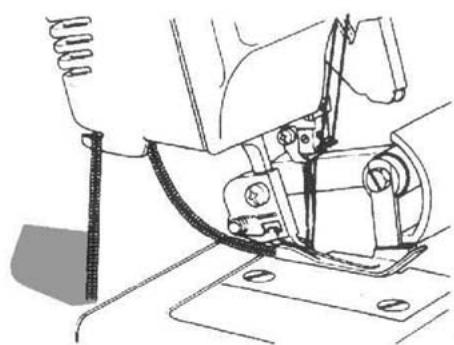
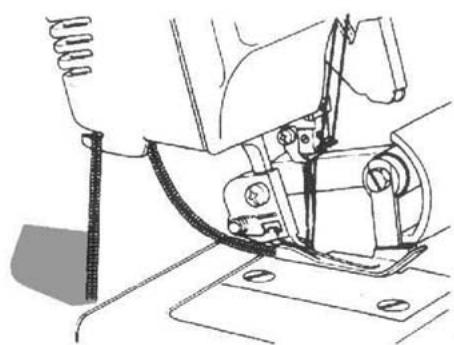
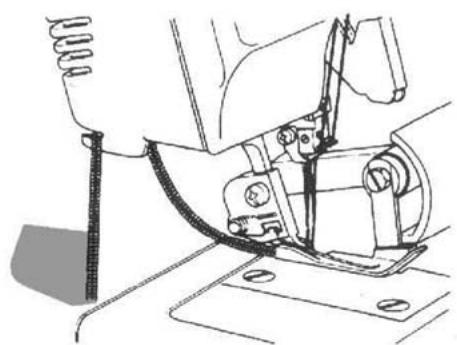
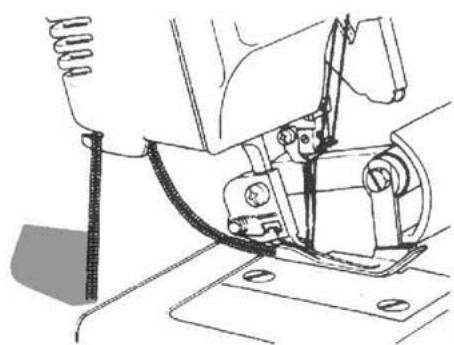
- Cut the empty chainstitch by using the blade at the rear of the machine (Fig. 52).
natural_image
Line drawing of hands operating a sewing machine with chains attached (no text or symbols)Fig. 51
natural_image
Technical line drawing of a sewing machine with a hand operating the hook (no text or symbols)Fig. 52
Recommended tension settings
i Note:
All information about tension settings for the different kinds of stitches are purely guiding values. The thread tension itself is always dependant on the type and thickness of the fabric, as well as needle strength and the strength, type and material composition of the yarn.
It is therefore absolutely necessary to sew a test seam. It is the only way you can find out if the tension settings are correct, or if they need to be changed.
2-thread overcast chain stitch (overlock)
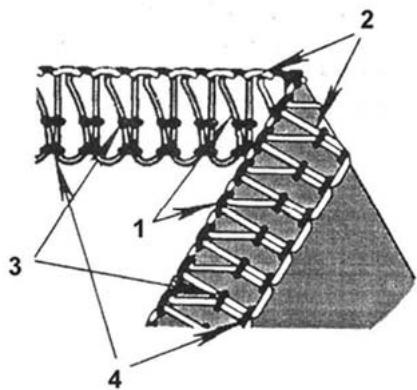
Figure 53 shows you the stitch pattern for this stitch.
This stitch with a needle and 2 threads is used for tidying the edges of light or stretchy fabrics. By changing the needle position you can obtain a narrow or a wide overcast seam.
Adjust the thread tension selectors 14 15 16 17 to the appropriate values (see table) then sew a test seam on the material being used.
For this type of stitch insert the upper looper element in the upper looper 19.
| Textiles | Tensioning the thread | |||
| blue | green | red | yellow | |
| light material | 2.0 | - | Inserting the upper looper element | 0 |
| medium-weight material | 2.5 | - | Inserting the upper looper element | 0 |
| heavy material | 3.5 | - | Inserting the upper looper element | 0.5 |
| Textiles | Tensioning the thread | |||
| blue | green | red | yellow | |
| light material | - | 1.5 | Inserting the upper looper element | 0.5 |
| medium-weight material | - | 1.5 | Inserting the upper looper element | 0.5 |
| heavy material | - | 3.0 | Inserting the upper looper element | 1.5 |
Should the lower looper yarn appear to be too tight or the needle thread too loose (Fig. 54):
- turn the thread tension selector for the lower looper thread 17 (yellow) to a lower number, or ...
- turn the thread tension selector for the needle (blue 14 or green 15) to a higher number.
Should the lower looper yarn appear to be too loose (Fig. 55), turn the thread tension selector for the lower looper thread 17 (yellow) to a higher number.
| Needle position |   |
| Seam width switch | S |
| Stitch length | 2 - 4 |
| Upper looper element | insert |
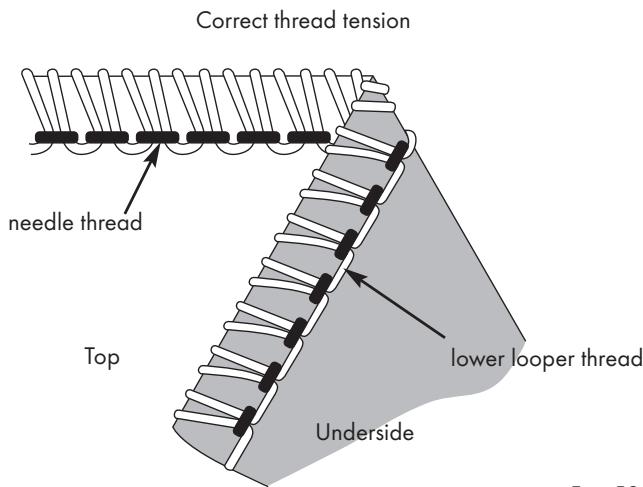
Fig. 53
Incorrect thread tension
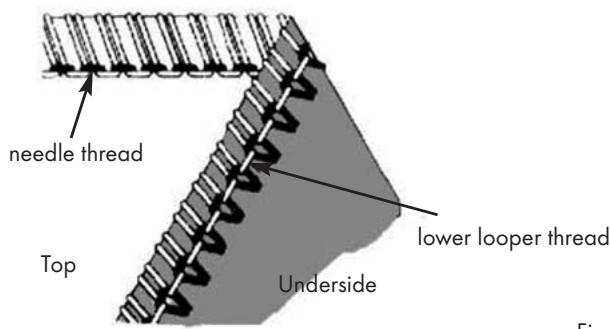
Fig. 54
Incorrect thread tension
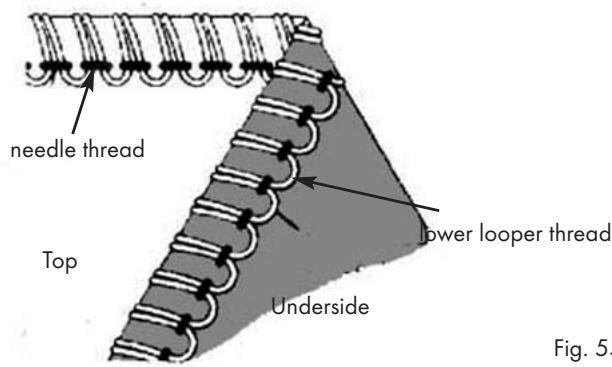
Fig. 55
2-thread-overcast-stitch
Figure 56 shows you the stitch pattern for this stitch.
This stitch with a needle and 2 threads is used for tidying normal fabrics with an overcast stitch. It is also ideal for flat stitch seams (fell or butt seams) and blind hemming.
By changing the needle position you can obtain a narrow or a wide overcast seam.
Adjust the thread tension selectors 14 15 16 17 to the appropriate values (see table) then sew a test seam on the material being used.
For this type of stitch insert the upper looper element in the upper looper 19.
| Textiles | Tensioning the thread | |||
| blue | green | red | yellow | |
| light material | 0.5 | - | Inserting the upper looper element | 1.0 |
| medium-weight material | 0.5 | - | Inserting the upper looper element | 1.5 |
| heavy material | 1.0 | - | Inserting the upper looper element | 1.5 |
| Textiles | Tensioning the thread | |||
| blue | green | red | yellow | |
| light material | - | 1.0 | Inserting the upper looper element | 3.0 |
| medium-weight material | - | 1.5 | Inserting the upper looper element | 3.5 |
| heavy material | - | 1.5 | Inserting the upper looper element | 3.5 |
Should the lower looper yarn lie on the underside of the textile (Fig. 57):
- turn the thread tension selector for the lower looper thread 17 (yellow) to a higher number, or ...
- turn the thread tension selector for the needle (blue 14 or green 15) to a lower number.
Should the needle yarn be too loose (Fig. 58):
- turn the thread tension selector for the needle (blue 14 or green 15) to a higher number.
- turn the thread tension selector for the lower looper thread 17 (yellow) to a lower number.
| Needle position |   |
| Seam width switch | S |
| Stitch length | 2 - 4 |
| Upper looper element | insert |
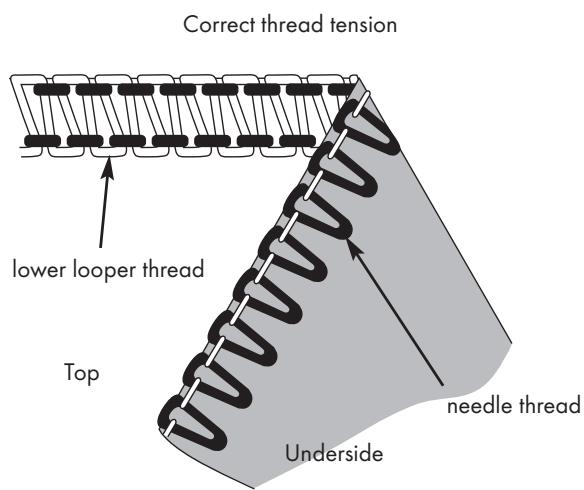
Fig. 56
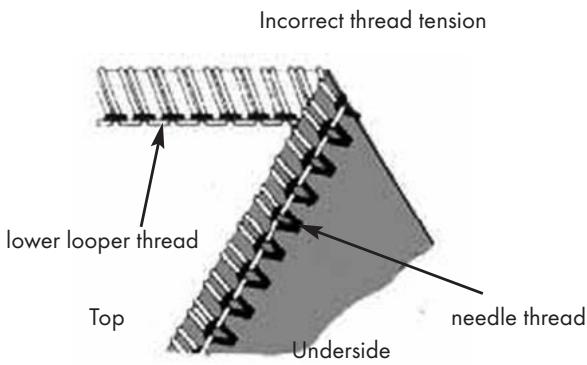
Fig. 57
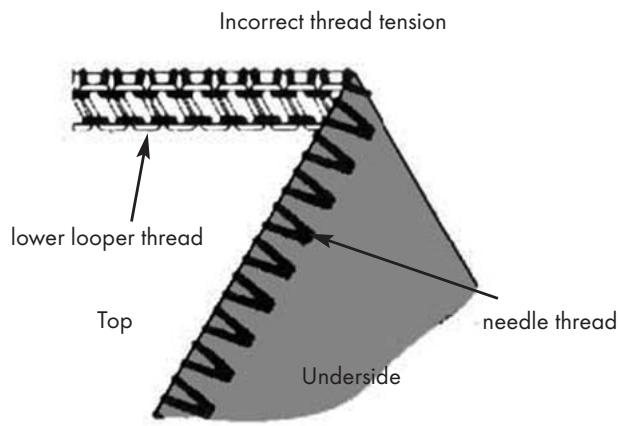
Fig. 58
3-thread chain stitch (overlock)
Figure 59 shows you the stitch pattern for this stitch.
This stitch with a needle and 3 threads is used for tidying of normal fabrics with an overcast stitch.
By changing the needle position you can obtain a narrow or a wide overcast seam.
Adjust the thread tension selectors 14 15 16 17 to the appropriate values (see table) then sew a test seam on the material being used.
| Textiles | Tensioning the thread | |||
| blue | green | red | yellow | |
| light material | 2.0 | - | 2.0 | 1.0 |
| medium-weight material | 3.0 | - | 2.0 | 1.5 |
| heavy material | 3.0 | - | 3.0 | 1.5 |
| Textiles | Tensioning the thread | |||
| blue | green | red | yellow | |
| light material | - | 2.0 | 7.0 | 2.0 |
| medium-weight material | - | 2.5 | 6.5 | 2.5 |
| heavy material | - | 3.5 | 6.5 | 2.5 |
Should the upper looper yarn lie on the underside of the textile (Fig. 60):
- turn the thread tension selector 16 for the upper looper thread (red) to a higher number, or ...
- turn the thread tension selector for the lower looper thread 17 (yellow) to a lower number.
Should the lower looper yarn lie on the upperside of the textile (Fig. 61):
- turn the thread tension selector for the lower looper thread ⑰ (yellow) to a higher number, or ...
- turn the thread tension selector 16 for the upper looper thread (red) to a lower number.
Should the needle thread appear to be too loose (Fig. 62), turn the thread tension selector for the needle thread (blue 14 or green 15) to a higher number.
| Needle position |   |
| Seam width switch | S |
| Stitch length | 2 - 4 |
| Upper looper element | not necessary |
Correct thread tension
upper looper thread
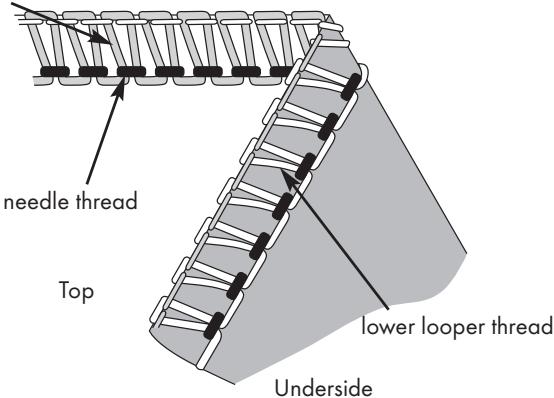
Fig. 59
Incorrect thread tensions
upper looper thread
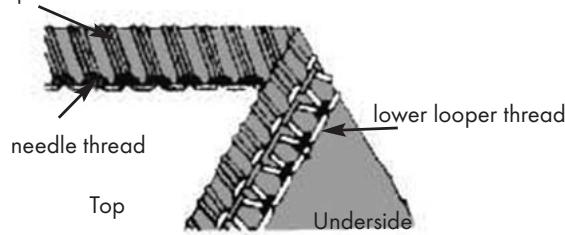
Fig. 60
upper looper thread
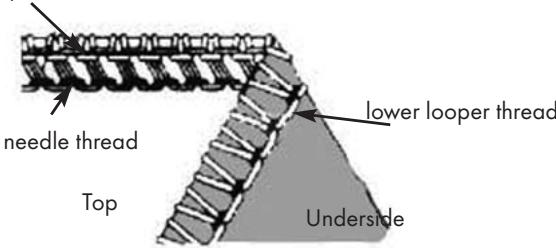
Fig. 61
upper looper thread
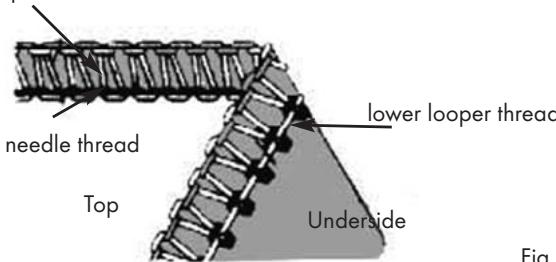
Fig. 62
3 - thread - flatlock seam
Figure 63 shows you the stitch pattern for this stitch.
This stitch with a needle and 3 threads is used for fell or butt seams and for ornamental stitches with decorative thread. By changing the needle position you can obtain a narrow or a wide flatlock seam (flatlock).
Adjust the thread tension selectors 14 15 16 17 to the appropriate values (see table) then sew a test seam on the material being used.
| Textiles | Tensioning the thread | |||
| blue | green | red | yellow | |
| light material | 0.5 | - | 2.5 | 2.5 |
| medium-weight material | 0.5 | - | 2.0 | 2.0 |
| heavy material | 1.0 | - | 3.0 | 3.0 |
| Textiles | Tensioning the thread | |||
| blue | green | red | yellow | |
| light material | - | 0 | 7.0 | 4.0 |
| medium-weight material | - | 0.5 | 7.0 | 4.0 |
| heavy material | - | 1.0 | 7.0 | 4.0 |
Should the lower looper yarn be too loose (Fig. 64):
- turn the thread tension selector for the lower looper thread 17 (yellow) to a higher number, or ...
- turn the thread tension selector for the needle (blue 14 or green 15) to a lower number.
Should the upper looper yarn be too loose (Fig. 65):
- turn the thread tension selector for the upper looper thread 16 (red) to a higher number, or ...
- turn the thread tension selector for the needle (blue 14 or green 15) to a lower number.
Should the needle yarn be too loose (Fig. 66):
- turn the thread tension selector for the needle (blue 14 or green 15) to a higher number.
- turn the thread tension selector for the upper looper thread 16 (red) to a lower number.
| Needle position |   |
| Seam width switch | S |
| Stitch length | 2 - 4 |
| Upper looper element | not necessary |
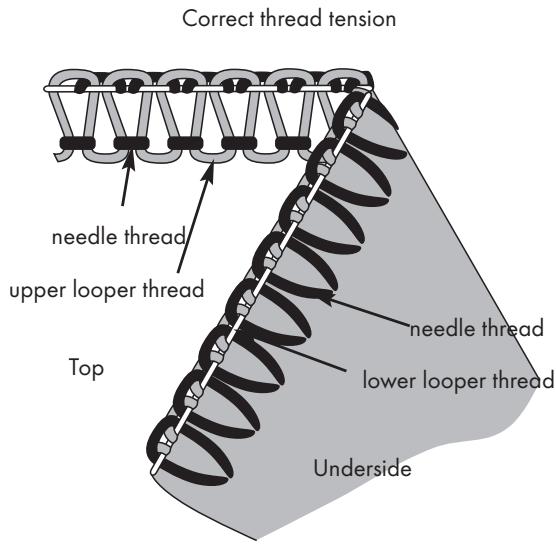
Fig. 63
Incorrect thread tensions
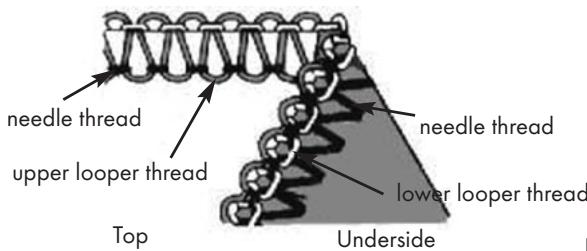
Fig. 64
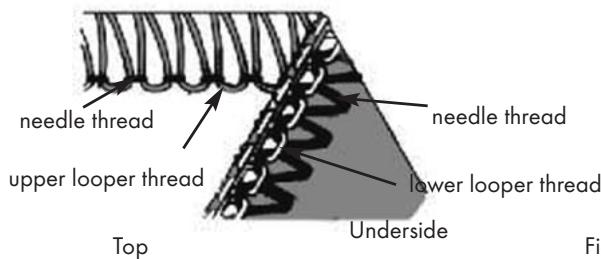
Fig. 65
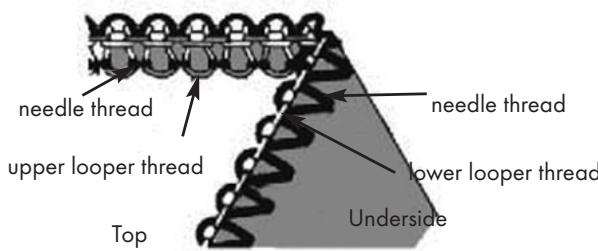
Fig. 66
3-thread overcast chain stitch (overlock)
Figure 67 shows you the stitch pattern for this stitch.
This stitch with a needle and 3 threads is used for sewing, for example, decorative edges.
By changing the needle position you can obtain a narrow or a wide overcast chain seam.
Adjust the thread tension selectors 14 15 16 17 to the appropriate values (see table) then sew a test seam on the material being used.
| Textiles | Tensioning the thread | |||
| blue | green | red | yellow | |
| light material | 2.0 | - | 0 | 4.0 |
| medium-weight material | 3.0 | - | 0.5 | 6.5 |
| heavy material | 4.0 | - | 0.5 | 7.5 |
| Textiles | Tensioning the thread | |||
| blue | green | red | yellow | |
| light material | - | 1.5 | 0 | 5.0 |
| medium-weight material | - | 2.5 | 1.0 | 7.0 |
| heavy material | - | 3.0 | 1.5 | 8.0 |
Should the upper looper yarn be too loose (Fig. 68):
- turn the thread tension selector for the upper looper thread 16 (red) to a higher number.
Should the lower looper yarn be too loose (Fig. 69):
- turn the thread tension selector for the lower looper thread ⑰ (yellow) to a higher number, or ...
- turn the thread tension selector for the upper looper thread 16 (red) to a lower number.
Should the needle yarn be too loose (Fig. 70):
- turn the thread tension selector for the needle (blue 14 or green 15) to a higher number.
- turn the thread tension selector for the upper looper thread 16 (red) to a lower number.
| Needle position |   |
| Seam width switch | S |
| Stitch length | 2 - 4 |
| Upper looper element | not necessary |
Correct thread tension
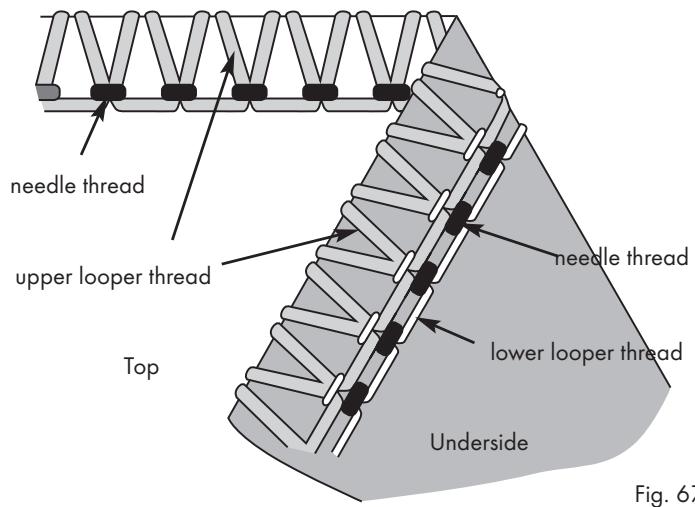
Fig. 67
Incorrect thread tension
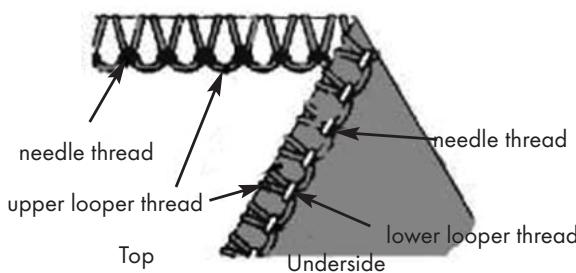
Fig. 68
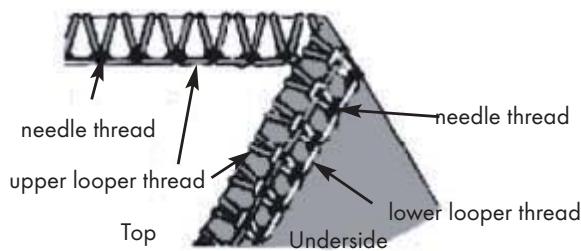
Fig. 69
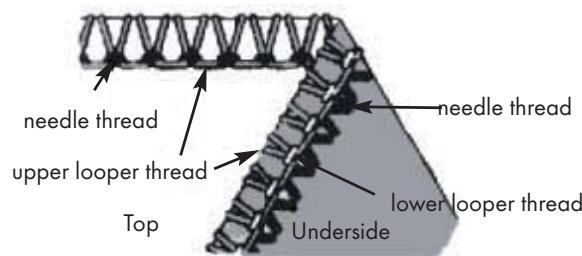
Fig. 70
3-thread safety stitch, highly elastic, imitated
Figure 71 shows you the stitch pattern for this stitch.
This stitch with 2 needles and 3 threads is ideal for lightweight, extremely stretchy fabrics such as jersey and spandex.
Adjust the thread tension selectors 14 15 16 17 to the appropriate values (see table) then sew a test seam on the material being used.
For this type of stitch insert the upper looper element in the upper looper 19.
| Textiles | Tensioning the thread | |||
| blue | green | red | yellow | |
| light material | 2.0 | 1.5 | Inserting the upper looper element | 0 |
| medium-weight material | 3.0 | 2.0 | Inserting the upper looper element | 0.5 |
| heavy material | 4.0 | 3.0 | Inserting the upper looper element | 1.0 |
Should the upper looper yarn be too loose (Fig. 72):
- turn the thread tension selector for the lower looper thread ⑰ (yellow) to a higher number.
Should the left needle yarn be too loose (Fig. 73):
- turn the thread tension selector for the left needle 14 (blue) to a higher number.
Should the right needle yarn be too loose (Fig. 74):
- turn the thread tension selector for the right needle 15 (green) to a higher number.
| Needle position |  ____ ____ |
| Seam width switch | S |
| Stitch length | 2 - 4 |
| Upper looper element | insert |
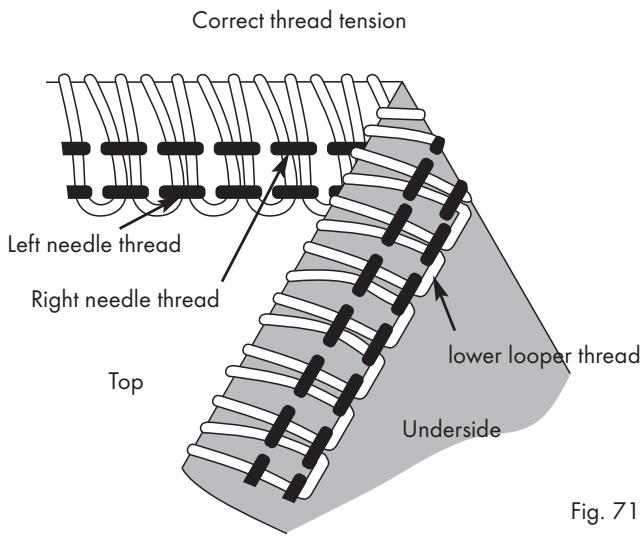
Incorrect thread tension
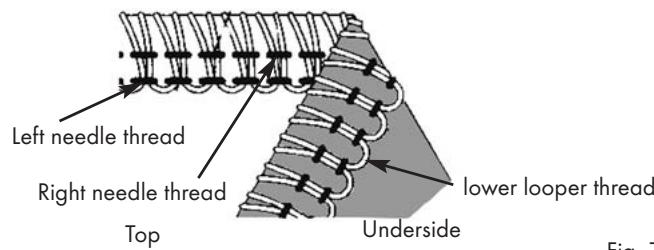
Fig. 72
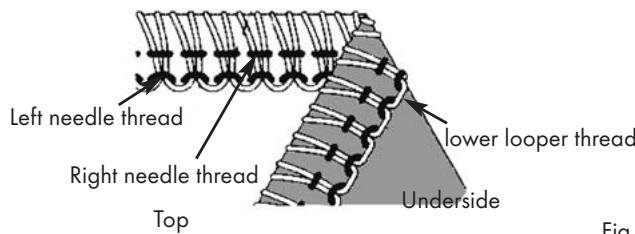
Fig. 73
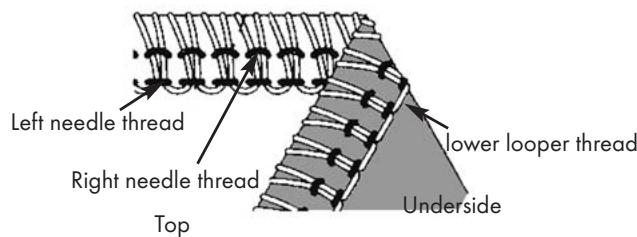
Fig. 74
4-thread safety stitch, highly elastic, imitated
Figure 75 shows you the stitch pattern for this stitch.
This stitch with 2 needles and 4 threads is ideal for medium to heavy, stretchy fabrics such as double-knitted materials and swimwear.
It is suitable for combining two materials and neatening the edges at the same time.
Adjust the thread tension selectors 14 15 16 17 to the appropriate values (see table) then sew a test seam on the material being used.
| Textiles | Tensioning the thread | |||
| blue | green | red | yellow | |
| light material | 2.5 | 2.0 | 2.5 | 2.0 |
| medium-weight material | 3.0 | 2.0 | 3.0 | 2.0 |
| heavy material | 4.0 | 2.5 | 4.0 | 2.5 |
Should the upper looper yarn lie on the underside of the textile (Fig. 76):
- turn the thread tension selector for the upper looper thread 16 (red) to a higher number, or ...
- turn the thread tension selector for the lower looper thread ⑰ (yellow) to a lower number.
Should the lower looper yarn lie on the upperside of the textile (Fig. 77):
- turn the thread tension selector for the lower looper thread ⑰ (yellow) to a higher number, or ...
- turn the thread tension selector for the upper looper thread 16 (red) to a lower number.
Should the left needle yarn be too loose (Fig. 78):
- turn the thread tension selector for the left needle 14 (blue) to a higher number.
Should the right needle yarn be too loose (Fig. 79):
- turn the thread tension selector for the right needle 15 (green) to a higher number.
| Needle position |  |
| Seam width switch | S |
| Stitch length | 2 - 4 |
| Upper looper element | not necessary |
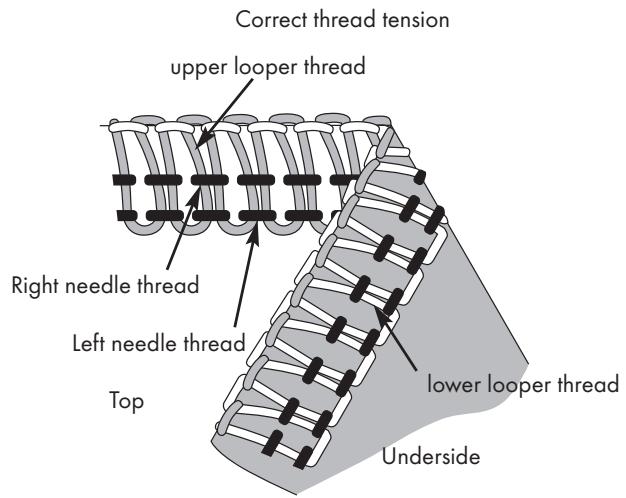
Fig. 75
Incorrect thread tension
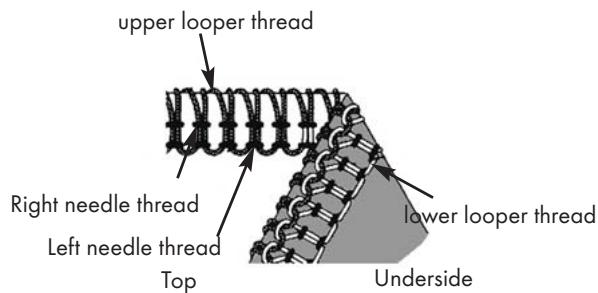
Fig. 76
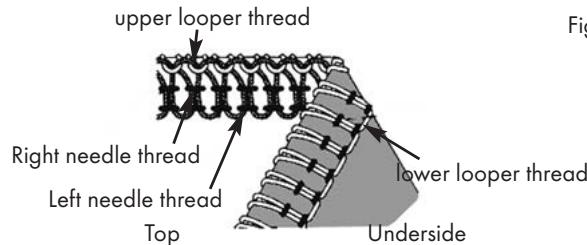
Fig. 77
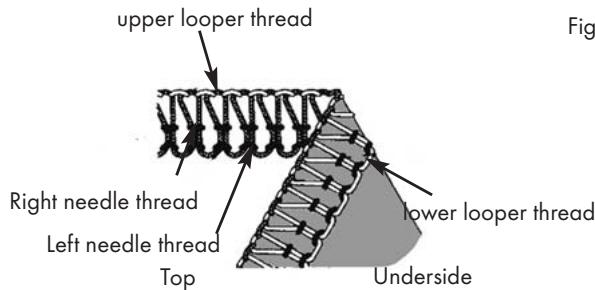
Fig. 78
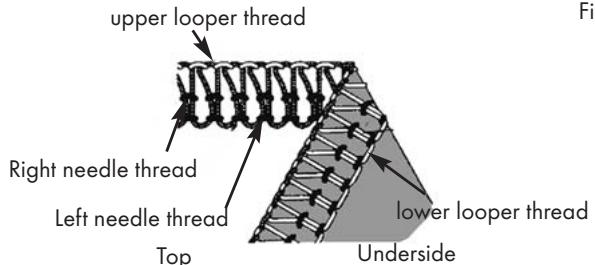
Fig. 79
With this machine you can sew four different roll hemming types. When sewing roll hemmings, the fabric edge is folded over and provided with an overlock seam. Lightweight fabrics such as batiste, chiffon, organza and so on are best for these kinds of seams. Heavy fabrics or stiff materials are not suitable for roll hemmings.
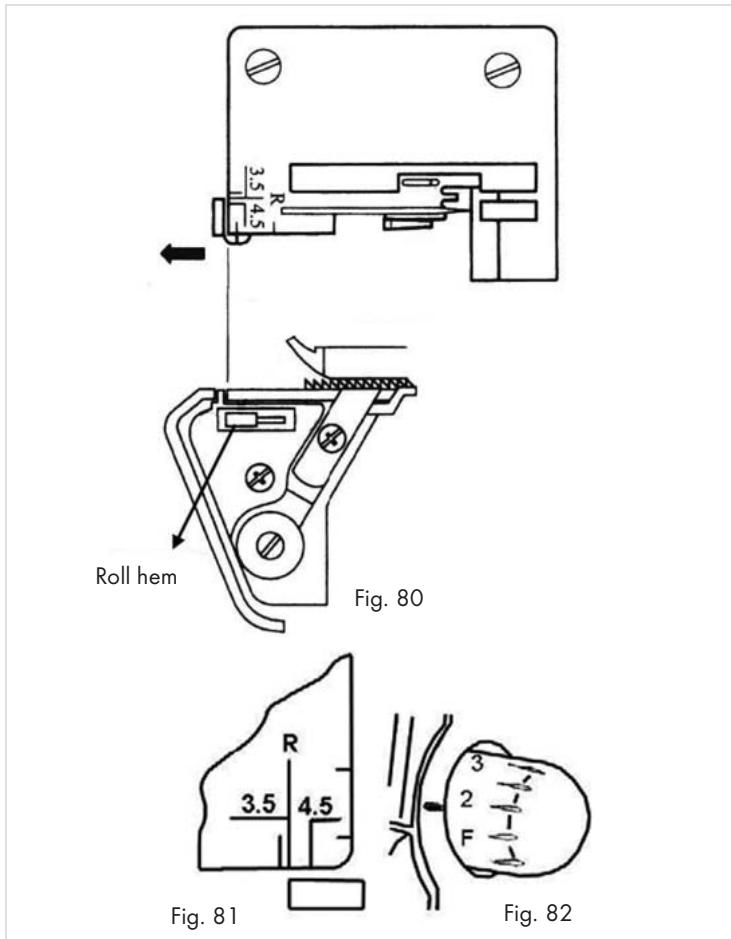
- Remove the left needle.
- Set the seam width switch 23 at "R" (Fig. 80).
- Align the support plate of the seam width finger on the marking "R" on the stitch plate by turning out the seam width adjustment knob 24 (Fig. 81).
- Place the dial for the stitch length ⑤ at "F - 2" (Fig. 82). With this a fine seam is sewn.
- For roll hemmings use a needle with specification Nr. 14.
i Tips:
- For a rolled hem many different combinations of yarn can be used. To create a particularly beautiful rolled hem (3-thread rolled hem), use a bushy yarn (bushy polyamid thread/woolly nylon) as the upper looper yarn and normal yarn for the needle and lower looper. For a 2-thread rolled hem use bushy yarn for the lower looper thread and normal yarn for the needle thread.
- At the start of sewing hold the empty thread chain firmly so that they cannot roll into the seam.
- Subject the material to slight tension in the sewing direction. This will make the seam more delicate.
- Before cutting the thread chain close to the textile, apply a small drop of fabric glue to the seam and allow it to dry. Check for colourfastness on the textile prior to this.
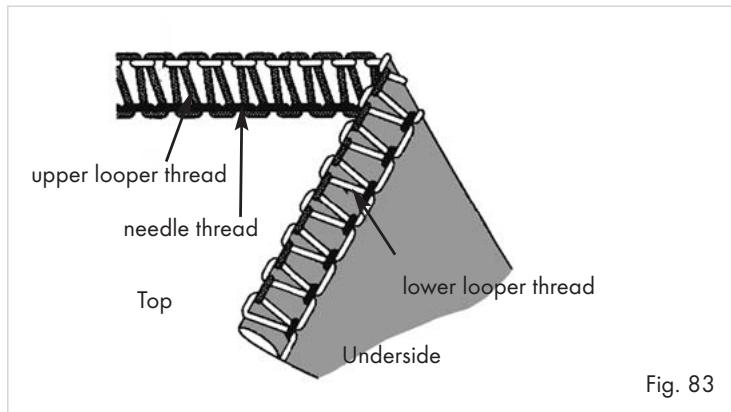
3-thread rolled hem
Figure 83 shows you the stitch pattern for this stitch. Adjust the thread tension selectors 15 16 17 to the appropriate values (see table) then sew a test seam on the material being used.
| Upper looper thread | Tensioning the thread | |||
| blue | green | red | yellow | |
| Polyester | - | 2.0 | 7.5 | 3.0 |
| Bushy yarn | - | 2.0 | 2.0 | 2.0 |
3-thread upper looper overcast rolled hem
Figure 84 shows you the stitch pattern for this stitch. Adjust the thread tension selectors 15 16 17 to the appropriate values (see table) then sew a test seam on the material being used.
| Upper looper thread | Tensioning the thread | |||
| blue | green | red | yellow | |
| Polyester | - | 2.0 | 5.5 | 7.0 |
| Bushy yarn | - | 2.0 | 0 | 2.5 |
| Needle position | |
| Seam width switch | R |
| Stitch length | F - 2 |
| Upper looper element | not necessary |
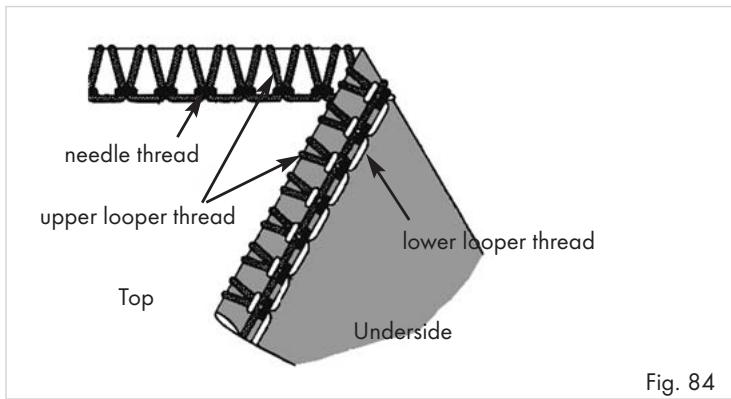
2-thread rolled hem
Figure 85 shows you the stitch pattern for this stitch.
Adjust the thread tension selectors 15 17 to the appropriate values (see table) then sew a test seam on the material being used.
For this type of stitch insert the upper looper element in the upper looper 19.
| Needle position |  |
| Seam width switch | R |
| Stitch length | F - 2 |
| Upper looper element | insert |
| Lower looper thread | Tensioning the thread | |||
| blue | green | red | yellow | |
| Bushy yarn | - | 1.5 | Inserting the upper looper element | 1.5 |
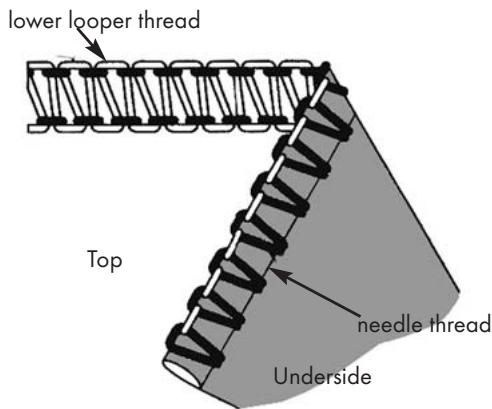
Fig. 85
2-thread lower looper overcast rolled hem
Figure 86 shows you the stitch pattern for this stitch..
Adjust the thread tension selectors 15 17 to the appropriate values (see table) then sew a test seam on the material being used.
For this type of stitch insert the upper looper element in the upper looper 19.
| Needle position |  |
| Seam width switch | R |
| Stitch length | F - 2 |
| Upper looper element | insert |
| Lower looper thread | Tensioning the thread | |||
| blue | green | red | yellow | |
| Polyester | - | 2.0 | Inserting the upper looper element | 2.0 |
| Bushy yarn | - | 1.5 | Inserting the upper looper element | 1.5 |
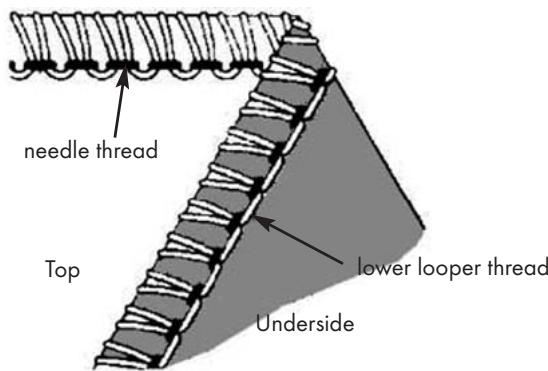
Fig. 86
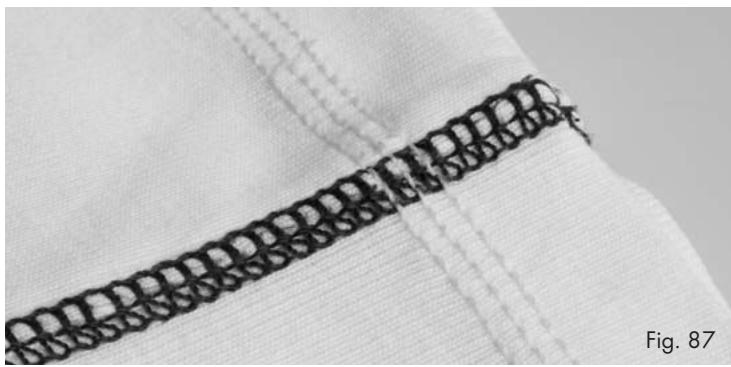
To produce flatlock seams, set up the thread tensions for a 3-thread overlock stitch. Sew a seam and then pull the fabric apart to smooth the seam.
The flatlock seam can be used as a decorative assembly seam or as pure ornamental stitching (Fig. 87, dark thread).
i Tips:
- Pay attention to proper tension, so that the workpiece can be pulled well apart after sewing.
-
Use a decorative thread as the upper looper thread, since this is the most important thread and will be clearly visible.
-
Remove the right or the left needle (Fig. 88).
-
Set up the recommended tension settings for a 3-thread overlock seam (Fig. 89).
- Then readjust the upper thread tensions (green or blue) so that they are much looser.
- Now also release the thread tension of the upper looper (red) somewhat.
- Then adjust the thread tension of the lower looper (yellow) considerably tighter.
Flatlock seam as assembly seam
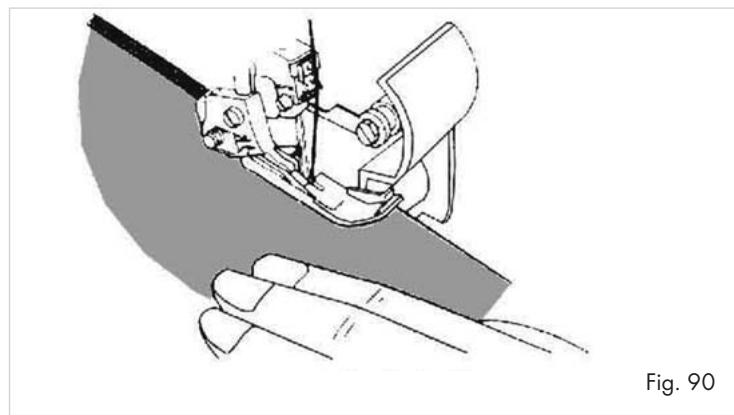
- Place the two fabrics to be sewn inside out to each other, so as to create a decorative seam on the front side.
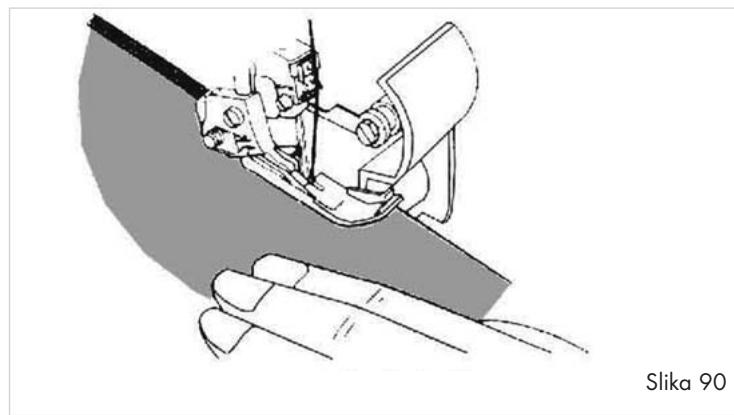
- Sew the seam and while doing this cut away the excess fabric (Fig. 90).
Figure 91 shows you the stitch pattern for this stitch.
- The upper thread (needle thread) (green or blue) then has a V-shaped pattern on the inside of the fabric.
- The lower looper thread runs as a straight line along the fabric edge.
- Pull the fabric apart on both sides of the seam, so that the stitches lie flat.
natural_image
Close-up of a zipper stitching on a white fabric with dashed seam lines (no text or symbols)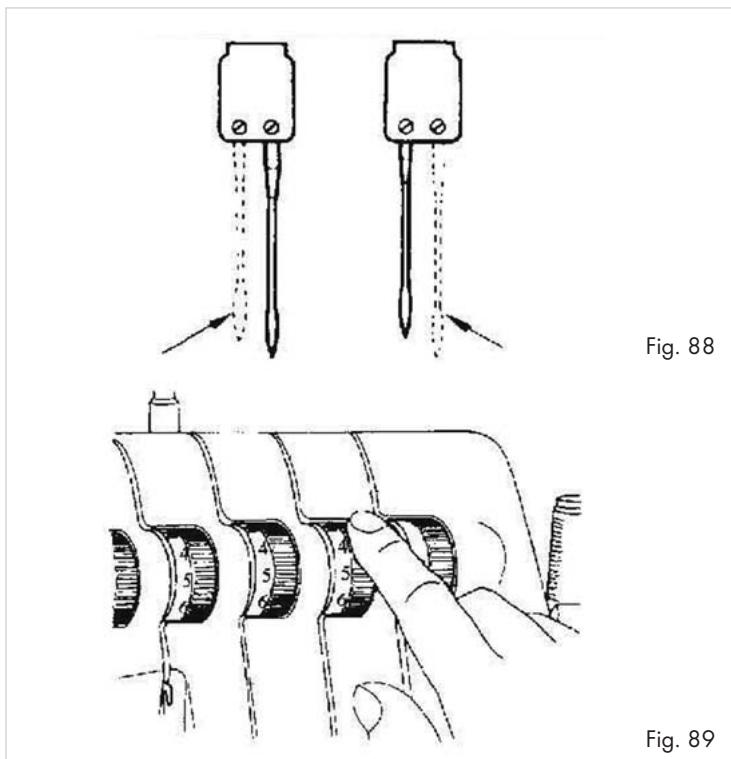
natural_image
Illustration of a sewing machine needle stitching fabric, no text or symbols present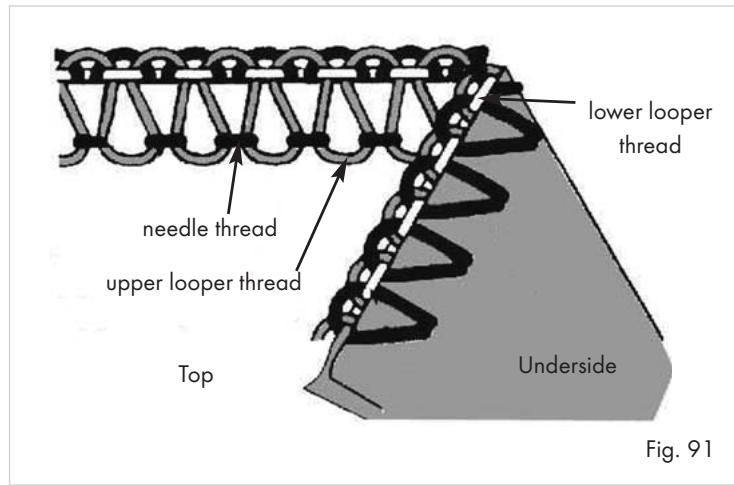
Flatlock seam as decorative seam
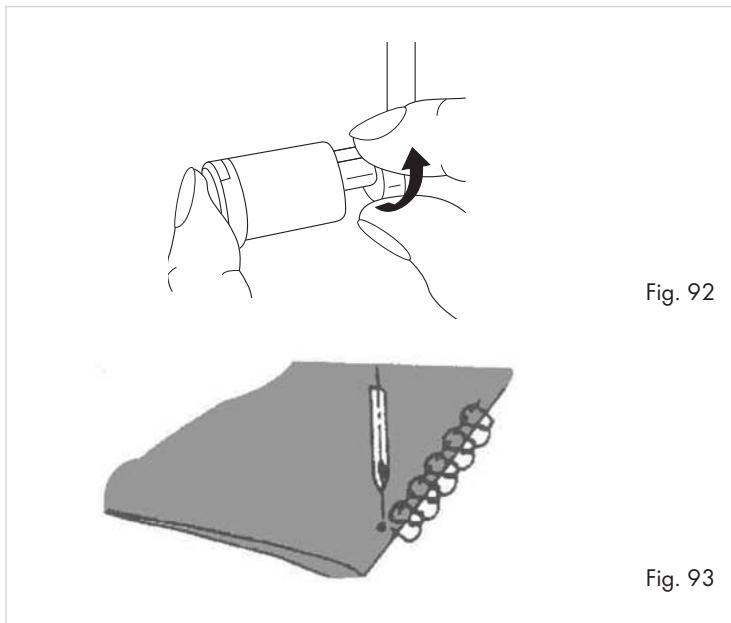
- Adjust the movable upper blade 18 into a rest position (Fig. 92). The textile is not trimmed in this type of seam.
-
Fold the textile so that the two inside sides lie on each other.
-
Place the textile so that a portion of the stitch is sewn outside of the textile (Fig. 93).
- Sew the seam.
- Then fold the textiles apart. The stitches will then lie flat.
Overlock blind hems
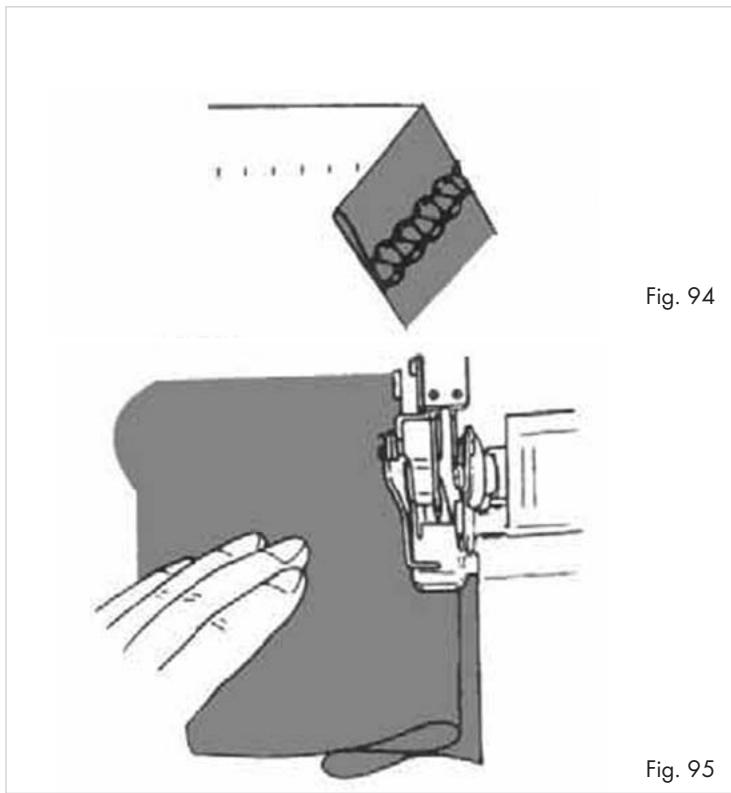
The overlock blind hem is best suited for knitwear. It creates a durable edgetidying and is hardly noticeable (Fig. 94).
In one operation the protruding material is cut away, the hem is sewn and the edges are provided with an overlock seam.
- Remove the left needle and set the machine up for a narrow 3-thread overlock seam.
- Set the stitch length to 4 mm.
- Fold the hem, first to the inside and then to the outside of the fabric, so that the fabric edge stands 6 mm above the first fold (Fig. 95).
- Sew carefully on the fold. Thereby, the needle must pierce straight into the edge of the fold.
natural_image
Illustration of a sewing machine with fabric being handled, labeled Fig. 94 and Fig. 95 (no text or symbols on the diagram itself)Pin tucks
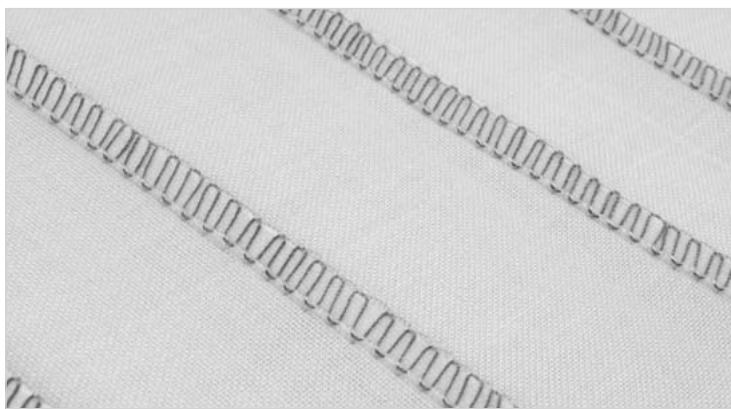
To render your decorative garment as more creative, it can be provided with pin tucks before trimming (Fig. 96). Pin tucks are ornamental seams, as shown in the figure 96.
- Remove the left needle and set the machine up for a narrow 3-thread over-lock seam.
- Adjust the upper blade 18 into the rest position.
- To achieve a uniform result, mark the desired number of pin-tucks on the fabric with water-soluble fabric pen or fabric chalk.
- Fold the fabric inside out and sew it.
- When all of the tucks are sewn, iron them all in one direction so that they lie evenly flat.
natural_image
Close-up of a patterned fabric with repeating zigzag and square indentations (no text or symbols)Fig. 96
Outer corners
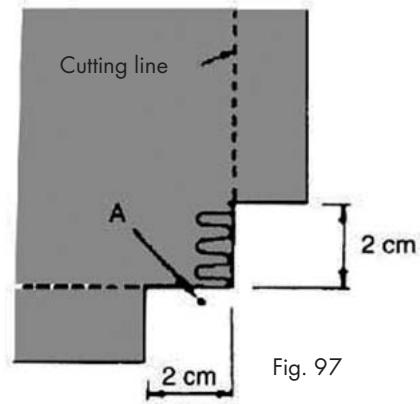
- Cut away, before and after the corner, about 2 cm to the seam line (Fig. 97).
-
Sew a stitch further than to the marking "A" on the drawing and then stop (Fig. 97).
-
Lift the needle and sewing foot 21.
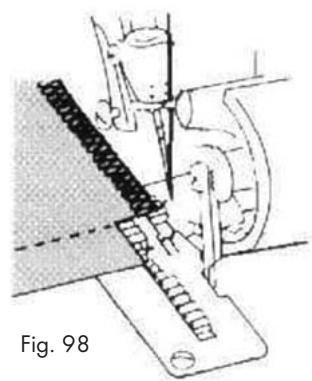
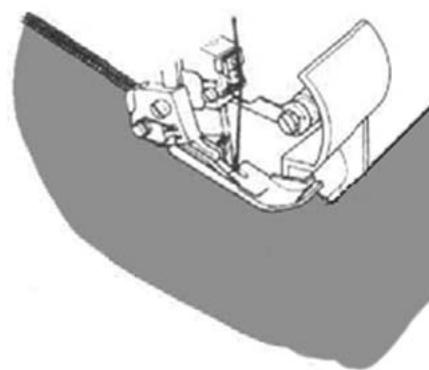
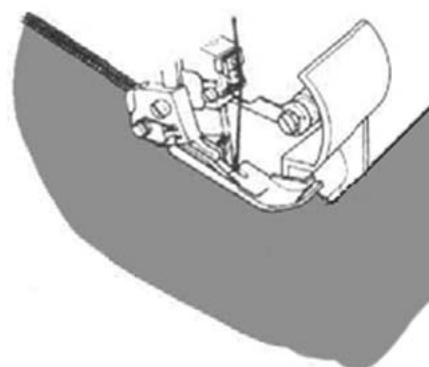
- Pull the fabric to the rear, such that the yarn being held by the finger of the stitch plate 13 is released. (For better recognition, on the drawing opposite the sewing foot 21 is not shown - Figure 98).
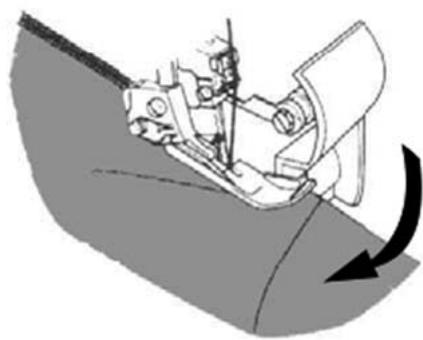
- Rotate the workpiece and lower the sewing foot 21 so that the upper blade 18 lies in a line with the cutting edge (Fig. 99).
- Pull the loose threads up and continue to sew.
Inner corners
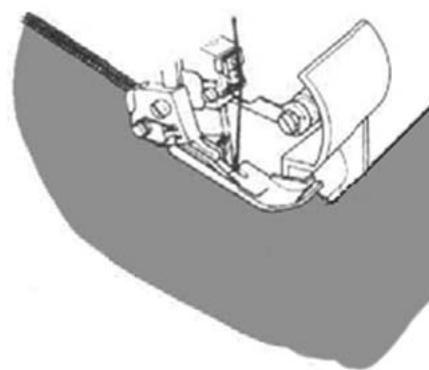
- Cut the fabric away from the seam edge.
-
Adjust the upper blade 18 into the rest position (Fig. 100).
-
Sew on the cutting edge (Fig. 101).
- Stop sewing just before reaching the corner.
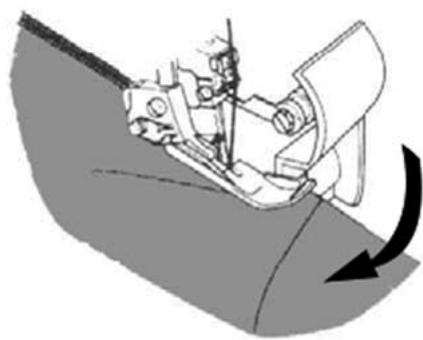
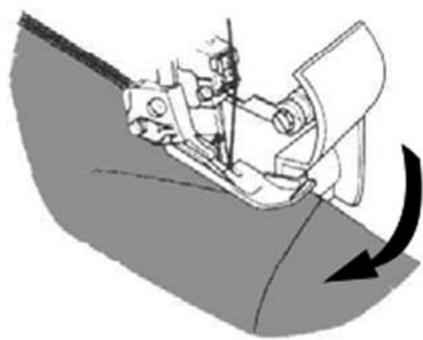
- Place a fold on the corner, so that the two edges form a line (Fig. 102).
- Sew slowly over the corner and along the second edge. Ensure that you do not include the fold!
natural_image
Mechanical sewing machine diagram showing needle insertion and stitching (no text or symbols)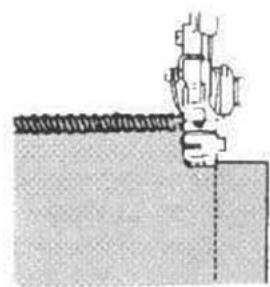
natural_image
Diagram of a mechanical assembly with a tool inserted into a threaded component (no text or symbols)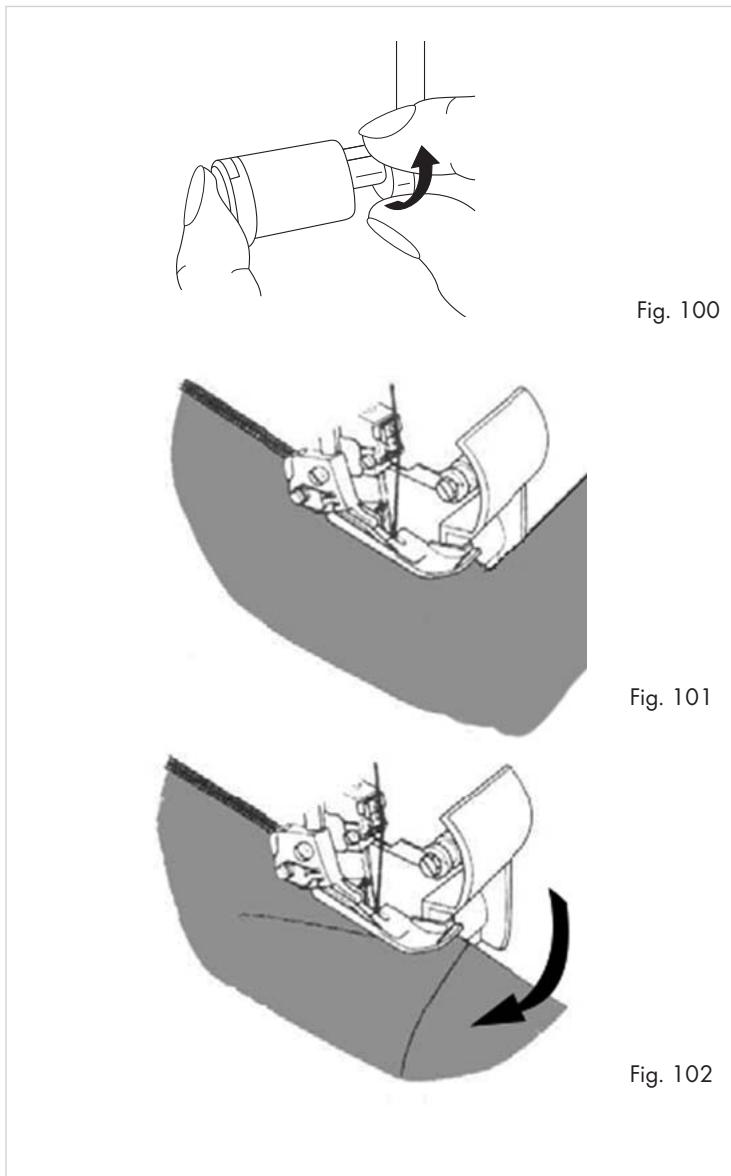
Using pins
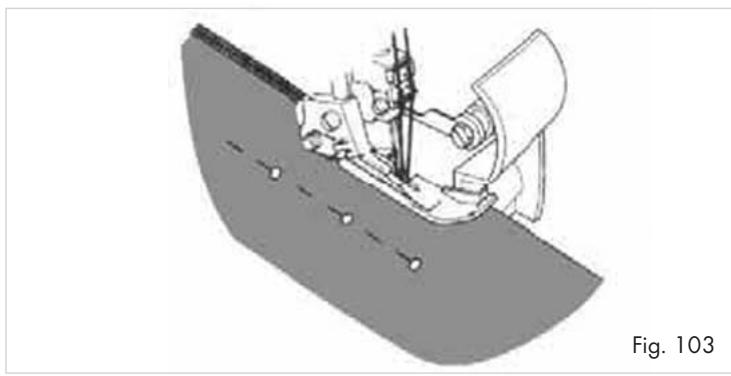
Always insert pins to the left of the sewing foot 21 (Fig. 103).
The pins are thus not in the cutting area of the blade 18 22 and they can be easily removed afterwards.
⚠ Attention! Appliance Damage!
NEVER sew over pins or other hard materials. The blade 18 22 could be irreparably damaged!
Secure empty threads
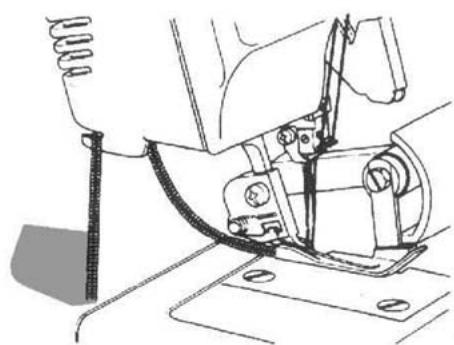
To prevent the loosening of an empty thread chain, you should thread the empty thread chain into a hand-sewing needle. For security, insert the needle into the end of the seam.
Seam reinforcement
The seam can be strengthened if it is sewn with a reinforcing strip.
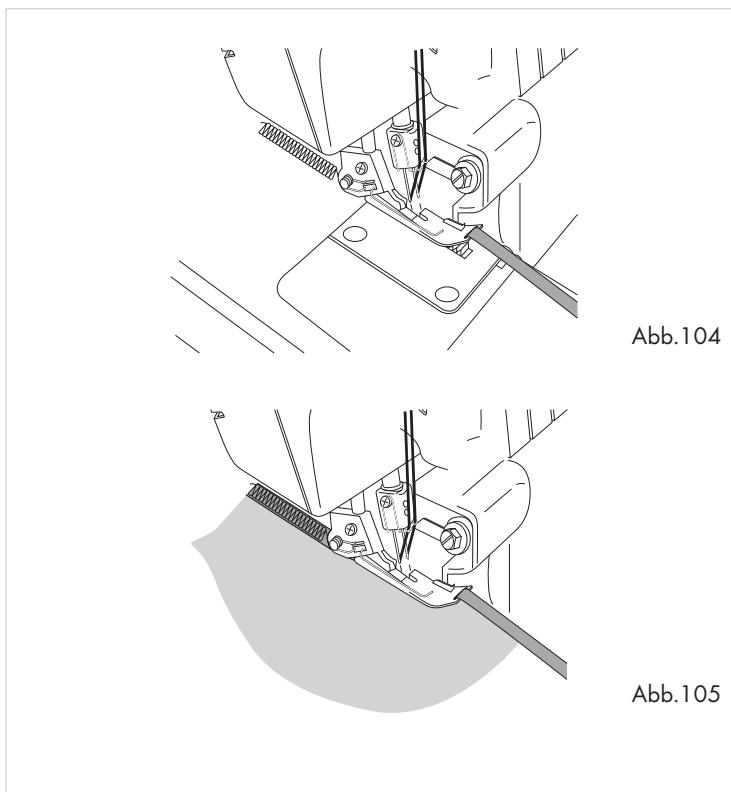
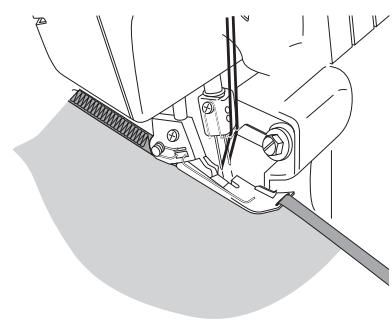
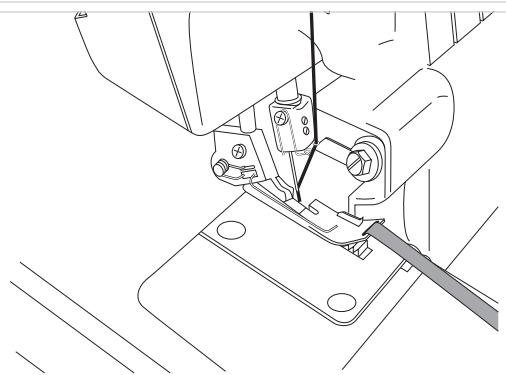
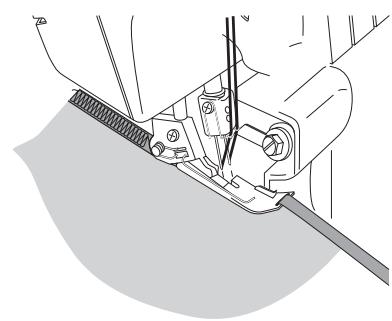
To do this, guide the strip through the slot in the front area of the sewing foot 21 (Fig. 104).
Place the strip under the foot and to the rear and then sew the seam. Thus the strip is sewn into the seam (Fig. 105).
Edging
- Adjust the upper blade ⑱ into the rest position.
- Remove the right needle and its thread.
-
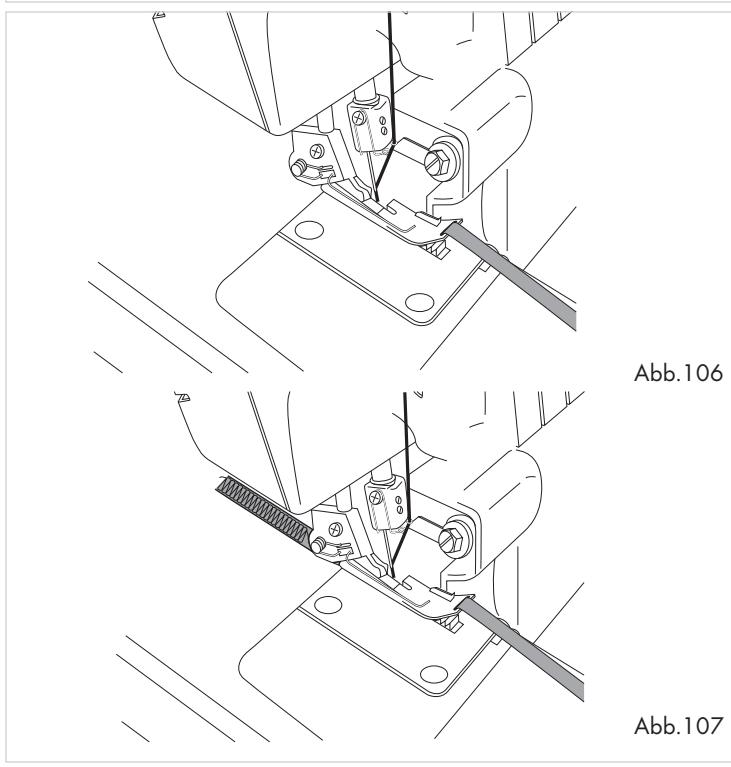
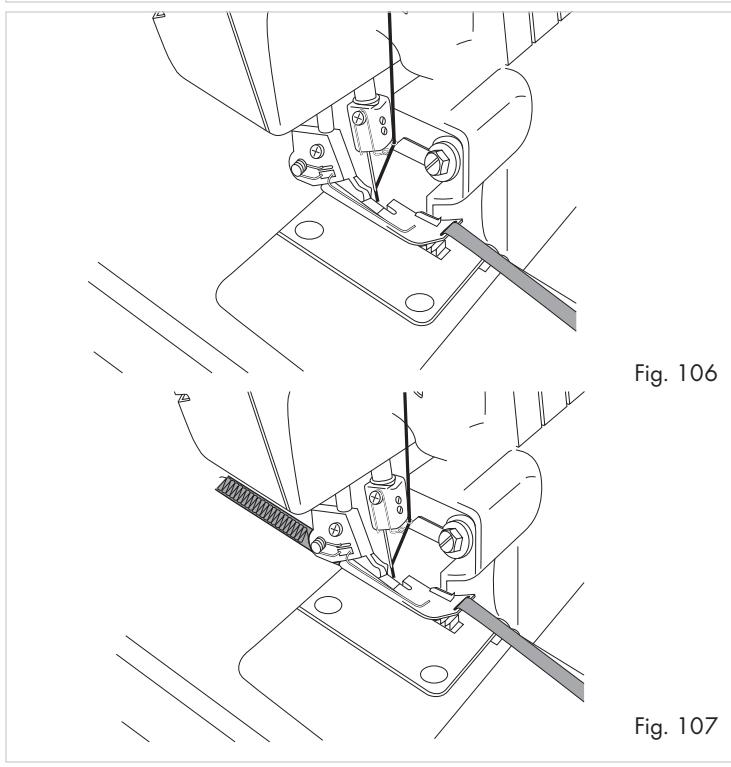
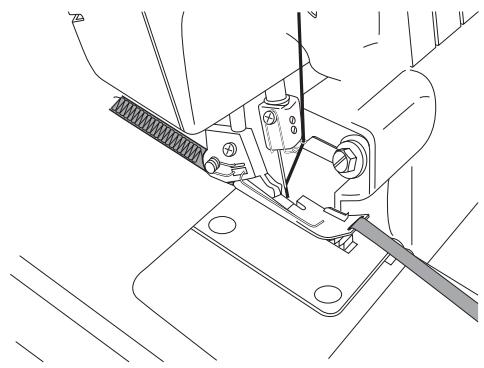
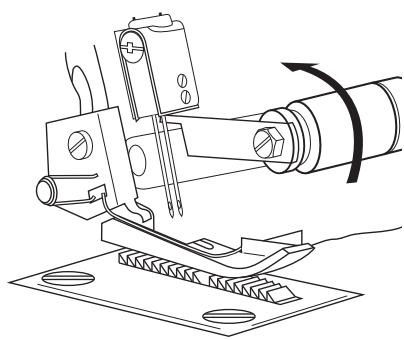
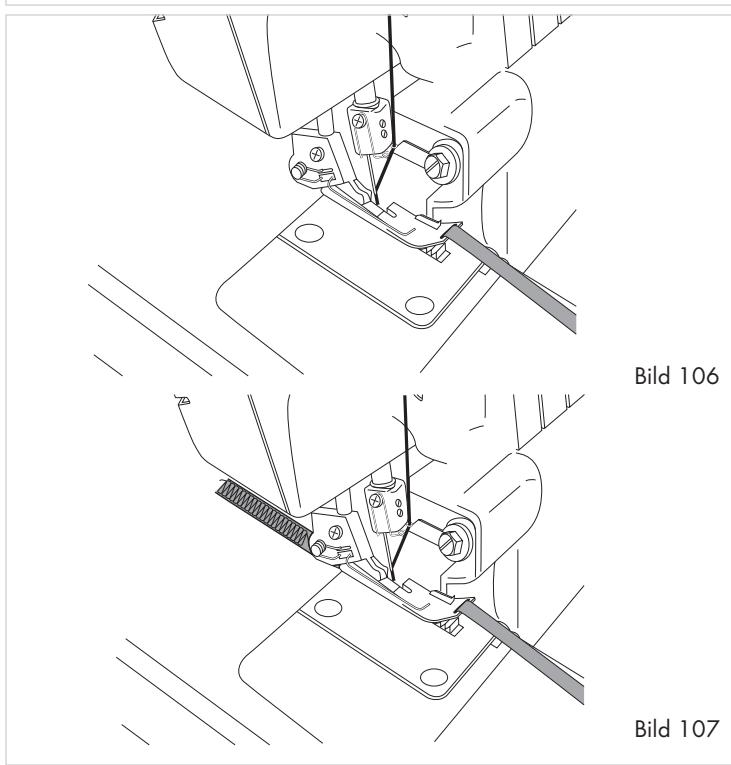
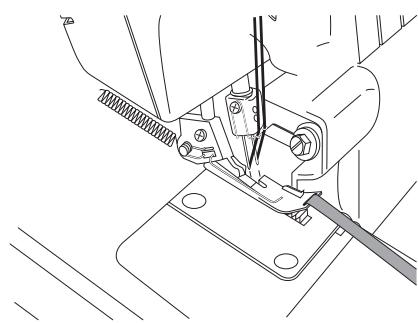
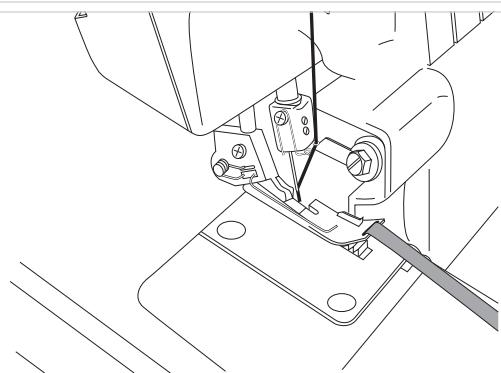
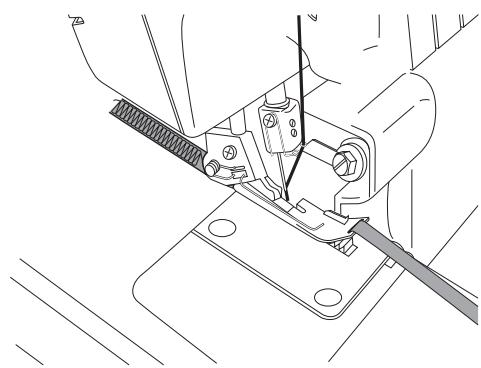
Pull the cord inlay (yarn or reinforcing strip) through the slot in the front of the sewing foot 21 (Fig. 106).
-
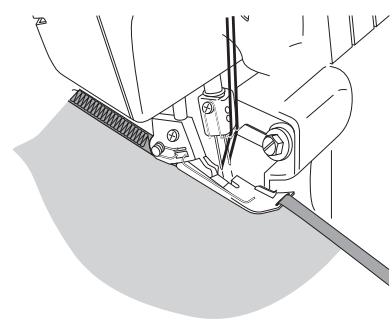
Lay the cord inlay under the sewing foot 21 and chainstitch the desired length (Fig. 107).
You can use the chainstitched edgings individually or weave several together.
natural_image
Mechanical sewing machine needle stitching a fabric (no text or symbols visible)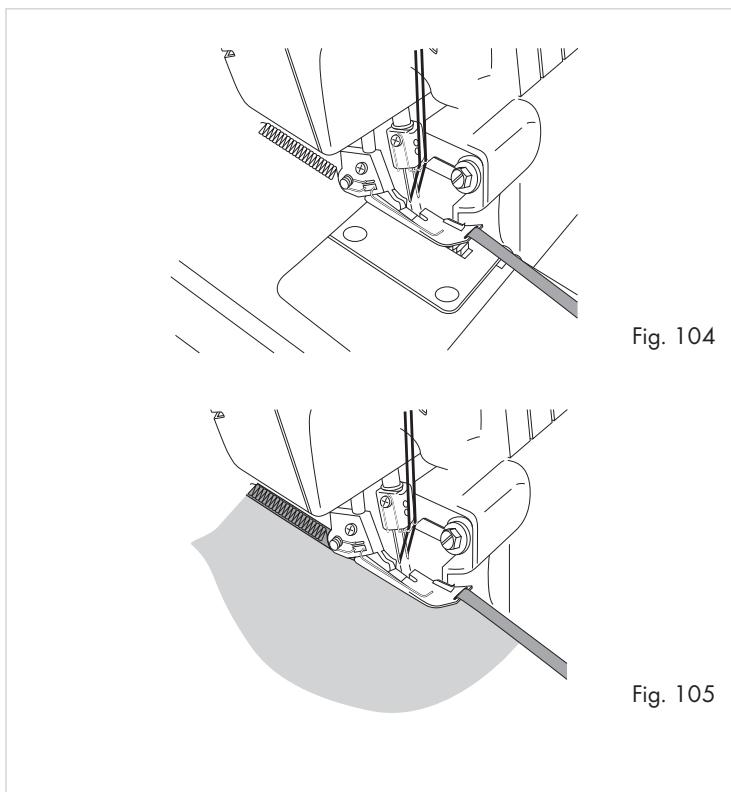

Attention!
Before cleaning or carrying out maintenance, ALWAYS remove the plug from the mains power socket. This prevents an unintended starting of the machine. If you do not, you run a risk of serious injury!
Cleaning and lubrication
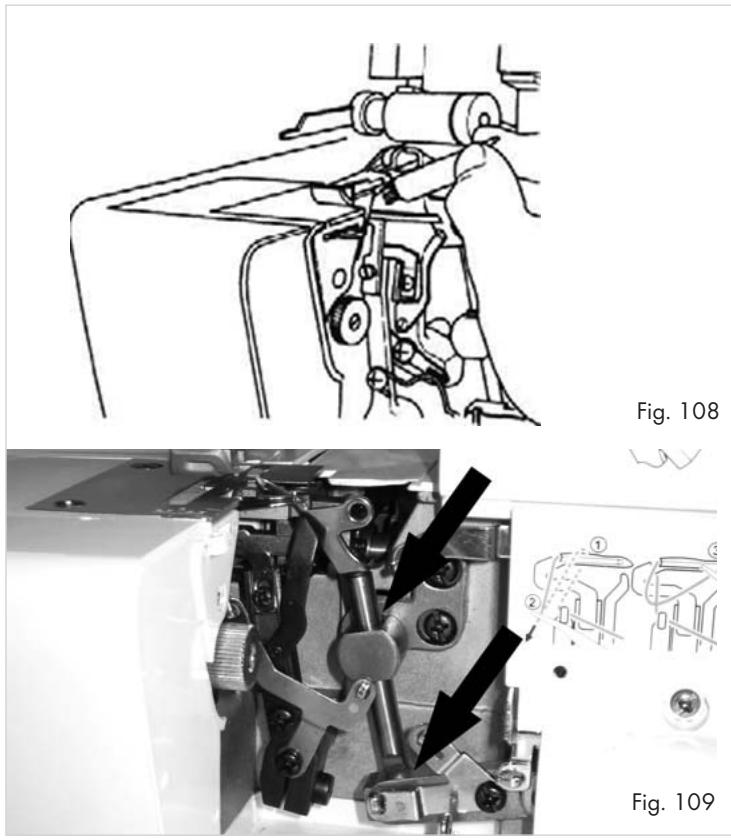
- Regularly remove dust and lint from the looper and blade areas. For this you can use the supplied brush (Fig. 108).
- Wipe the machine with a lightly moistened cloth.
- Lubricate the machine regularly at the lubrication points shown on Figure 109. For this use exclusively sewing machine oil.
natural_image
Technical diagram showing mechanical assembly with labeled parts, no readable text or symbols present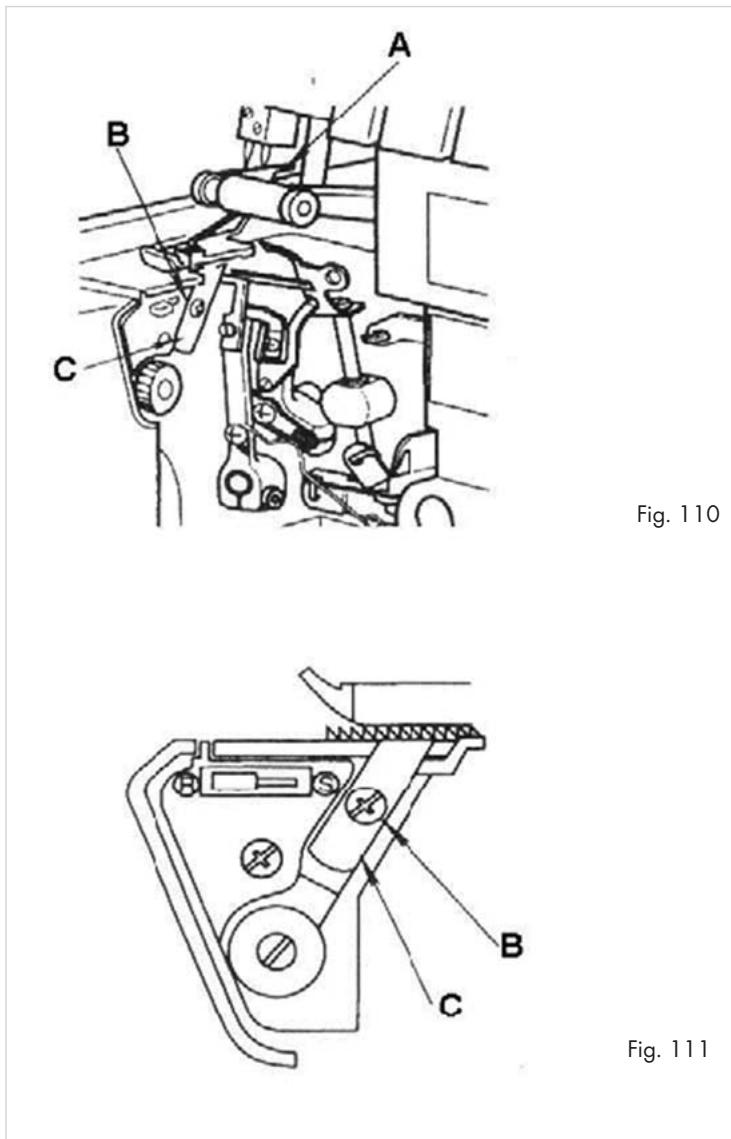
Exchanging the lower blade

Attention!
Before changing the blade 22 ALWAYS remove the plug from the mains power socket. This prevents an unintended starting of the machine. If you do not, you run a risk of serious injury!
Change the lower blade 22 as soon as you notice that the lower blade 22 no longer provides accurate and clean cuts. Use Figure 110 for assistance.
- Open the front flap ⑩.
- Adjust the upper blade 18 into the rest position (A).
- Remove the screw on the lower blade 22 (B) and remove the blade 22 (C) (Fig. 111).
- Slide the new blade 22 into the retainer and then tighten it with the screws.
- Place the upper blade 18 in the work position and close the front flap 10.
IMPORTANT:
ALWAYS remove the plug from the mains power socket before putting the machine into storage. This prevents an unintentional starting of the appliance, and thus the risk of injury, as well as an overheating of it!
When the machine is not in use, always cover it with the hood. This will protect the machine from dust. Store the machine at a clean and dry location.
Always transport the machine with the fold-out handle.
Disposal

Do not dispose of the appliance in your normal domestic waste. This product is subject to the provisions of European Directive 2002/96/EC.
Dispose of the appliance through an approved disposal centre or at your community waste facility.
Observe the currently applicable regulations. In case of doubt, please contact your waste disposal centre.

Dispose of the packaging materials in an environmentally responsible manner.
Under no circumstances should you dispose of the sewing machine oil with household waste. Do not pour it down the drain. Dispose of the machine oil through an approved disposal centre or at your community waste facility.
Warranty and Service
You receive a 3-year warranty for this appliance as of the purchase date. This appliance has been manufactured with care and meticulously examined before delivery.
Please retain your receipt as proof of purchase. In the case of a warranty claim, please make contact by telephone with our service department. Only in this way can a post-free despatch for your goods be assured.
The warranty covers only claims for material and manufacturing defects, not for transport damage, wearing parts or for damage to fragile components, e.g. buttons or batteries. This product is for private use only and is not intended for commercial applications.
In the event of misuse and improper handling, use of force and interference not carried out by our authorized service branch, the warranty will become void.. Your statutory rights are not restricted in any way by this warranty.
The warranty is not extended by repairs made under warranty. This also applies to replaced and repaired parts. Damages and defects extant on purchase must be reported immediately after unpacking, at latest by two days after the purchase date. Repairs carried out after expiry of the warranty period are subject to charge.
GB DES UK LTD
Tel.: 0871 5000 700 (£ 0.10 / minute)
e-mail: support.uk@kompernass.com
IE Kompernass Service Ireland
Tel.: 1850 930 412 (0,082 EUR/Min.)
Standard call rates apply. Mobile operators may vary.
e-mail: support.ie@kompernass.com
CY Kompernass Service Cyprus
Tel.: 800 9 44 01
e-mail: support.cy@kompernass.com
Importer
KOMPERNASS GMBH
BURGSTRASSE 21
44867 BOCHUM, GERMANY
www.kompernass.com
| Problem | Cause | Solution |
| Needles break | · Needles are bent, blunt or damaged at the points. | · Fit new needles. |
| · Needles are not correctly inserted. | · Insert the needles into the retainers correctly. | |
| · You have pulled the material too heftily. | · Carefully guide the material with both hands. | |
| Thread breaks | · Yarn has not been correctly threaded. | · Thread the yarn correctly. |
| · Thread tension is too high. | · Reduce the thread tension. | |
| · Needles are not correctly inserted. | · Insert the needles into the retainers correctly. | |
| Stitches are omitted | · Needles are bent, blunt or damaged at the points. | · Fit new needles. |
| · Needles are not correctly inserted. | · Insert the needles into the retainers correctly. | |
| · Yarn has not been correctly threaded. | · Check the course of the individual threads. | |
| Stitches are irregular | · Thread tension is not correct. | · Correct the thread tension. |
| · Thread is trapped. | · Check the course of the individual threads. | |
| Seams cause wrinkles | · Thread tension is too high. | · Adjust the thread tension. |
| · Yarn has not been correctly threaded. | · Thread the yarn correctly. | |
| · Thread is blocked. | · Check the course of the individual threads. | |
| · Differential feed motion not adjusted. | · Correctly adjust the differential transport. | |
| Material is not cut off cleanly | · Blades are blunt or improperly fitted. | · Exchange the blade or reinsert it correctly. |
| Material edges ruffle themselves | · Too much material in a stitch. | · Altering the seam width. |
natural_image
Illustration of hands holding a cylindrical object with an arrow indicating rotation (no text or symbols)Kuva 2
natural_image
Technical line drawing of a sewing machine with a rotating shaft and base plate (no text or symbols)Kuva 3
Tietoja neuloista
natural_image
Line drawing of a hand holding a key and a lock (no text or symbols)Kuva 4a
natural_image
Technical line drawing of a mechanical component with a valve and housing (no text or symbols)⚠️ Huomio!
Kuva 6
Kuva 7
natural_image
Hand placing a button into a device casing with an arrow indicating rotation (no text or symbols present)Kuva 8
natural_image
Line drawing of hands operating a sewing machine with a sewing machine needle inserted (no text or symbols)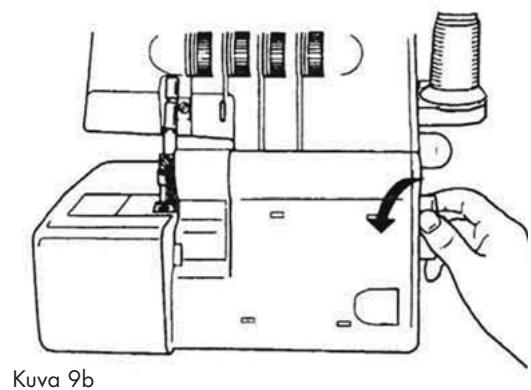
natural_image
Line drawing of hands operating a sewing machine with a tool, no text or symbols present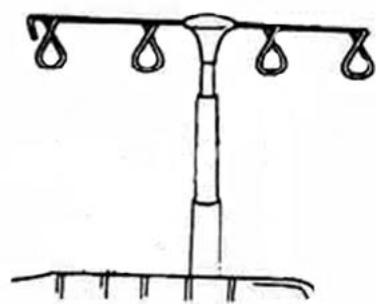
natural_image
Simple line drawing of a lever with hanging weights (no text or symbols)Kuva 11
natural_image
Illustration of hands using a spool to spread or spread material (no text or symbols visible)Kuva 12
i Ohje:
Kuva 14
Kuva 15
natural_image
Close-up of a mechanical assembly with metal rods and a triangular component (no visible text or symbols)Kuva 16
natural_image
Line drawing of a sewing machine with hands operating the mechanism (no text or symbols present)Kuva 17
Kuva 18
natural_image
Close-up of a white mechanical component with metal clips and circular holes, no visible text or symbolsKuva 20
natural_image
Line drawing of hands operating a sewing machine with numbered parts (no text or symbols)Kuva 21
natural_image
Close-up of a mechanical assembly with metal rods and a cylindrical component (no visible text or symbols)Kuva 25
natural_image
Illustration of a sewing machine needle stitching a seam, with hands adjusting the mechanism (no text or symbols present)Kuva 26
natural_image
Close-up of a sewing machine with numbered components (1, 2, 3, 4) and a close-up inset showing a sewing machine sketch (no readable text or symbols)Kuva 27
Kuva 28
natural_image
Close-up of a white mechanical component with four vertical pins and a metal rod, no visible text or symbols.Kuva 30
natural_image
Illustration of a sewing machine needle stitching a workpiece, no text or symbols presentKuva 31
Kuva 40
Toimintatapa
natural_image
Line drawing of hands operating a sewing machine with chains attached (no text or symbols)Kuva 51
natural_image
Technical line drawing of a sewing machine with a hand operating the hook (no text or symbols)Kuva 52
natural_image
Close-up of a zipper stitching on a white fabric with dashed seam lines (no text or symbols)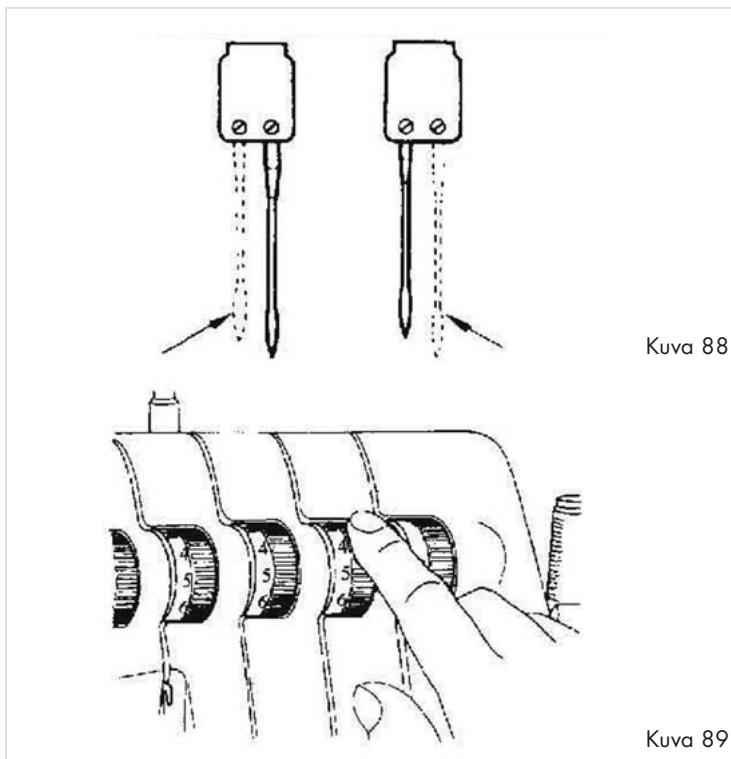
natural_image
Line drawing of a sewing machine needle stitching fabric, no text or symbols present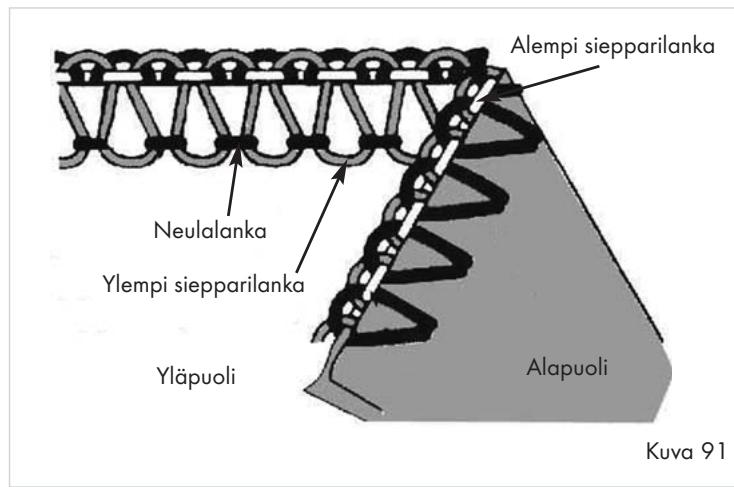
natural_image
Close-up of a patterned fabric with repeating zigzag and square cutouts on a textured background (no text or symbols)Kuva 96
Ulkokulmat
natural_image
Mechanical sewing machine diagram showing needle and base components (no text or symbols)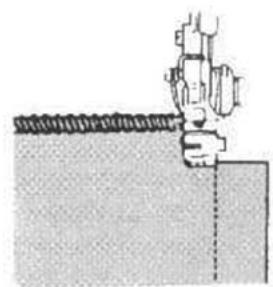
natural_image
Pure mechanical assembly diagram showing a threaded fastener inserted into a rectangular block (no text or symbols)Kuva 99
Sisäkulmat
natural_image
Illustration of hands holding a cylindrical object with an arrow indicating rotation (no text or symbols)Kuva 100
natural_image
Mechanical assembly diagram showing a sewing machine tool interacting with a workpiece (no text or symbols visible)Kuva 101
natural_image
Mechanical sewing machine diagram showing needle insertion and rotation (no text or symbols)Kuva 102
Nuppineulojen asettaminen
natural_image
Mechanical sewing machine needle stitching a fabric (no text or symbols visible)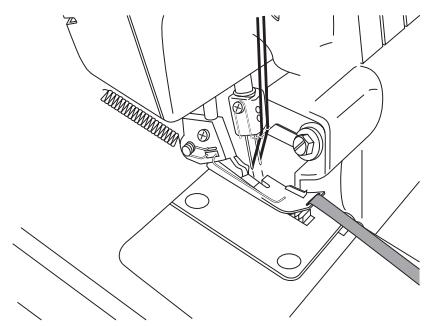
natural_image
Technical line drawing of a sewing machine needle and base (no text or symbols)Kuva 104
natural_image
Technical line drawing of a sewing machine needle and screw (no text or symbols)Kuva 105
natural_image
Technical line drawing of a sewing machine needle and base mount (no text or symbols)Kuva 106
natural_image
Technical line drawing of a mechanical assembly with no visible text or symbolsKuva 107

Huomio!
natural_image
Technical line drawing of a mechanical component with an arrow indicating direction (no text or symbols)Tekniska data
Antal trådar 2,3 eller 4
natural_image
Illustration of hands holding a cylindrical object with an arrow indicating rotation (no text or symbols)Bild 2
natural_image
Technical line drawing of a sewing machine with a rotating shaft and base plate (no text or symbols)Bild 3
natural_image
Line drawing of a hand holding a key and a lock (no text or symbols)Bild 4a
natural_image
Technical line drawing of a mechanical component with a valve and housing (no text or symbols)⚠️ Akta!
Bild 6
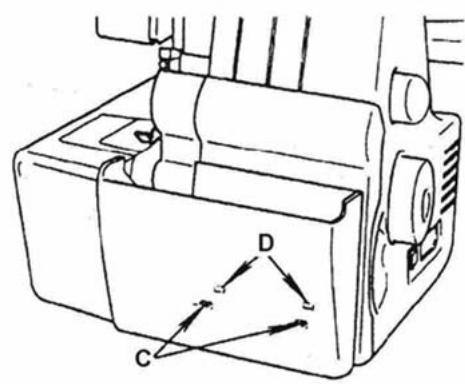
Bild 7
natural_image
Hand placing a button into a device casing with an arrow indicating rotation (no text or symbols)Bild 8
Ta ut nål(ar)

Akta!
natural_image
Simple line drawing of a balance scale with six hanging weights (no text or symbols)Bild 11
natural_image
Illustration of hands using a tool to apply a spiral or spiral component (no text or symbols present)Bild 12
i Observera:
natural_image
Line drawing of a person operating industrial equipment with pipes and valves (no text or symbols)Bild 13
Bild 14
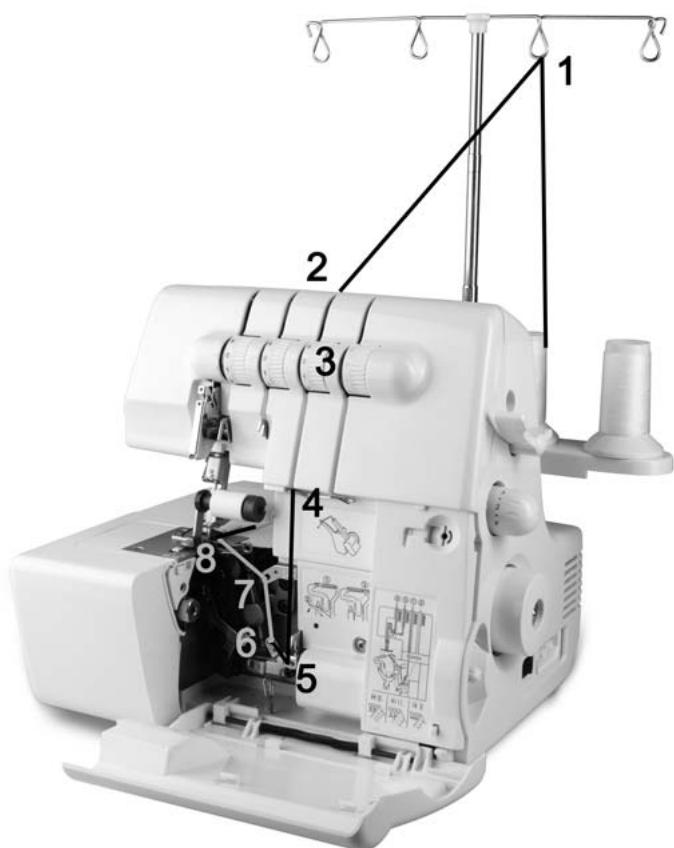
Bild 15
natural_image
Close-up of a mechanical assembly with metal rods and a triangular component (no visible text or symbols)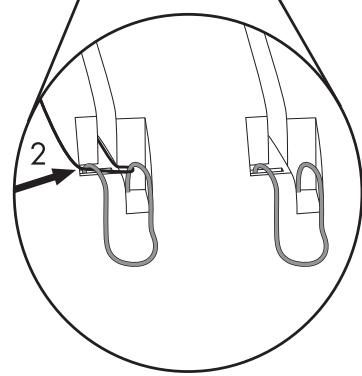
natural_image
Line drawing of a sewing machine with hands operating it (no text or symbols present)Bild 17
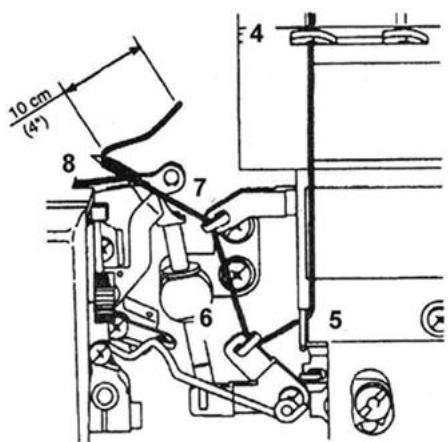
Bild 18
natural_image
Line drawing of hands operating a sewing machine with numbered parts (no text or symbols)Bild 21
natural_image
Close-up of a mechanical assembly with metal rods and a circular component, no visible text or symbolsBild 25
natural_image
Illustration of a sewing machine needle stitching a seam, with hands adjusting the mechanism (no text or symbols present)Bild 26
natural_image
Close-up of a sewing machine with numbered components (1, 2, 3, 4) and a close-up inset showing mechanical parts (no readable text or symbols)Bild 27

natural_image
Close-up of a white electronic device with metal pins and circular ports, no visible text or symbolsBild 30
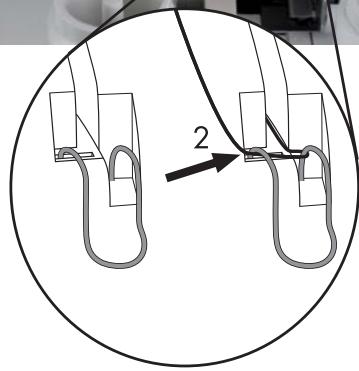
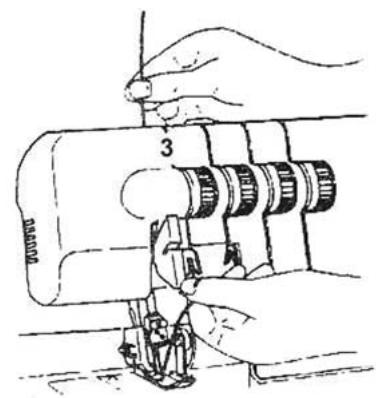
Bild 31
natural_image
Line drawing of hands operating a sewing machine with chains attached (no text or symbols)Bild 51
natural_image
Technical line drawing of a sewing machine with a hand operating the hook (no text or symbols)Bild 52
natural_image
Close-up of a zipper stitching on a white fabric with dashed seam lines (no text or symbols)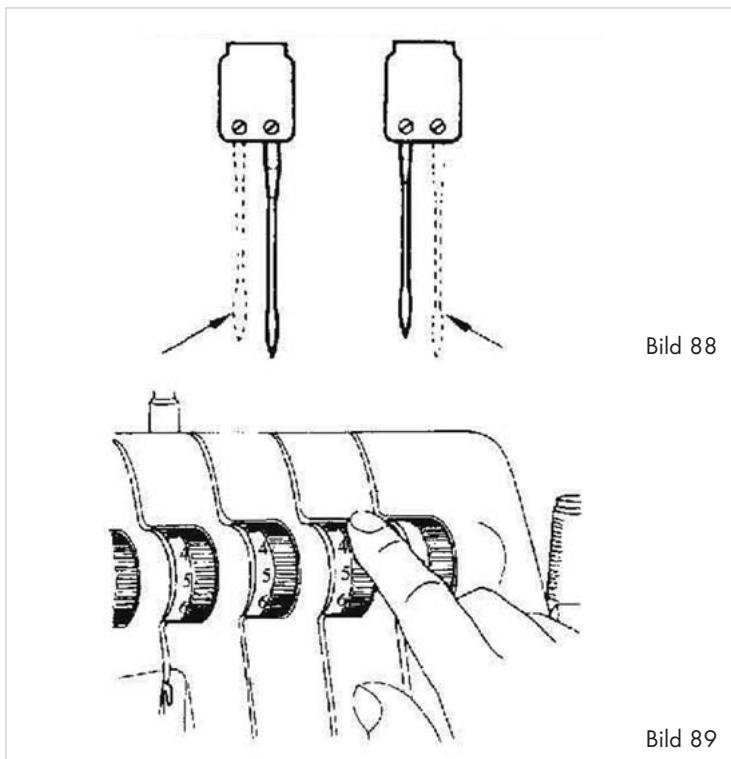
natural_image
Line drawing of a sewing machine needle stitching fabric, no text or symbols present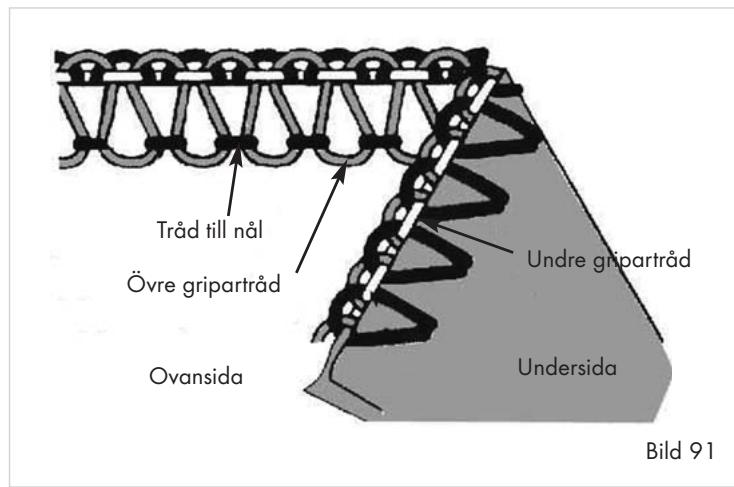
natural_image
Close-up of a patterned fabric with repeating zigzag and square indentations (no text or symbols)Bild 96
Ytterhörn
natural_image
Mechanical sewing machine diagram showing needle and base components (no text or symbols)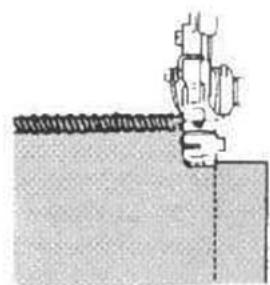
natural_image
Diagram of a mechanical joint or fastener assembly with no visible text or symbolsBild 99
Innerhörn
natural_image
Illustration of hands holding a cylindrical object with an arrow indicating rotation (no text or symbols)Bild 100
natural_image
Mechanical assembly diagram showing a sewing machine tool interacting with a workpiece (no text or symbols visible)Bild 101
natural_image
Mechanical sewing machine needle stitching a garment (no text or symbols visible)Bild 102
Sätta i knappnålar
natural_image
Mechanical sewing machine needle stitching a fabric (no text or symbols visible)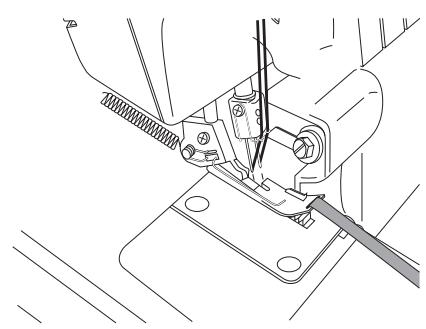
natural_image
Technical line drawing of a sewing machine needle and base (no text or symbols)Bild 104
natural_image
Technical line drawing of a sewing machine needle and screw (no text or symbols)Bild 105
natural_image
Illustration of hands holding a cylindrical object with an arrow indicating rotation (no text or symbols)Απεικ. 2
natural_image
Technical line drawing of a sewing machine with a rotating shaft and base plate (no text or symbols)Απεικ. 3
natural_image
Line drawing of a hand holding a key and a lock (no text or symbols)Απεικ. 4α
natural_image
Technical line drawing of a mechanical component with no visible text or symbols⚠️ Προσοχή!
Απεικ. 6

Απεικ. 7
natural_image
Hand placing a button into a device casing with an arrow indicating rotation (no text or symbols present)Απεικ. 8
natural_image
Line drawing of a sewing machine needle being adjusted, showing the blade and handle (no text or symbols)Απεικ. 9b
natural_image
Line drawing of hands operating a sewing machine tool (no text or symbols visible)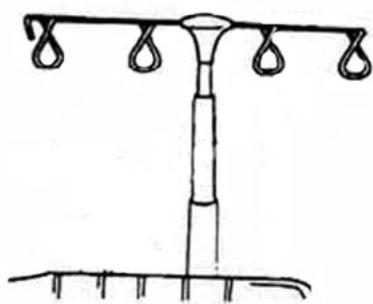
natural_image
Simple line drawing of a balance scale with six hanging weights (no text or symbols)Απεικ. 11
natural_image
Illustration of hands using a tool to apply a spiral or spiral component (no text or symbols present)Απεικ. 12
① Υπόδειξη:
natural_image
Pure technical diagram of an electrical circuit with no text, numbers, or symbolsΑπεικ. 13
Απεικ. 14
Απεικ. 15
natural_image
Close-up of a mechanical assembly with metal rods and a triangular component (no visible text or symbols)Απεικ. 16
natural_image
Line drawing of a sewing machine with hands operating the mechanism (no text or symbols present)Απεικ. 17
Απεικ. 18
natural_image
Close-up of a white mechanical component with metal rods and circular holes, no visible text or symbolsΑπεικ. 20
natural_image
Line drawing of hands operating a sewing machine with numbered parts (no text or symbols)Απεικ. 21
natural_image
Close-up of a mechanical assembly with metal rods and a cylindrical component (no visible text or symbols)Απεικ. 25
natural_image
Illustration of a sewing machine needle stitching a fabric, with hands operating the mechanism (no text or symbols present)Απεικ. 26
natural_image
Close-up of a sewing machine with numbered components (1, 4, 5) and a close-up inset showing mechanical parts (no readable text or symbols)Απεικ. 27
Απεικ. 28
natural_image
Close-up of a white mechanical component with four vertical pins and a metal rod, no visible text or symbols.Απεικ. 30
natural_image
Illustration of a sewing machine needle stitching a fabric, with hands operating the work (no text or symbols visible)Απεικ. 31
Απεικ. 40
Απεικ. 41
Τρόπος λειτουργίας
natural_image
Line drawing of hands operating a sewing machine with chains attached (no text or symbols)Απεικ. 51
natural_image
Line drawing of a sewing machine needle and base (no text or symbols)Απεικ. 52
natural_image
Close-up of a zipper stitching on a white fabric with dashed seam lines (no text or symbols)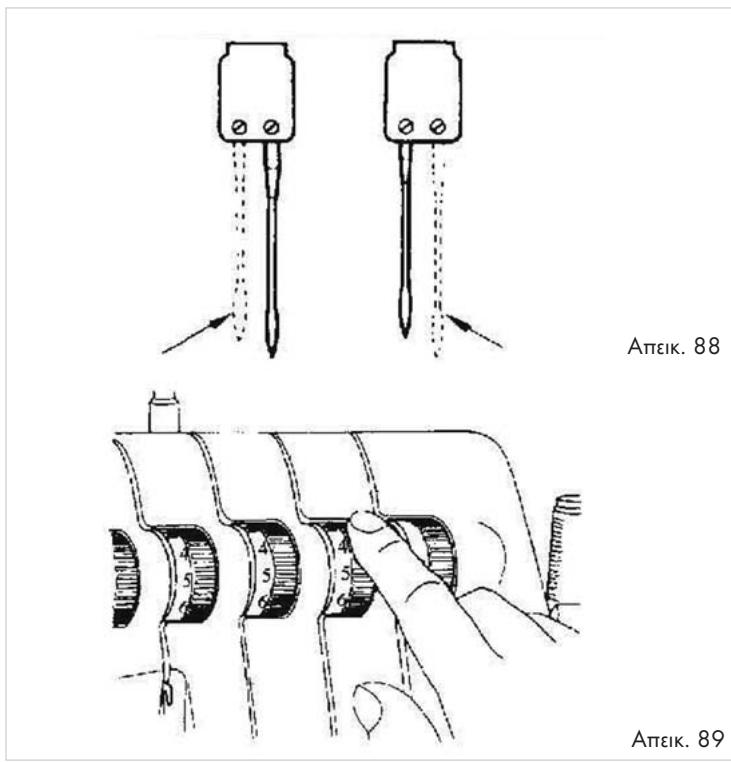
natural_image
Line drawing of a sewing machine needle stitching fabric, no text or symbols present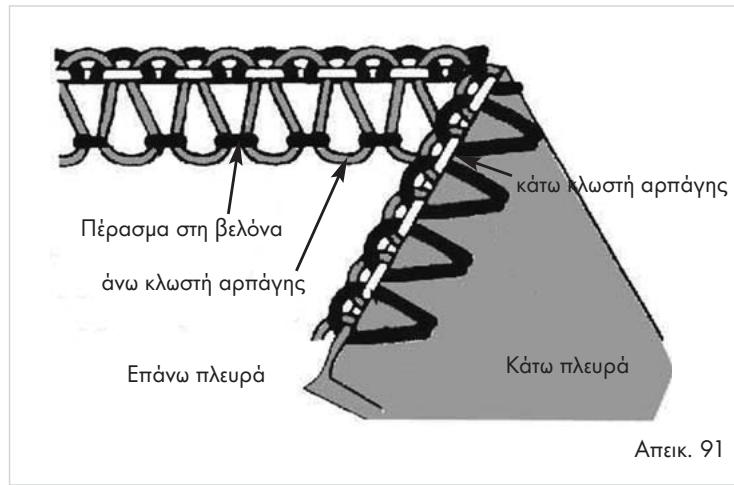
natural_image
Close-up of a patterned fabric with repeating zigzag and square cutouts (no text or symbols)Απεικ. 96
Εξωτερικές γωνίες
natural_image
Mechanical sewing machine diagram showing needle and screw mechanism (no text or symbols)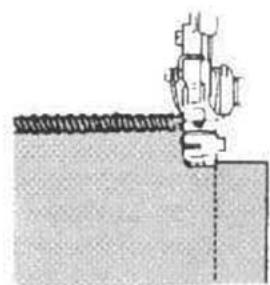
natural_image
Pure mechanical diagram showing a tool interacting with a textured surface (no text or symbols)Απεικ. 99
Εσωτερικές γωνίες
natural_image
Illustration of hands holding a cylindrical object with an arrow indicating rotation (no text or symbols)Απεικ. 100
natural_image
Mechanical assembly diagram showing a sewing machine tool interacting with a base (no text or symbols visible)Απεικ. 101
natural_image
Mechanical sewing machine needle stitching a garment (no text or symbols visible)Απεικ. 102
Εισαγωγή βελονών
natural_image
Illustration of a sewing machine needle stitching fabric (no text or symbols)Απεικ. 103
natural_image
Technical line drawing of a sewing machine needle and base mount (no text or symbols)Απεικ. 104
natural_image
Technical line drawing of a sewing machine needle and screw (no text or symbols)Απεικ. 105
natural_image
Technical line drawing of a sewing machine needle and base mount (no text or symbols)Απεικ. 106
natural_image
Technical line drawing of a sewing machine tool (no text or symbols visible)Απεικ. 107
⚠️ Προσοχή!
(local charge 0,031 EUR/minute (including VAT 19 %))
e-mail: support.gr@kompernass.com

Kompernass Service Cyprus
Tel.: 800 9 44 01
e-mail: support.cy@kompernass.com
Εισαγωγέας
KOMPERNASS GMBH
BURGSTRASSE 21
44867 BOCHUM, ГЕРMANIA
www.kompernass.com
natural_image
Technical line drawing of a mechanical component with an arrow indicating direction (no text or symbols)Tehnični podatki
natural_image
Illustration of hands holding a cylindrical object with an arrow indicating rotation (no text or symbols)Slika 2
natural_image
Technical line drawing of a sewing machine with a rotating shaft and base plate (no text or symbols)Slika 3
Informacije o šivankah
natural_image
Line drawing of a hand holding a key and a lock (no text or symbols)Slika 4a:
natural_image
Technical line drawing of a mechanical component with a valve and housing (no text or symbols)⚠️ Pozor!
natural_image
Line drawing of hands operating a sewing machine with a tool, no text or symbols present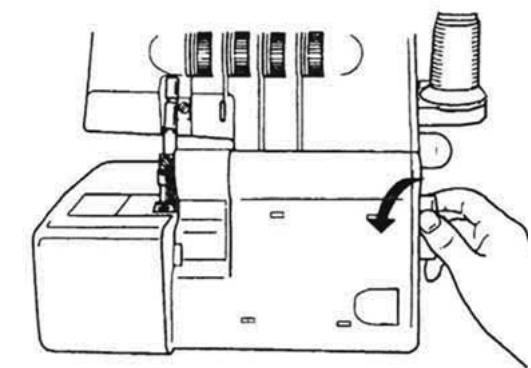
natural_image
Line drawing of a sewing machine needle being adjusted, showing the blade and handle (no text or symbols)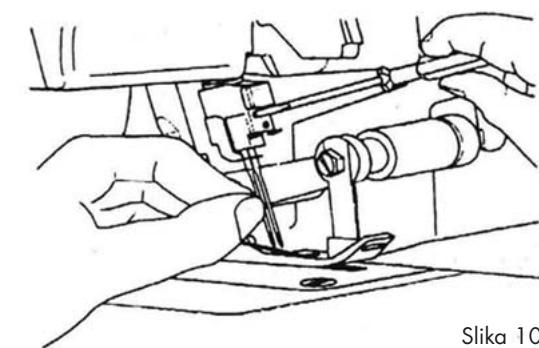
natural_image
Line drawing of hands operating a sewing machine with a tool, no text or symbols present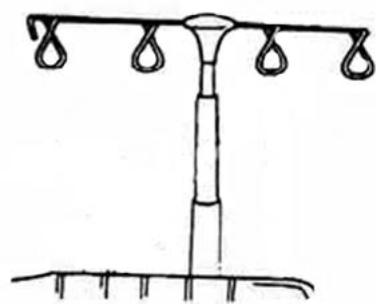
natural_image
Simple line drawing of a balance scale with six hanging weights (no text or symbols)Slika 11
natural_image
Illustration of hands using a spool to spread or spread material (no text or symbols)Slika 12
i Napotek:
natural_image
Pure technical diagram of a mechanical or electrical component with no text, numbers, or symbolsSlika 13
Slika 14
Slika 15
natural_image
Line drawing of hands operating a sewing machine with numbered parts (no text or symbols)Slika 21
natural_image
Close-up of a mechanical assembly with metal rods and a circular component, no visible text or symbolsSlika 25
Slika 26
Vdevanje niti v levo šivanko (modra)
⚠️ Pozor!
natural_image
Close-up of a white electronic device with metal pins and circular ports, no visible text or symbolsSlika 30

natural_image
Illustration of a hand using a sewing machine to adjust a component (no text or symbols visible)Slika 31
-
Nit vdenite s pomočjo modrih oznak (4-6) (slika 32/33).
-
Nit speljite skozi levo šivanko (7) (slika 33).
- Nit speljite nazaj, pod tačko 21.
Poskusno delovanje
Kadar prvič vdevate sukanec ali će se vam je pretrgal in ga morate ponovno vdeti, postopajte, kot sledi:
Dvignite tačko 21.
Konca niti držite s konicami prstov leve roke, zasukajte kolesce ⑥ počasi dva- do trikrat k sebi in nit ponovno preverite.
Slika 40
Slika 41
Način delovanja
natural_image
Line drawing of hands operating a sewing machine with chains attached (no text or symbols)Slika 51
natural_image
Technical line drawing of a sewing machine with a hand operating the hook (no text or symbols)Slika 52
natural_image
Close-up of a zipper stitching on a white fabric with dashed seam lines (no text or symbols)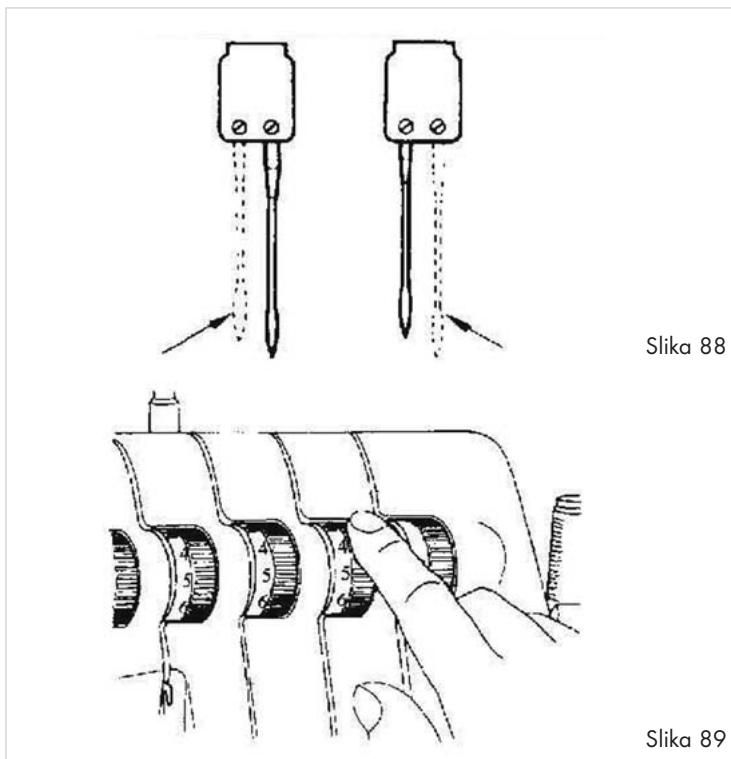
natural_image
Line drawing of a sewing machine needle stitching fabric, no text or symbols present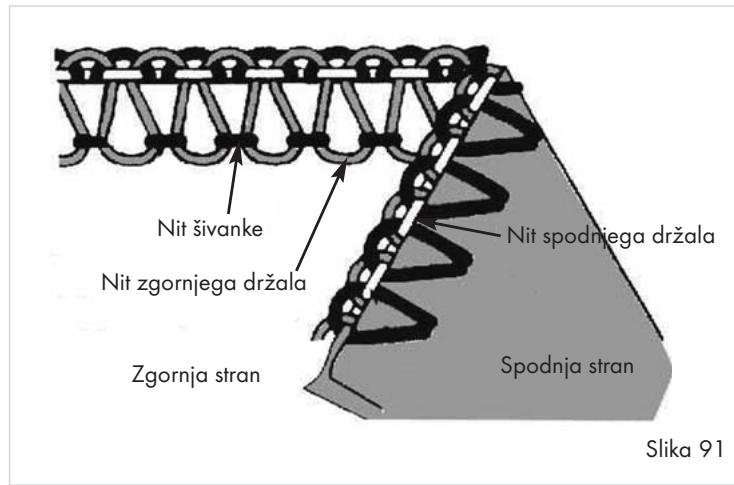
natural_image
Close-up of a patterned fabric with repeating zigzag and square motifs (no text or symbols)Slika 96
Zunanji vogali
natural_image
Technical line drawing of a sewing machine needle stitching a fabric (no text or symbols)
natural_image
Pure mechanical assembly diagram showing a bolt and threaded fastener (no text or symbols)Slika 99
Notranji vogali
-
Blago odrežite ob robu šiva.
-
Pomaknite zgornje rezilo 18 v položaj mirovanja (slika 100).
-
Šivajte po odrezanem robu (slika 101).
-
Tik preden dosežete vogal, prenehajte šivati.
-
V točki vogala ustvarite gubo, tako da oba robova tvorita ravno linijo (slika 102).
-
Počasi pošijte vogal in za njim še drugi rob. Pri tem pazite, da ne pošijete tudi gube!
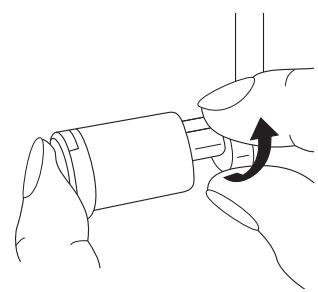
natural_image
Illustration of hands holding a cylindrical object with an arrow indicating rotation (no text or symbols)Slika 100
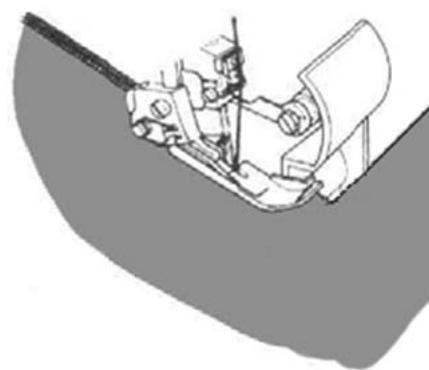
natural_image
Mechanical assembly diagram showing a sewing machine tool interacting with a workpiece (no text or symbols visible)Slika 101
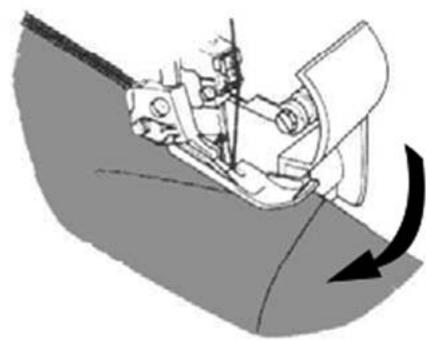
natural_image
Mechanical assembly diagram showing a sewing machine needle stitching a curved surface (no text or symbols)Slika 102
Vdevanje bucik
Bucike zmeraj vdevajte levo od tačke 21 (slika 103).
natural_image
Mechanical sewing machine needle stitching a fabric (no text or symbols visible)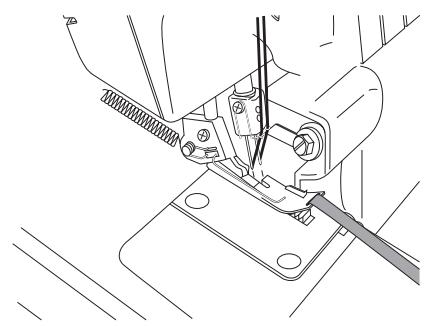
natural_image
Technical line drawing of a sewing machine needle and base mount (no text or symbols)Slika 104
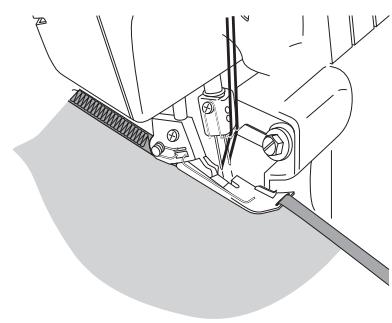
natural_image
Technical line drawing of a sewing machine needle and screw (no text or symbols)Slika 105
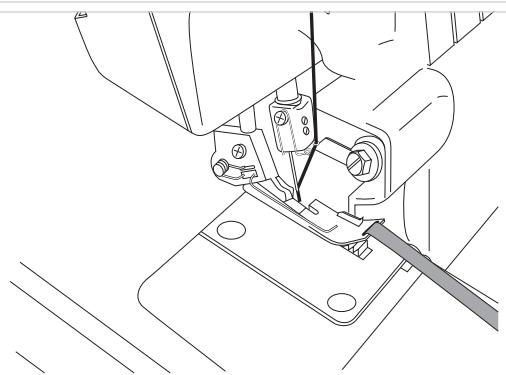
natural_image
Technical line drawing of a sewing machine needle and base mount (no text or symbols)Slika 106
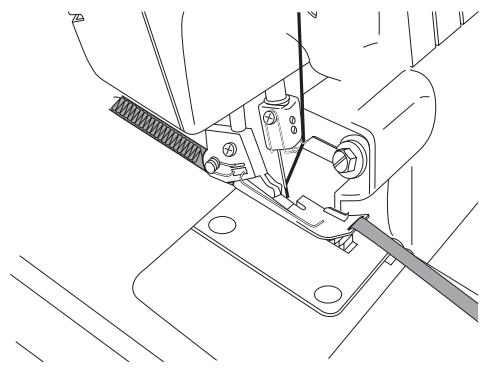
natural_image
Technical line drawing of a mechanical assembly with no visible text or symbolsSlika 107
⚠️ Pozor!
natural_image
Technical line drawing of a mechanical component with an arrow indicating direction (no text or symbols)Technische Daten
Anzahl der Fäden
2, 3 oder 4
Anzahl der Nadeln
2 oder 1
Nähgeschwindigkeit
ca. 1200 U/min
Stichbreite
rechts:
3,0 mm - 4,5 mm
links:
5,2 mm - 6,7 mm
Stichlänge
1 - 4 mm
Nadeln
natural_image
Illustration of hands holding a cylindrical object with an arrow indicating rotation (no text or symbols)Abb.2
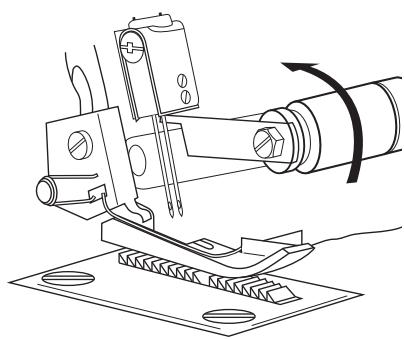
natural_image
Technical line drawing of a sewing machine with a rotating shaft and base plate (no text or symbols)Abb.3
Nadelinformationen
natural_image
Line drawing of a hand holding a key and a lock (no text or symbols)Abb.4a
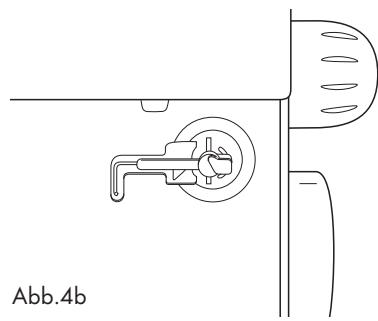
natural_image
Technical line drawing of a mechanical component with a circular feature and a curved handle (no text or symbols)
Achtung!
natural_image
Line drawing of hands operating a sewing machine with a tool, no text or symbols present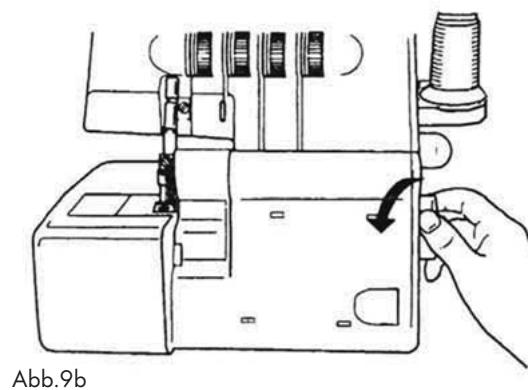
natural_image
Line drawing of a sewing machine needle being adjusted, showing the blade and handle (no text or symbols)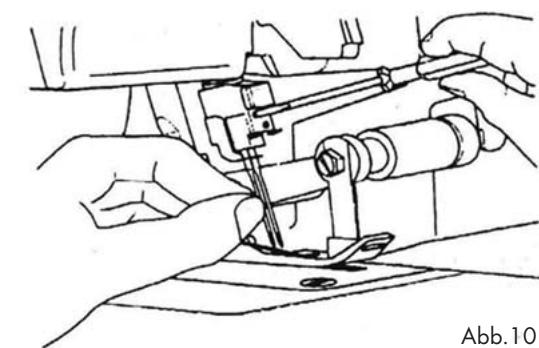
natural_image
Line drawing of hands operating a sewing machine with a tool, no text or symbols present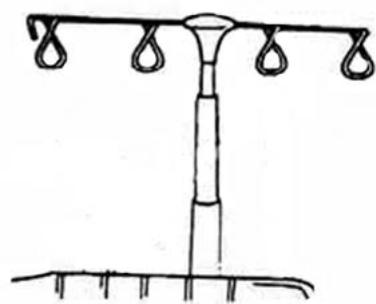
natural_image
Simple line drawing of a balance scale with six hanging weights (no text or symbols)Abb.11
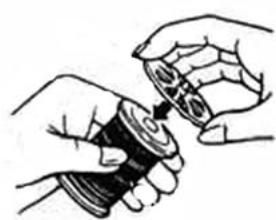
natural_image
Illustration of hands using a spool to handle a cylindrical object (no text or symbols present)Abb.12
i Hinweis:
natural_image
Pure technical diagram of a mechanical or electrical component with no text, numbers, or symbolsAbb.13
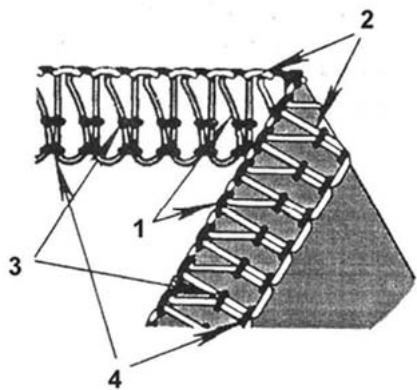
Abb.14
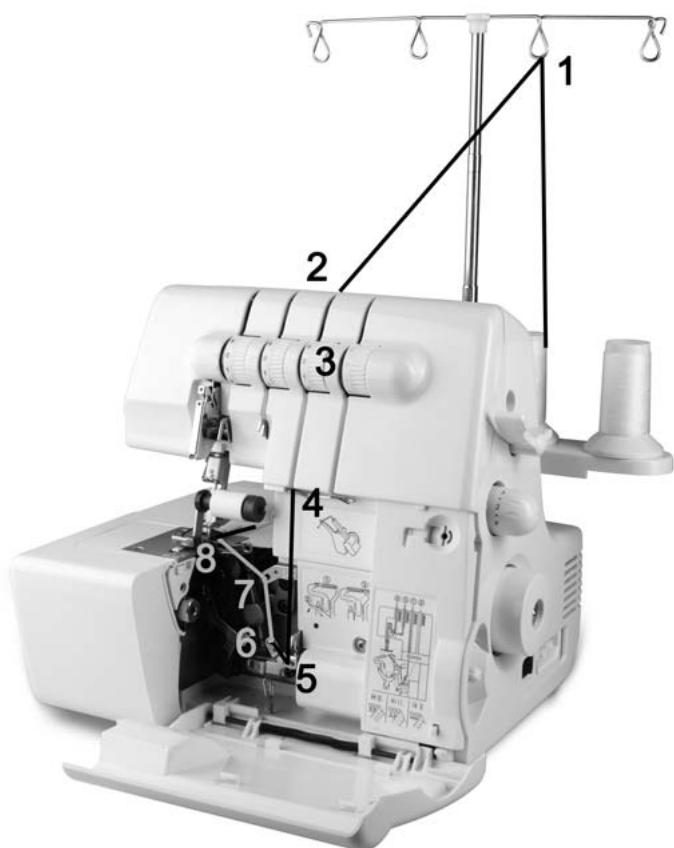
Abb.15
natural_image
Close-up of a white mechanical component with metal clips and circular holes, no visible text or symbolsAbb.20
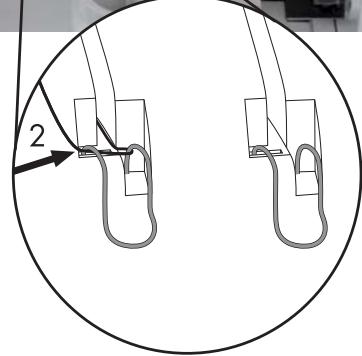
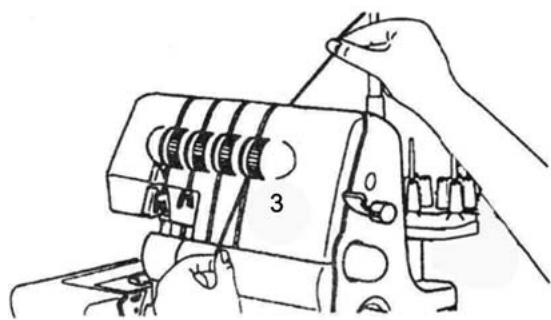
natural_image
Line drawing of hands operating a sewing machine with numbered parts (no text or symbols)Abb.21
natural_image
Close-up of a mechanical assembly with metal rods and a circular component overlay (no visible text or symbols)Abb.25
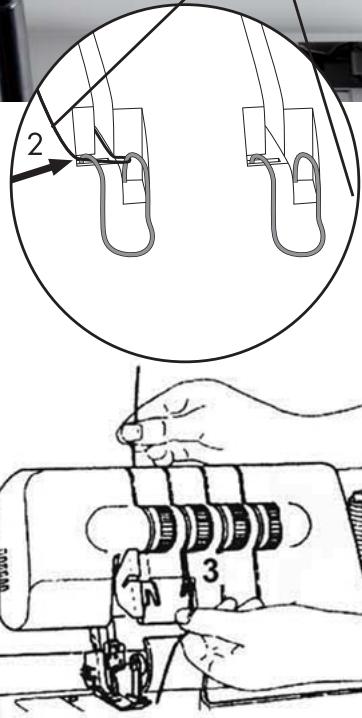
Abb.26
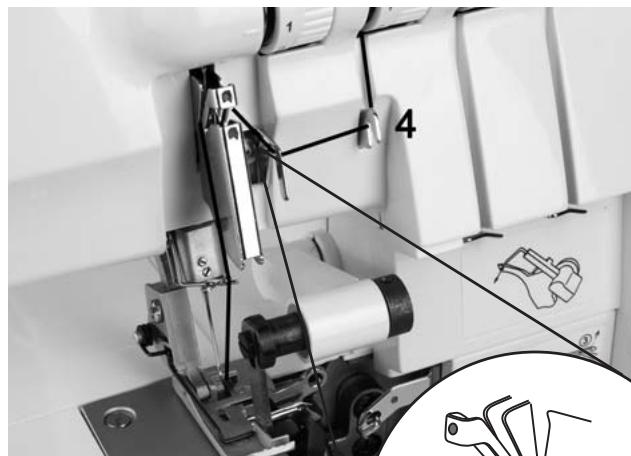
natural_image
Close-up of a sewing machine with numbered components (1, 4) and a close-up inset showing mechanical parts (no readable text or symbols)Abb.27
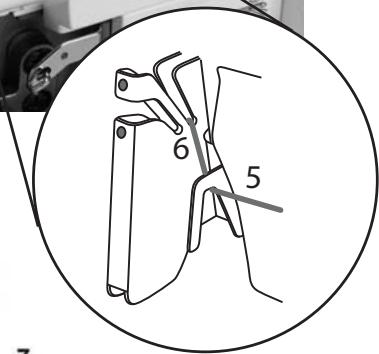
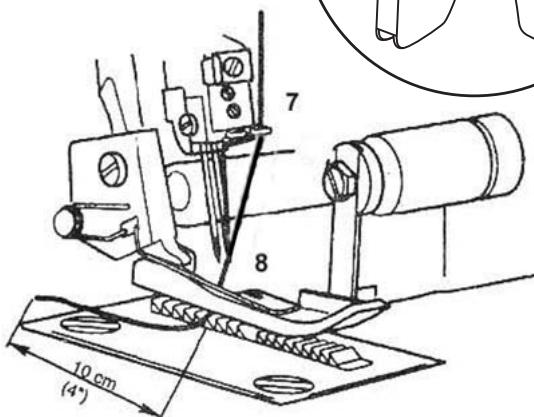
Abb.28
natural_image
Close-up of a white mechanical component with metal rods and circular holes, no visible text or symbolsAbb.30
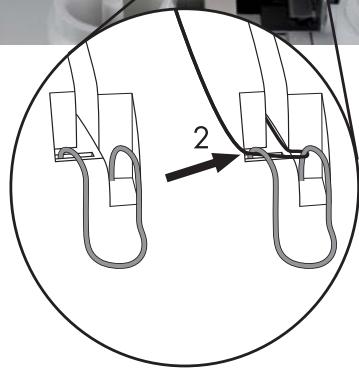
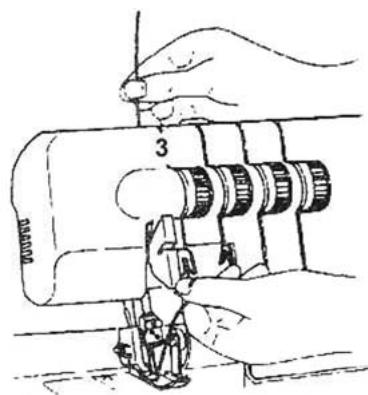
natural_image
Illustration of a hand using a sewing machine to measure a mechanical part (no text or symbols visible)Abb.31
natural_image
Line drawing of hands operating a sewing machine with chains and a mechanical component (no text or symbols)Abb.51
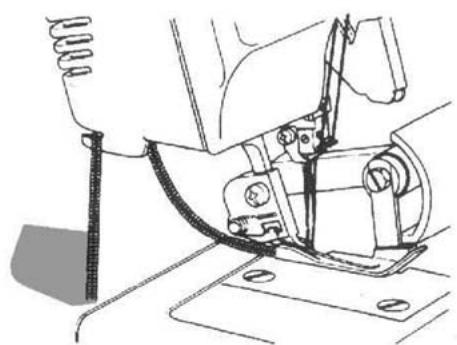
natural_image
Line drawing of a sewing machine needle and clasp mechanism (no text or symbols)Abb.52
natural_image
Close-up of a zipper stitching on a white fabric with dashed seam lines (no text or symbols)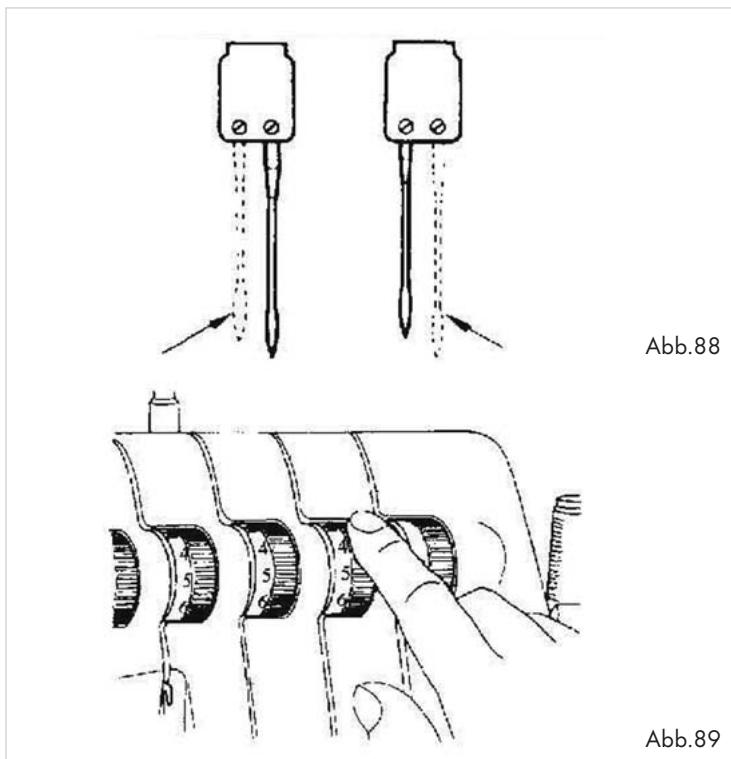
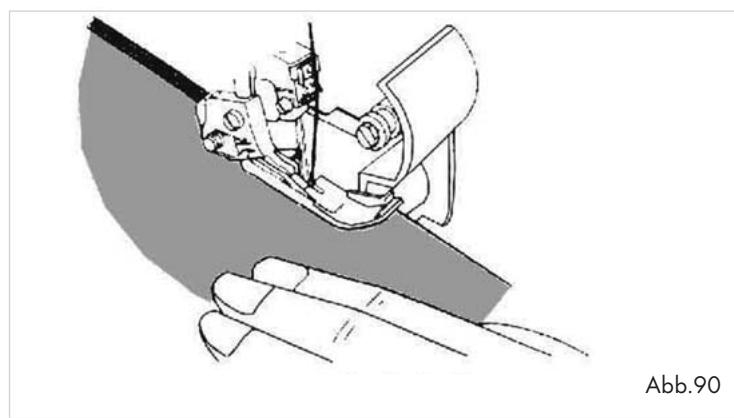
natural_image
Line drawing of a sewing machine needle stitching fabric, no text or symbols present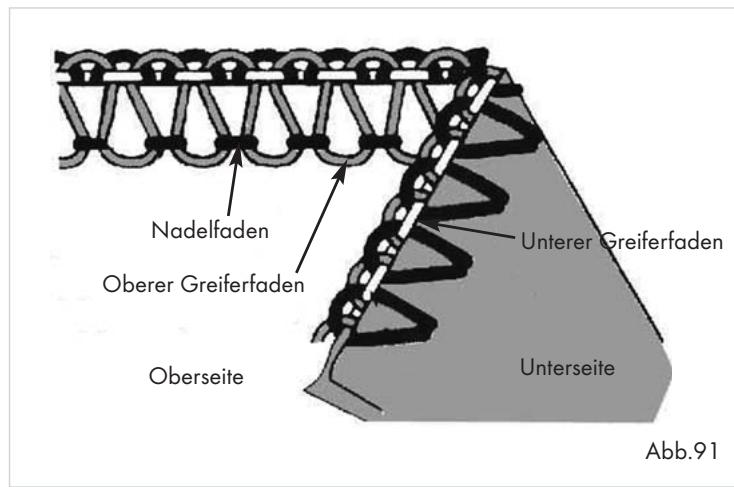
natural_image
Close-up of a patterned fabric with repeating zigzag and square cutouts (no text or symbols)Abb.96
Außenecken
natural_image
Mechanical sewing machine diagram showing needle stitching and cutting tool (no text or symbols)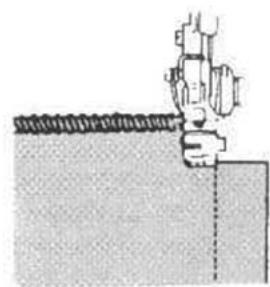
natural_image
Diagram of a mechanical assembly with a tool inserted into a threaded component (no text or symbols)Abb.99
Innenecken
natural_image
Illustration of a hand holding a cylindrical object with an arrow indicating rotation (no text or symbols)Abb.100
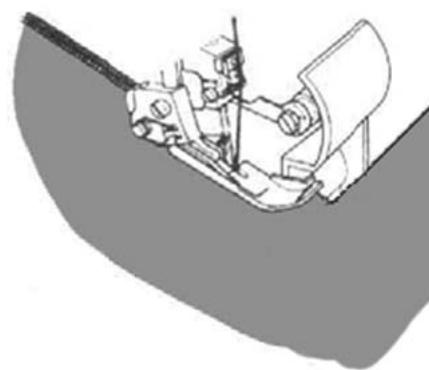
natural_image
Mechanical assembly diagram showing a sewing machine tool interacting with a workpiece (no text or symbols visible)Abb.101
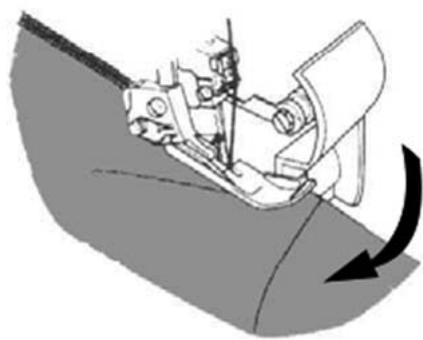
natural_image
Mechanical sewing machine diagram showing needle insertion and rotation (no text or symbols)Abb.102
Stecknadeln einstecken
natural_image
Mechanical sewing machine needle stitching a fabric (no text or symbols visible)